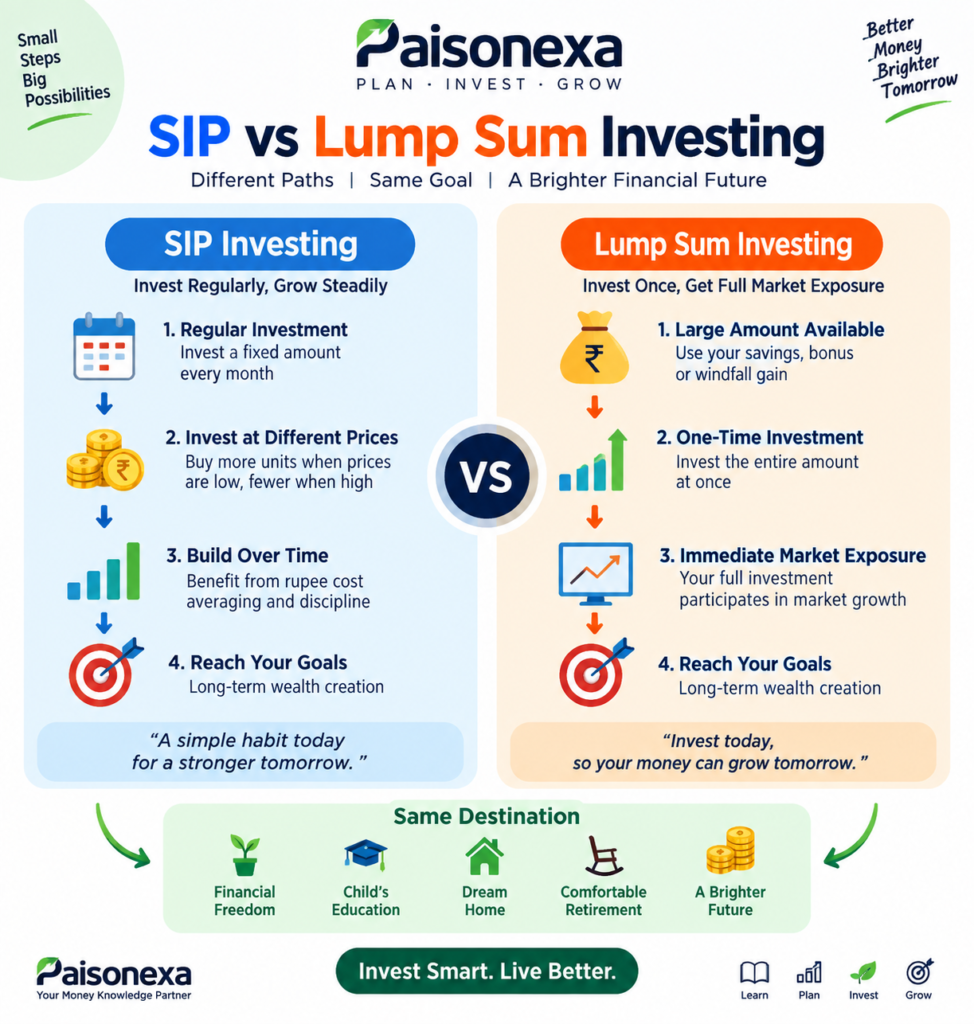
When you have money to invest, one important question often comes up:
Should you invest a fixed amount regularly through SIP, or invest a larger amount at once through lump sum investing?
Both strategies can be useful, but they work differently.
In India, SIP (Systematic Investment Plan) is widely used for regular investing. In other markets, a similar approach is often called dollar-cost averaging (DCA) or regular investing.
This guide explains SIP vs lump sum investing, their advantages and limitations, market timing, risk, and when each approach may make sense.
SIP vs Lump Sum: The Basic Difference
The simplest way to understand the difference is:
SIP = Invest gradually over time
Lump Sum = Invest a larger amount at one time
The right choice depends on your cash flow, available capital, investment horizon, financial goals and comfort with market fluctuations.
What Is SIP Investing?
A Systematic Investment Plan (SIP) allows an investor to invest a fixed amount at regular intervals, usually monthly.
For example, an investor could invest ₹10,000 every month into a mutual fund.
The amount is invested regularly, regardless of whether the market is currently higher or lower.
SIP can make regular investing easier to follow, especially for people who receive a monthly income.
It also means that investments are made at different market prices over time.
Why Do People Use SIP?
- To invest regularly
- To build investing discipline
- To invest with regular income
- To spread investments across different dates
- To work toward long-term financial goals
SIP itself does not guarantee profits. The underlying investment can rise or fall in value.
Advantages of SIP
1. Easy to Start
SIP allows investors to begin with smaller regular amounts instead of waiting to accumulate a large amount.
2. Builds Investing Discipline
Regular investing can help create a consistent investing habit over the long term.
3. Multiple Investment Points
Because investments are made at different times, your money enters the market at different prices.
4. Suitable for Regular Income
SIP can be convenient for people who receive a salary or other regular income.
5. Supports Long-Term Goals
Regular investing can become part of a long-term plan for goals such as retirement, education or wealth creation.
Limitations of SIP
SIP does not guarantee profits or protect an investor from market losses.
It is simply a method of investing regularly. The value of the underlying investment can rise or fall depending on market conditions.
What Is Lump Sum Investing?
Lump sum investing means investing a larger amount of money at one time.
For example, an investor may receive a bonus, have accumulated savings, or already have capital available for investment.
Instead of investing the money gradually, the investor invests the available amount at once.
The main difference is that the entire amount gets market exposure immediately.
A Simple Lump Sum Example
Suppose you have ₹5,00,000 available for investment.
With a lump sum approach, the entire ₹5,00,000 could be invested at one time rather than divided into monthly investments.
This means the full amount is exposed to market movements immediately.
SIP vs Lump Sum: Key Differences
| Factor | SIP | Lump Sum |
|---|---|---|
| Investment style | Regular | One-time |
| Capital required | Smaller amounts | Larger amount |
| Market exposure | Gradual | Immediate |
| Investment timing | Spread across dates | One main entry point |
| Cash-flow fit | Regular income | Existing capital |
| Discipline | Encourages regular investing | Requires one-time decision |
| Timing impact | Spread out | More concentrated |
| Suitable for | Regular investors | Investors with available capital |
SIP vs Lump Sum: Market Exposure
SIP
Regular Investment
↓
Multiple Entry Points
↓
Different Market Prices
↓
Long-Term Investing
Lump Sum
Available Capital
↓
One-Time Investment
↓
Immediate Market Exposure
↓
Long-Term Investing
Both approaches can ultimately be used to work toward long-term financial goals.
Is SIP Better Than Lump Sum?
There is no universal answer.
The outcome can depend on market performance, investment timing, investment horizon and the amount of money available.
If you receive money regularly from your salary, SIP may be a practical way to invest consistently.
If you already have a large amount available, lump sum investing may provide immediate market exposure.
The important point is to avoid assuming that SIP always produces better returns or that lump sum always produces better returns.
Neither is guaranteed.
SIP and Market Volatility
One reason investors choose SIP is that their money enters the market at different points.
For example:
Market falls → The same investment amount may buy more units
Market rises → The same investment amount may buy fewer units
This is commonly associated with rupee-cost averaging in India and dollar-cost averaging in other markets.
However, averaging does not guarantee a profit or protect an investor from losses.
Lump Sum and Market Timing
Lump sum investing creates greater exposure to the market immediately.
Imagine an investor has ₹5 lakh.
If the entire ₹5 lakh is invested at once, the portfolio immediately experiences the effect of future market movements.
If the market rises, the investor benefits from having the full amount invested.
If the market falls, the full invested amount is also exposed to that decline.
This is why market timing can feel more important with lump sum investing.
However, consistently predicting the perfect market entry point is extremely difficult.
What Is Dollar-Cost Averaging?
For international readers, it is useful to understand the terminology.
SIP is commonly used in India.
Dollar-cost averaging (DCA) is a widely used term in international investing discussions.
The basic idea is similar:
Invest a predetermined amount at regular intervals instead of trying to predict the perfect entry point.
So when comparing:
SIP vs Lump Sum
international readers may also search for:
Dollar-Cost Averaging vs Lump Sum Investing
Can You Use SIP and Lump Sum Together?
Yes.
You do not necessarily have to choose only one method.
An investor can use regular investments from monthly income while also making additional investments when suitable extra capital becomes available.
Paisonexa Combined Approach
Monthly Income → SIP
Extra Available Capital → Lump Sum
↓
Long-Term Investment Portfolio
The important factor is having a clear investment plan rather than choosing a method simply because it is popular.
When May SIP Make Sense?
SIP may be convenient when:
- You have regular monthly income.
- You prefer investing smaller amounts.
- You want to build an investing habit.
- You have a long-term financial goal.
- You do not currently have a large amount available.
When May Lump Sum Make Sense?
Lump sum investing may be considered when:
- You already have significant capital available.
- You have a long investment horizon.
- You understand market fluctuations.
- Your emergency fund is already planned.
- The investment fits your overall financial plan.
SIP vs Lump Sum for Beginners
For a beginner with regular income, SIP can be easier to understand and follow because the investment amount is divided into regular contributions.
For someone who already has a significant amount available, lump sum investing may also be considered.
But the investment method is only one part of the decision.
Investors should also consider:
- Asset allocation
- Investment horizon
- Risk tolerance
- Diversification
- Investment costs
- Financial goals
Common Mistakes to Avoid
1. Believing SIP Is Risk-Free
SIP is a method of investing, not a guarantee against losses.
2. Trying to Predict Every Market Move
Consistently identifying the perfect market entry or exit is extremely difficult.
3. Ignoring Investment Costs
Investment costs can affect long-term results.
4. Investing Money Needed Soon
Money required for short-term expenses may not be suitable for volatile investments.
5. Choosing a Strategy Only Because Others Use It
Your investment method should match your own financial situation.
A Simple Paisonexa Decision Guide
Ask yourself:
Do I receive regular income?
→ SIP may be convenient.
Do I already have a large amount available?
→ Lump sum may be considered.
Am I investing for a long-term goal?
→ Focus on the complete investment plan.
Can I tolerate market fluctuations?
→ Understand the risk before investing.
Do I have emergency savings?
→ Make sure short-term financial needs are covered first.
Final Verdict: SIP or Lump Sum?
There is no single winner in the SIP vs Lump Sum debate.
SIP provides a structured way to invest regularly.
Lump sum investing provides immediate market exposure when capital is already available.
The better approach depends on your:
Cash Flow + Available Capital + Time Horizon + Risk Tolerance + Financial Goals
For many investors, consistency and a well-designed long-term plan may matter more than trying to predict the perfect market entry point.
Frequently Asked Questions
Is SIP better than lump sum?
Not always. Both strategies have different characteristics, and the appropriate choice depends on the investor’s circumstances.
What is the difference between SIP and lump sum?
SIP involves investing regularly over time, while lump sum investing involves investing a larger amount at one time.
Is SIP the same as dollar-cost averaging?
They are similar concepts. SIP is commonly used in India, while dollar-cost averaging is a broader international term for investing fixed amounts at regular intervals.
Does SIP guarantee returns?
No. SIP does not guarantee returns. The underlying investment remains exposed to market risk.
Can I invest through both SIP and lump sum?
Yes. An investor can use regular investments and additional lump sum investments as part of an overall strategy.
Which is better during a market fall?
Neither method guarantees a better outcome. SIP continues investing at different prices, while a lump sum investment may experience a larger immediate impact from market movements.
Paisonexa Takeaway
SIP: Invest regularly.
Lump Sum: Invest available capital at once.
DCA: A global term for regular investing.
Smart Investing: Choose a strategy that matches your financial goals, time horizon and ability to handle risk.
Educational Disclaimer
This article is provided for educational and informational purposes only. It is not personalized financial, investment or tax advice. Investments are subject to market risks, and past performance does not guarantee future results. Consider your financial circumstances and risk tolerance before making investment decisions.