1. What Is Risk Management?
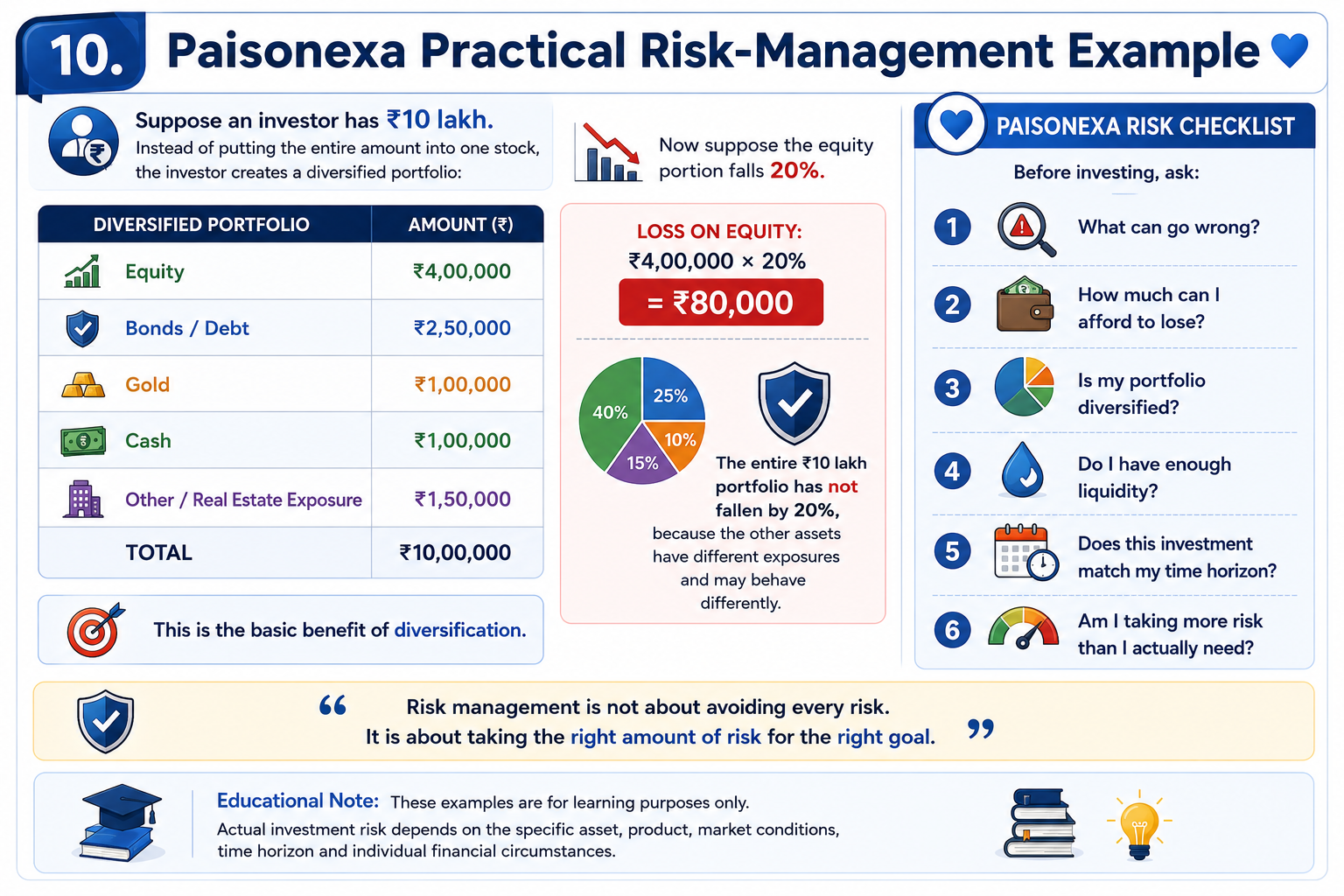
Investment risk management means understanding the risks associated with an investment and taking practical steps to control or reduce the impact of those risks.
Risk management does not mean eliminating all risk.
Instead, the goal is to make sure that:
- One investment cannot seriously damage your entire portfolio
- You invest according to your financial capacity
- Your investments match your goals and time horizon
- You can handle market volatility without making emotional decisions
Simple Example
Suppose you have ₹10 lakh.
If you invest the entire ₹10 lakh in one stock and that stock falls 50%, your portfolio could fall by approximately ₹5 lakh.
If your money is diversified across different assets and investments, the impact of one poor performer may be smaller.
Good risk management is about controlling what you can control.
2. Types of Investment Risk
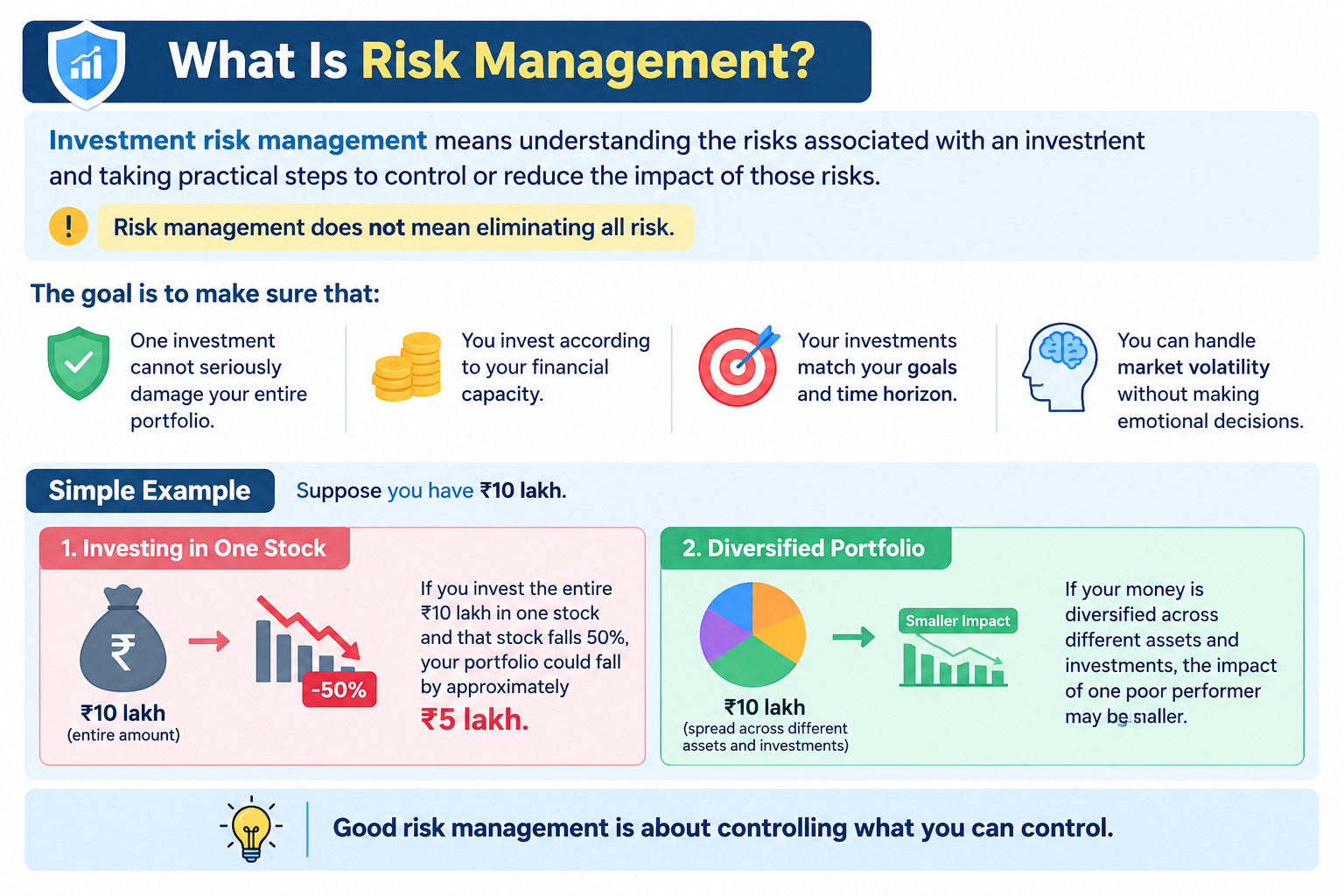
Different investments have different risks.
Market Risk
The value of investments can fall because of overall market movements.
Example:
The stock market falls 15% during a major correction.
Company-Specific Risk
A particular company’s stock may fall because of:
- Poor earnings
- Management problems
- Debt issues
- Regulatory action
- Loss of customers
Credit / Default Risk
The issuer of a bond or debt investment may fail to make interest or principal payments.
Interest Rate Risk
Changes in interest rates can affect the market value of bonds and other fixed-income investments.
Generally:
Interest rates rise → existing bond prices tend to fall.
Inflation Risk
Inflation reduces the purchasing power of money.
For example, if your investment earns 6% but inflation is 5%, your real purchasing-power growth is much lower before considering taxes and other costs.
Liquidity Risk
An investment may not be easy to sell quickly at a fair price.
Real estate is a common example of an asset that can take time to sell.
Concentration Risk
Putting too much money into one:
- Stock
- Sector
- Asset class
- Property
- Investment
can increase portfolio risk.
3. Risk vs Return
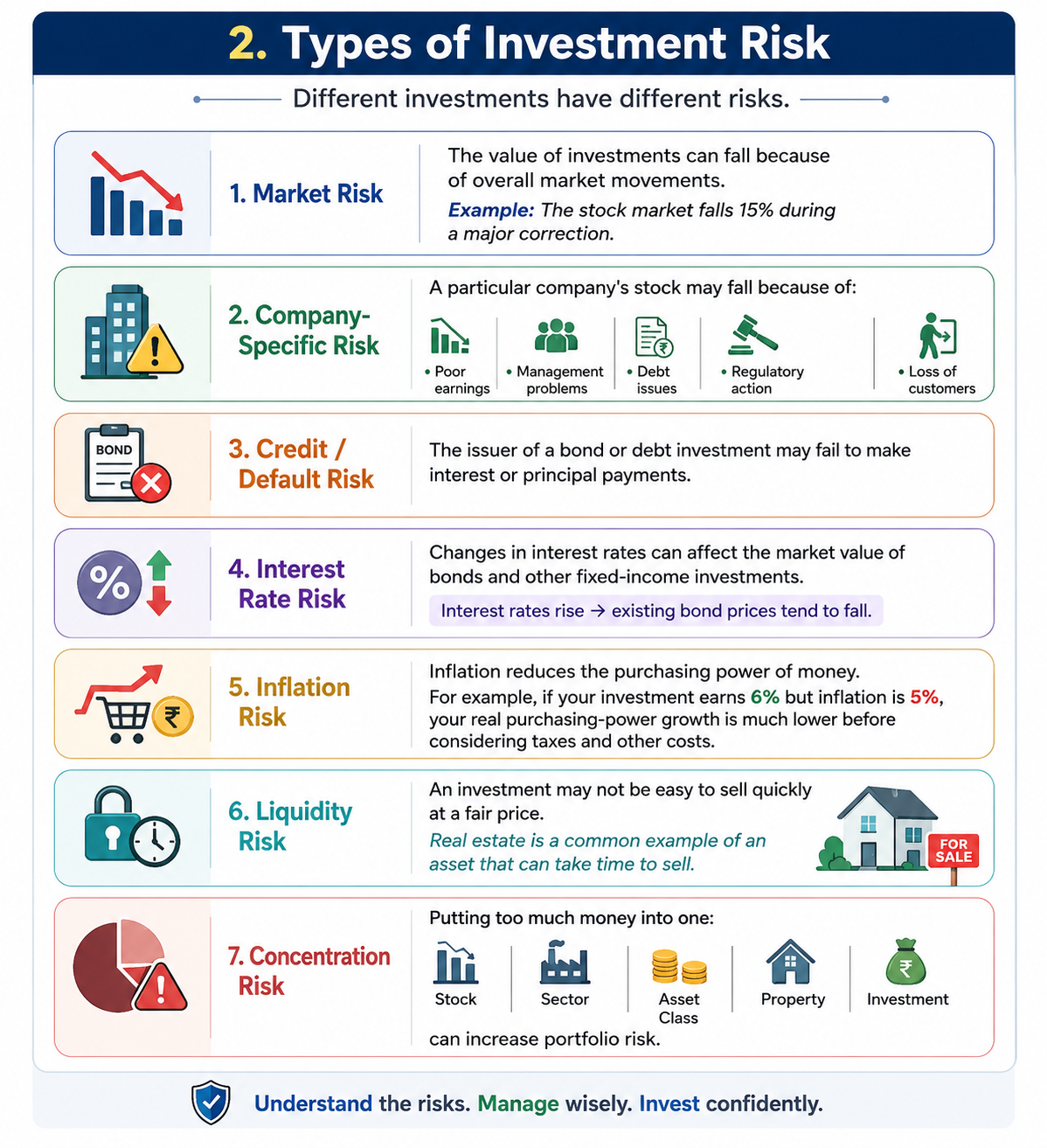
One of the most important investment principles is:
Higher potential returns generally come with higher risk.
For example:
Cash → Lower volatility, lower growth potential
Bonds → Moderate risk depending on issuer and maturity
Equity → Higher volatility, higher long-term growth potential
Speculative investments → Potentially very high risk
This does not mean that taking more risk automatically produces higher returns.
A high-risk investment can also produce large losses.
Remember
Risk should be taken deliberately, not accidentally.
4. Diversification
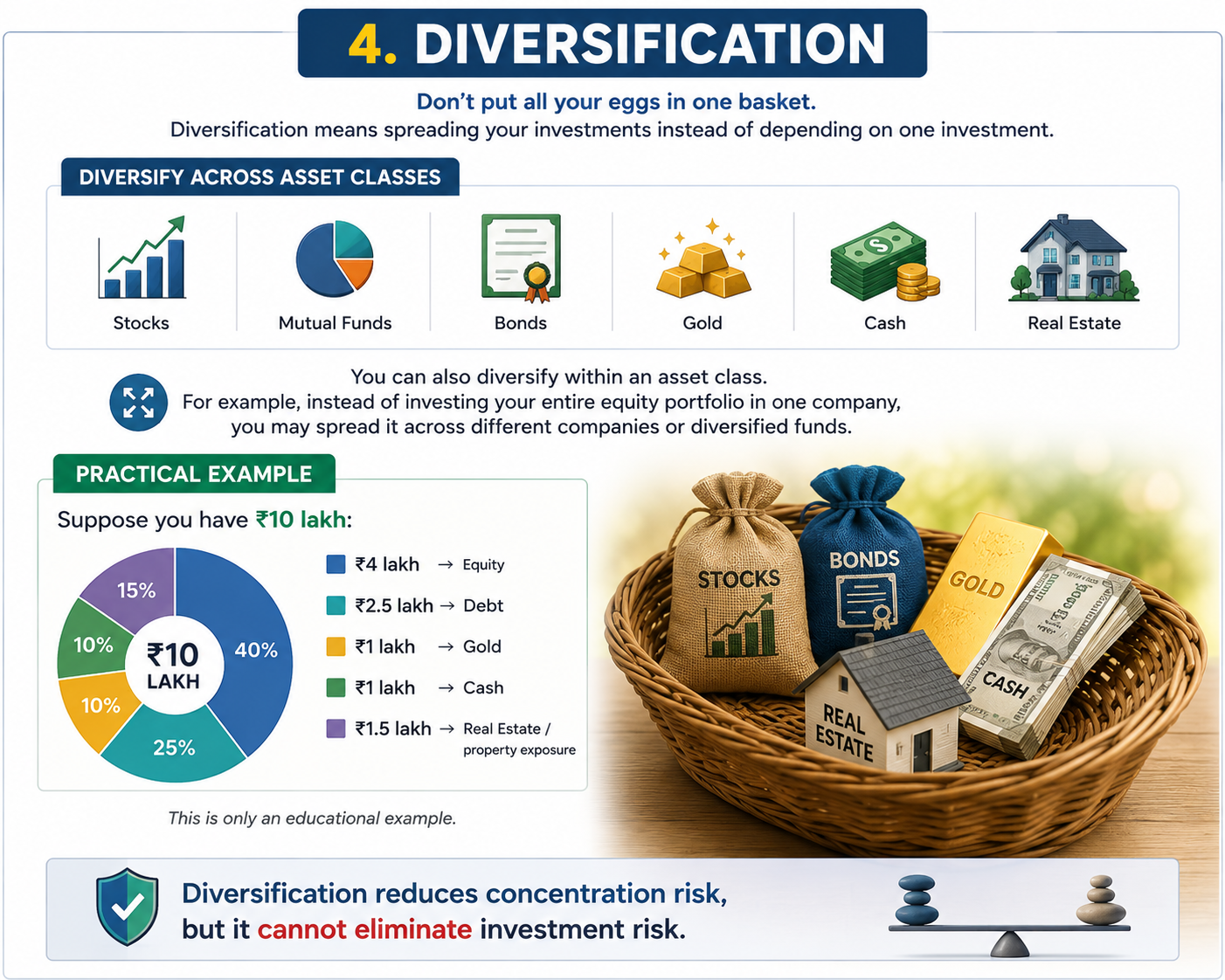
Diversification means spreading your investments instead of depending on one investment.
You can diversify across:
- Stocks
- Mutual Funds
- Bonds
- Gold
- Cash
- Real Estate
You can also diversify within an asset class.
For example, instead of investing your entire equity portfolio in one company, you may spread it across different companies or diversified funds.
Practical Example
Suppose you have ₹10 lakh:
₹4 lakh → Equity
₹2.5 lakh → Debt
₹1 lakh → Gold
₹1 lakh → Cash
₹1.5 lakh → Real Estate / property exposure
This is only an educational example.
Diversification reduces concentration risk, but it cannot eliminate investment risk.
5. How Much Risk Can You Take?
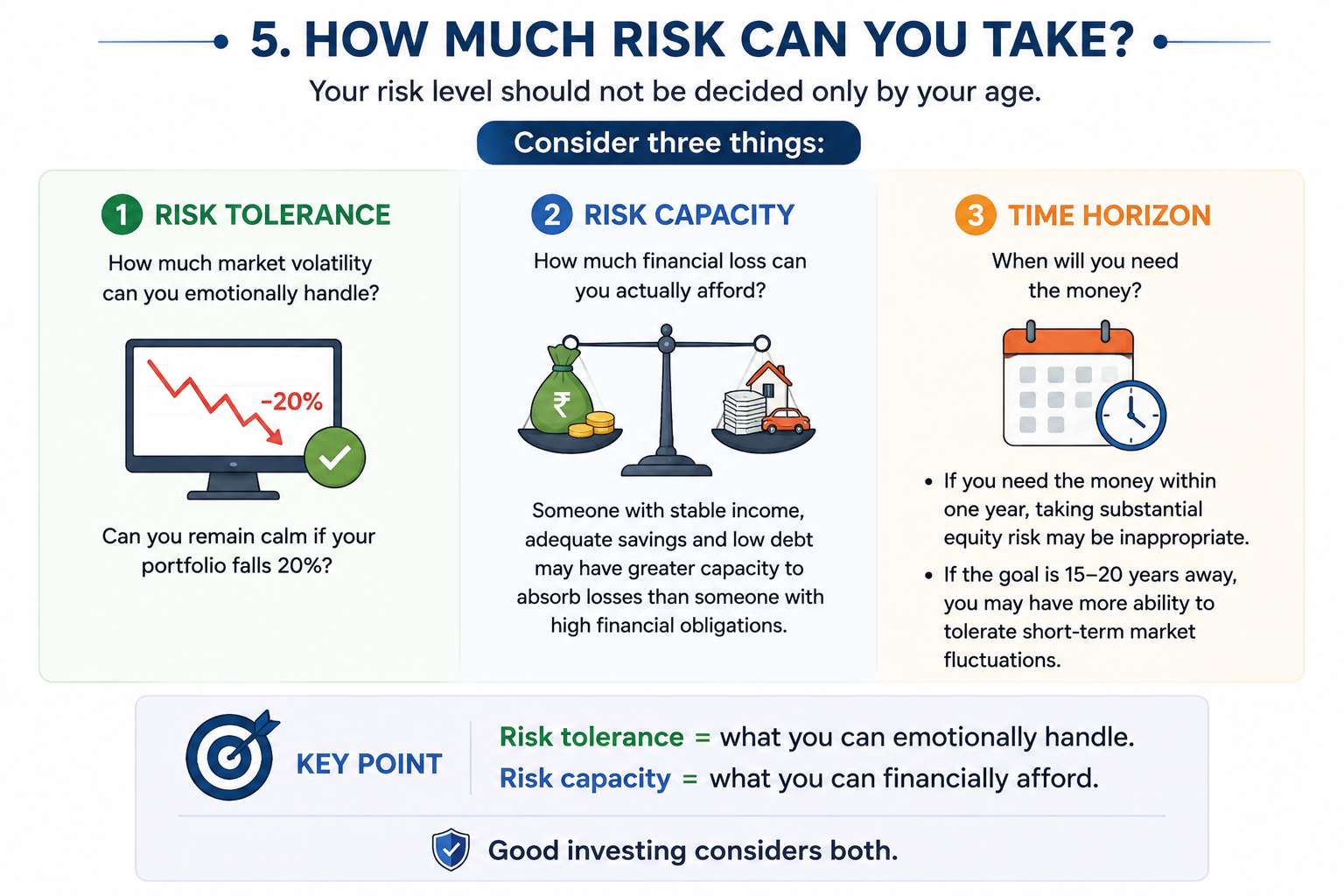
Your risk level should not be decided only by your age.
Consider three things:
1. Risk Tolerance
How much market volatility can you emotionally handle?
Can you remain calm if your portfolio falls 20%?
2. Risk Capacity
How much financial loss can you actually afford?
Someone with stable income, adequate savings and low debt may have greater capacity to absorb losses than someone with high financial obligations.
3. Time Horizon
When will you need the money?
If you need the money within one year, taking substantial equity risk may be inappropriate.
If the goal is 15–20 years away, you may have more ability to tolerate short-term market fluctuations.
Key Point
Risk tolerance = what you can emotionally handle.
Risk capacity = what you can financially afford.
Good investing considers both.
6. Position Sizing & Concentration Risk
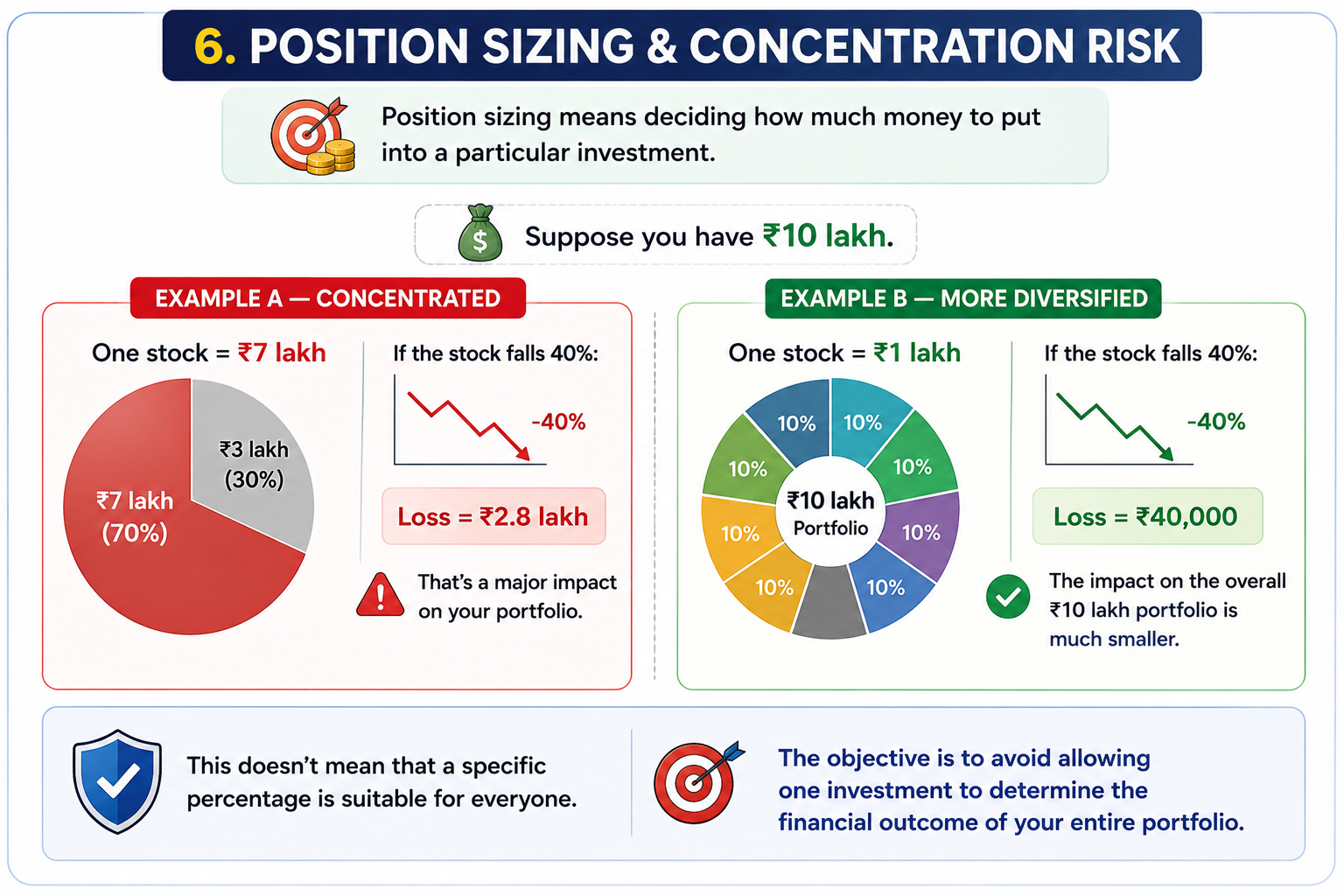
Position sizing means deciding how much money to put into a particular investment.
Suppose you have ₹10 lakh.
Example A — Concentrated
One stock = ₹7 lakh
If the stock falls 40%:
Loss = ₹2.8 lakh
That’s a major impact on your portfolio.
Example B — More Diversified
One stock = ₹1 lakh
If it falls 40%:
Loss = ₹40,000
The impact on the overall ₹10 lakh portfolio is much smaller.
This doesn’t mean that a specific percentage is suitable for everyone.
The objective is to avoid allowing one investment to determine the financial outcome of your entire portfolio.
7. Emergency Fund & Debt Management
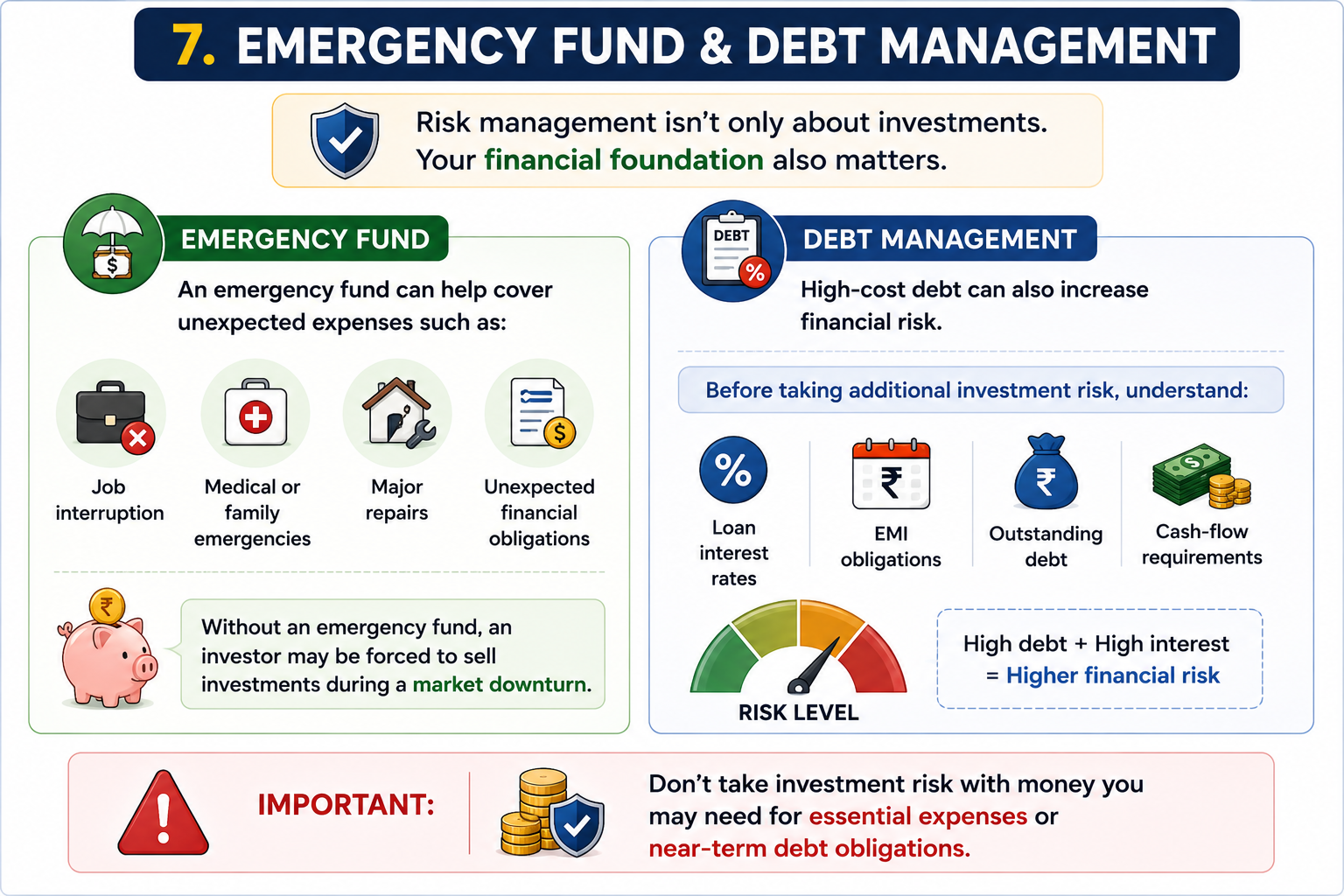
Risk management isn’t only about investments.
Your financial foundation also matters.
Emergency Fund
An emergency fund can help cover unexpected expenses such as:
- Job interruption
- Medical or family emergencies
- Major repairs
- Unexpected financial obligations
Without an emergency fund, an investor may be forced to sell investments during a market downturn.
Debt Management
High-cost debt can also increase financial risk.
Before taking additional investment risk, understand:
- Loan interest rates
- EMI obligations
- Outstanding debt
- Cash-flow requirements
Important
Don’t take investment risk with money you may need for essential expenses or near-term debt obligations.
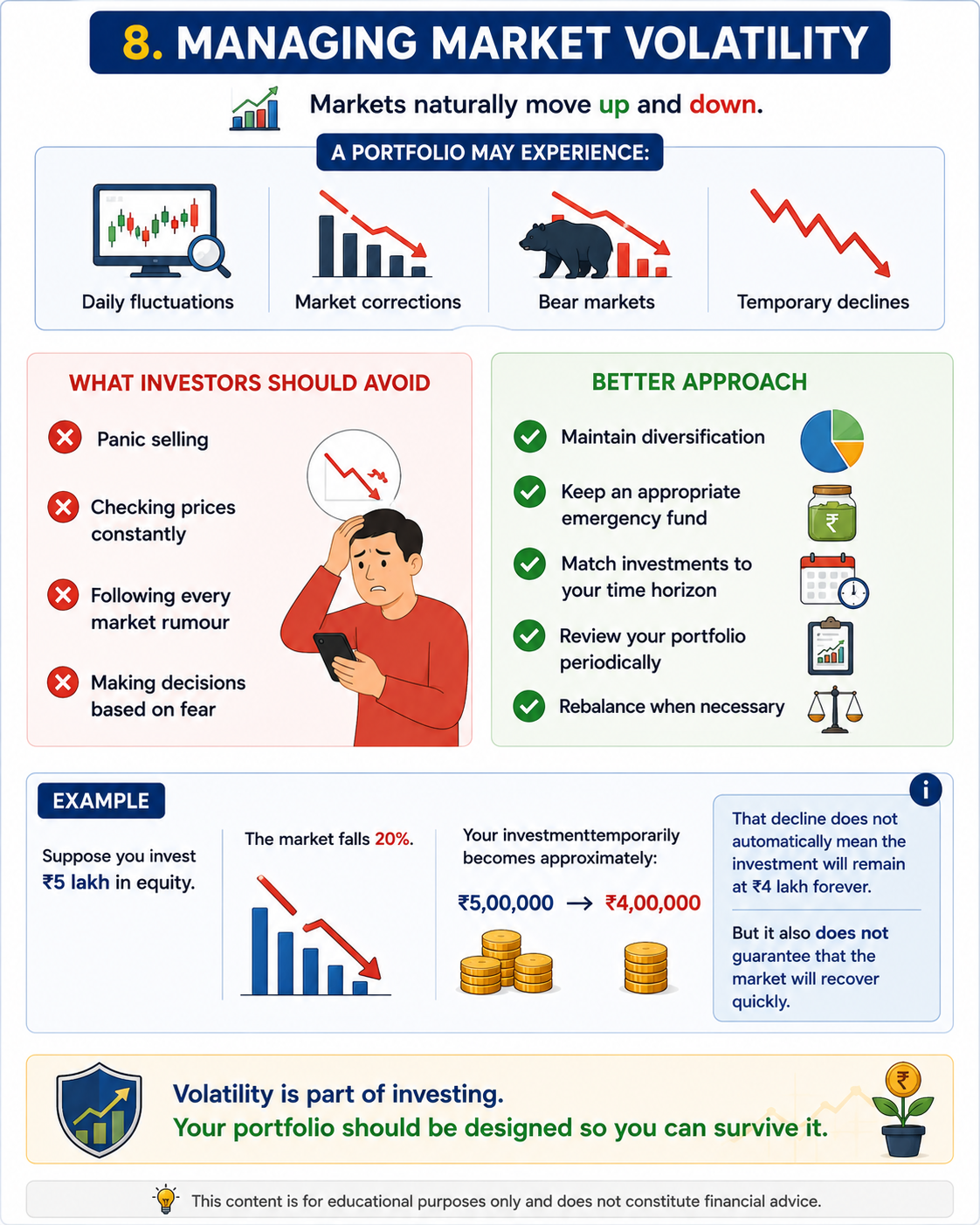
8. Managing Market Volatility
Markets naturally move up and down.
A portfolio may experience:
- Daily fluctuations
- Market corrections
- Bear markets
- Temporary declines
What Should Investors Avoid?
❌ Panic selling
❌ Checking prices constantly
❌ Following every market rumour
❌ Making decisions based on fear
Better Approach
✅ Maintain diversification
✅ Keep an appropriate emergency fund
✅ Match investments to your time horizon
✅ Review your portfolio periodically
✅ Rebalance when necessary
Example
Suppose you invest ₹5 lakh in equity.
The market falls 20%.
Your investment temporarily becomes approximately:
₹5,00,000 → ₹4,00,000
That decline does not automatically mean the investment will remain at ₹4 lakh forever.
But it also does not guarantee that the market will recover quickly.
Volatility is part of investing. Your portfolio should be designed so you can survive it.
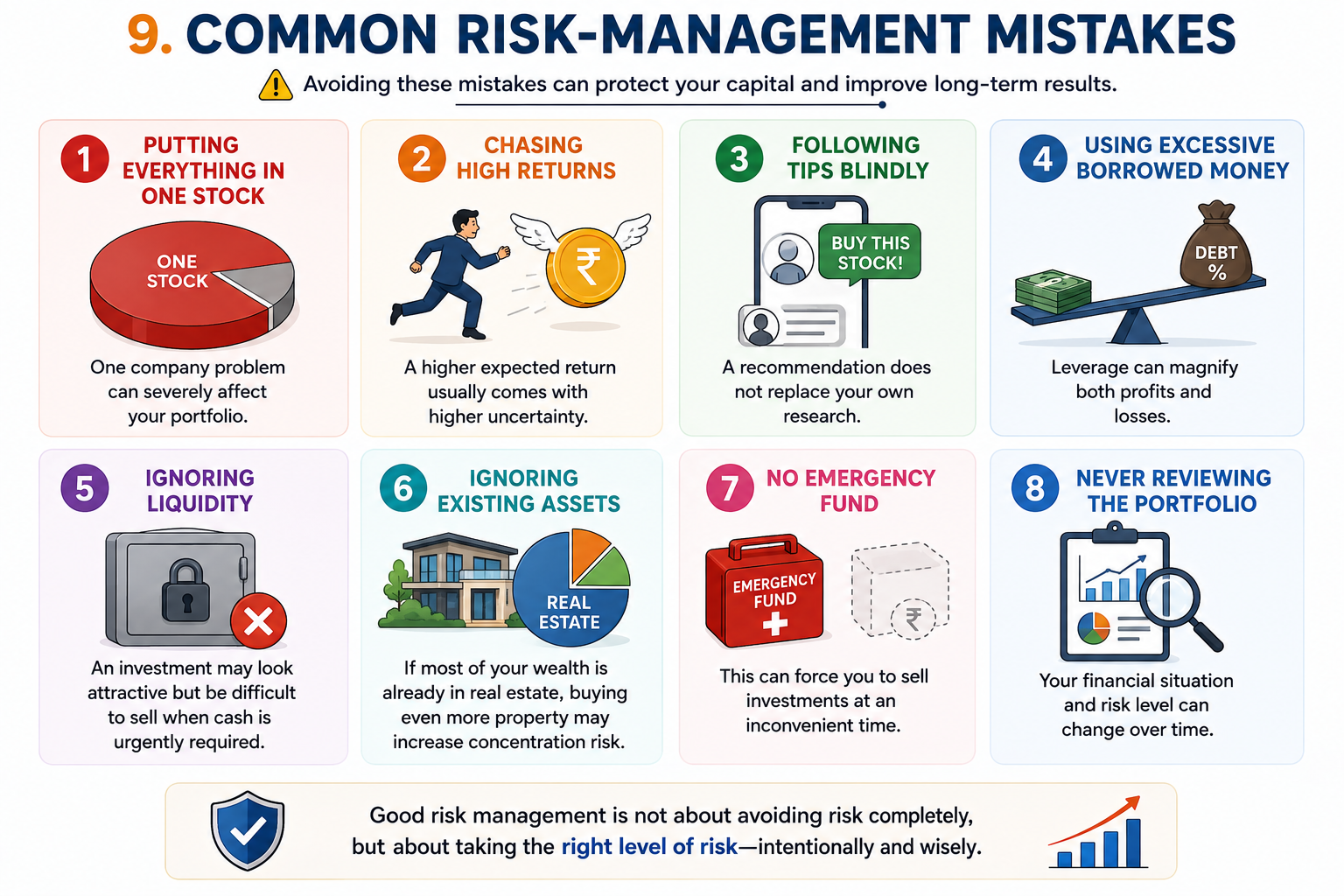
9. Common Risk-Management Mistakes
1. Putting Everything in One Stock
One company problem can severely affect your portfolio.
2. Chasing High Returns
A higher expected return usually comes with higher uncertainty.
3. Following Tips Blindly
A recommendation does not replace your own research.
4. Using Excessive Borrowed Money
Leverage can magnify both profits and losses.
5. Ignoring Liquidity
An investment may look attractive but be difficult to sell when cash is urgently required.
6. Ignoring Existing Assets
If most of your wealth is already in real estate, buying even more property may increase concentration risk.
7. No Emergency Fund
This can force you to sell investments at an inconvenient time.
8. Never Reviewing the Portfolio
Your financial situation and risk level can change over time.
10. Paisonexa Practical Risk-Management Example 💙
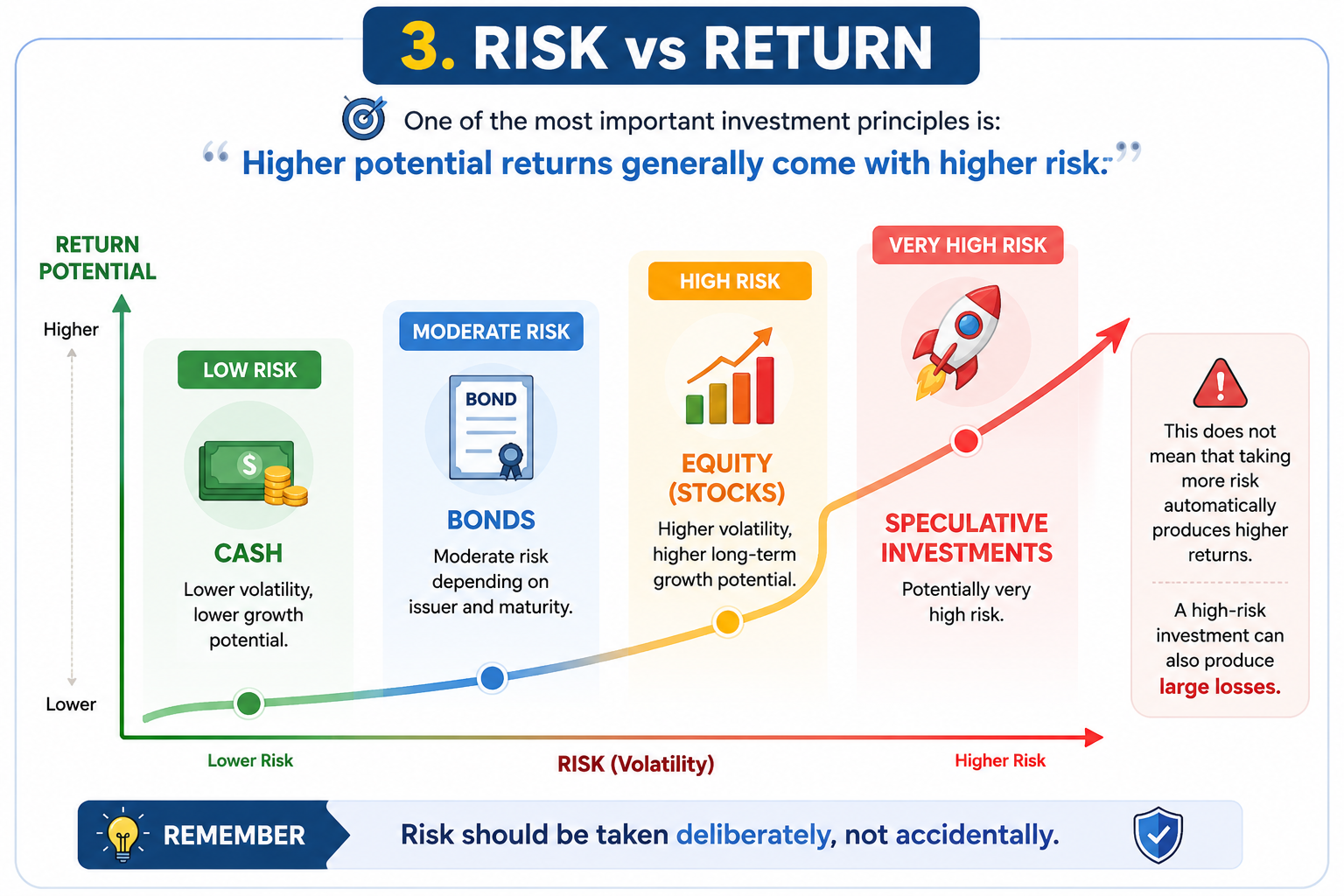
Suppose an investor has ₹10 lakh.
Instead of putting the entire amount into one stock, the investor creates a diversified portfolio:
| Asset | Amount |
|---|---|
| Equity | ₹4,00,000 |
| Bonds / Debt | ₹2,50,000 |
| Gold | ₹1,00,000 |
| Cash | ₹1,00,000 |
| Other / Real Estate Exposure | ₹1,50,000 |
| Total | ₹10,00,000 |
Now suppose the equity portion falls 20%.
Loss on equity:
₹4,00,000 × 20% = ₹80,000
The entire ₹10 lakh portfolio has not fallen by 20%, because the other assets have different exposures and may behave differently.
This is the basic benefit of diversification.
💙 Paisonexa Risk Checklist
Before investing, ask:
1. What can go wrong?
2. How much can I afford to lose?
3. Is my portfolio diversified?
4. Do I have enough liquidity?
5. Does this investment match my time horizon?
6. Am I taking more risk than I actually need?
Risk management is not about avoiding every risk. It is about taking the right amount of risk for the right goal.
Educational Note: These examples are for learning purposes only. Actual investment risk depends on the specific asset, product, market conditions, time horizon and individual financial circumstances.