What Are Bonds & How Do They Work?
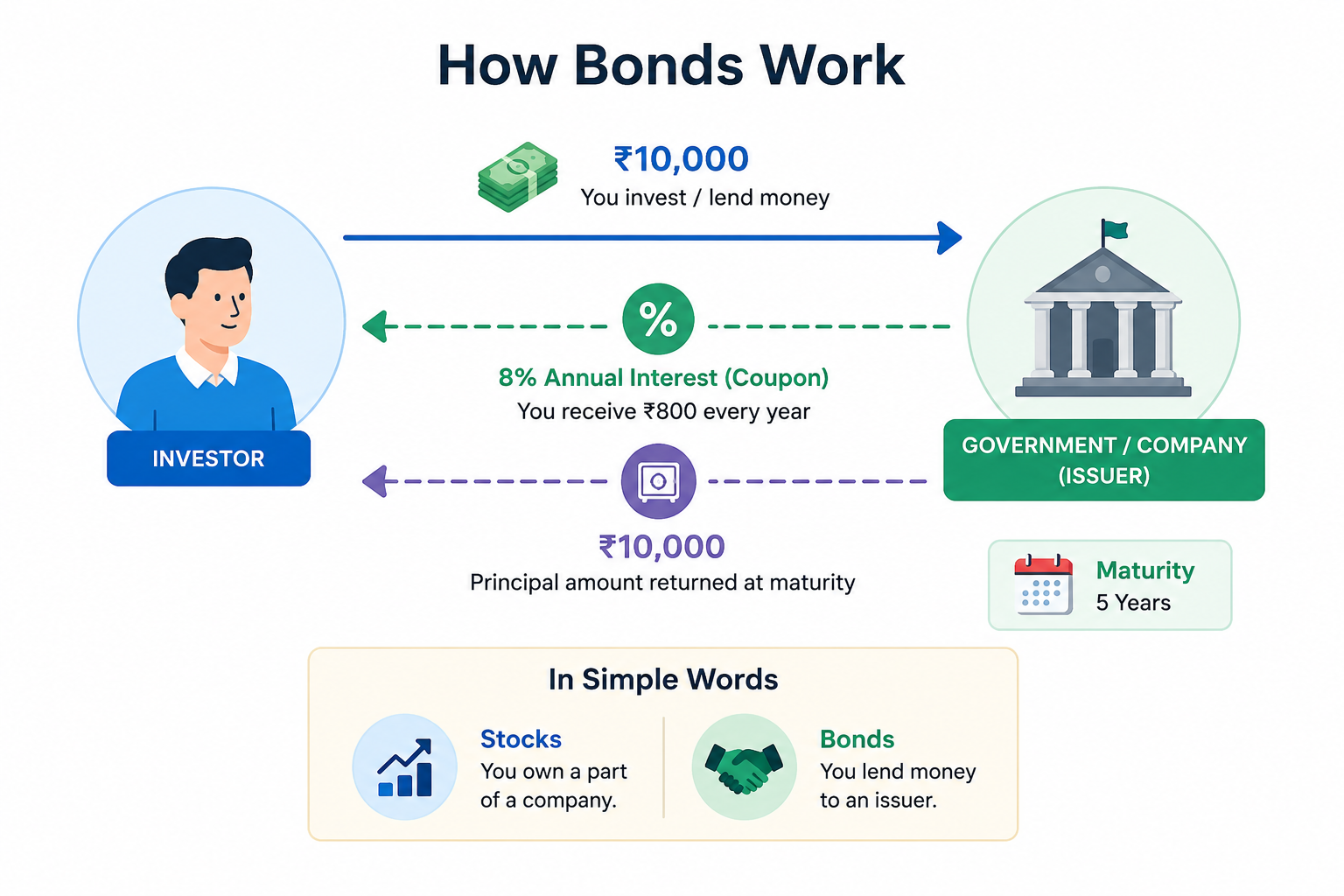
A bond is a type of investment where you lend money to a government, company, or other issuer for a specific period.
In return, the issuer generally agrees to pay interest and repay the principal amount according to the bond’s terms.
Simple Example:
Suppose you invest ₹10,000 in a bond with an 8% annual coupon.
- Investment / Face Value: ₹10,000
- Coupon Rate: 8%
- Annual Interest: ₹800
- Maturity: 5 years
So, you may receive ₹800 per year as interest, subject to the bond’s terms.
In simple words:
Stocks = You own a part of a company.
Bonds = You lend money to an issuer.
2. Why Are Bonds Issued?
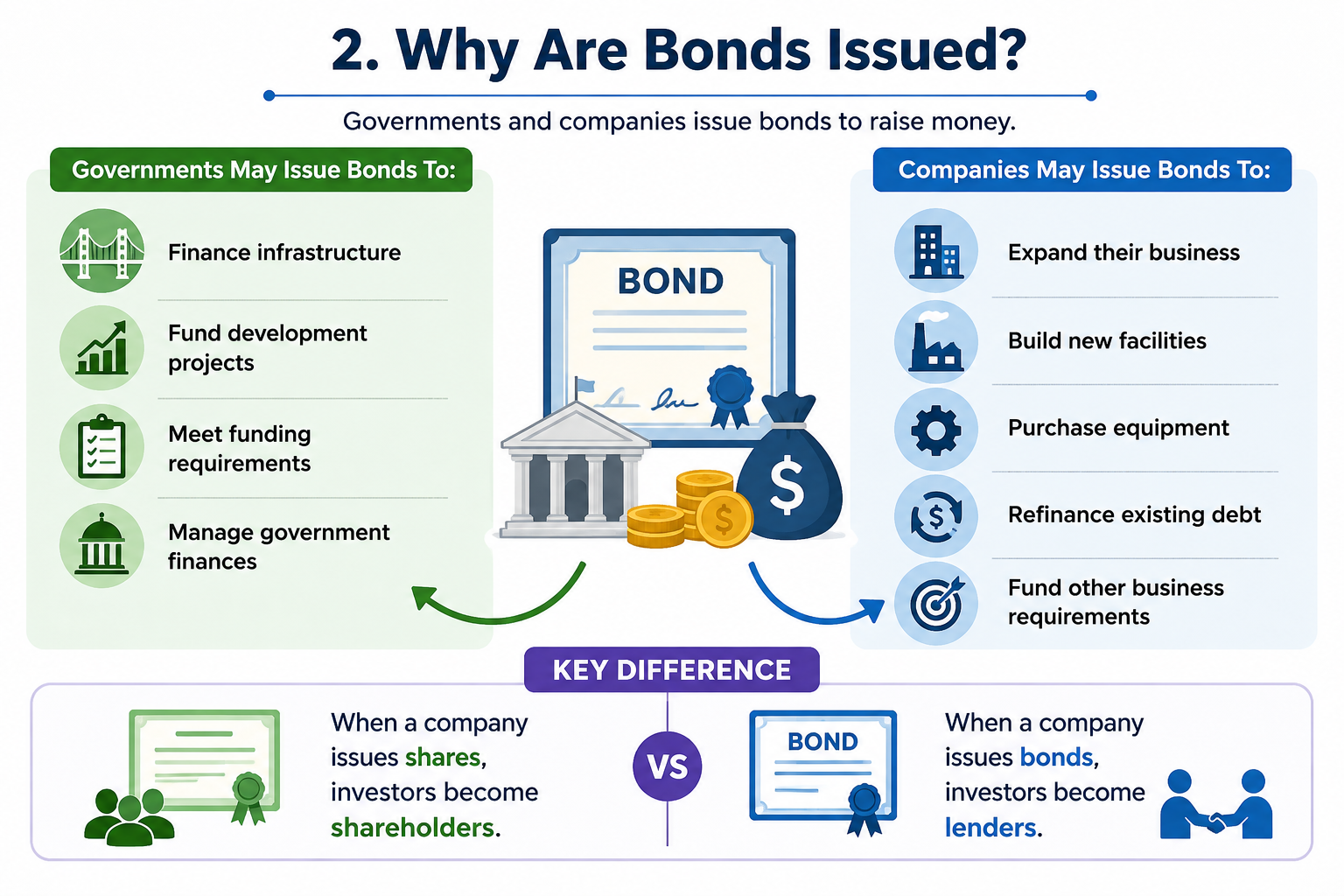
Governments and companies issue bonds to raise money.
Governments may issue bonds to:
- Finance infrastructure
- Fund development projects
- Meet funding requirements
- Manage government finances
Companies may issue bonds to:
- Expand their business
- Build new facilities
- Purchase equipment
- Refinance existing debt
- Fund other business requirements
Key difference:
When a company issues shares, investors become shareholders.
When a company issues bonds, investors become lenders.
3. Types of Bonds
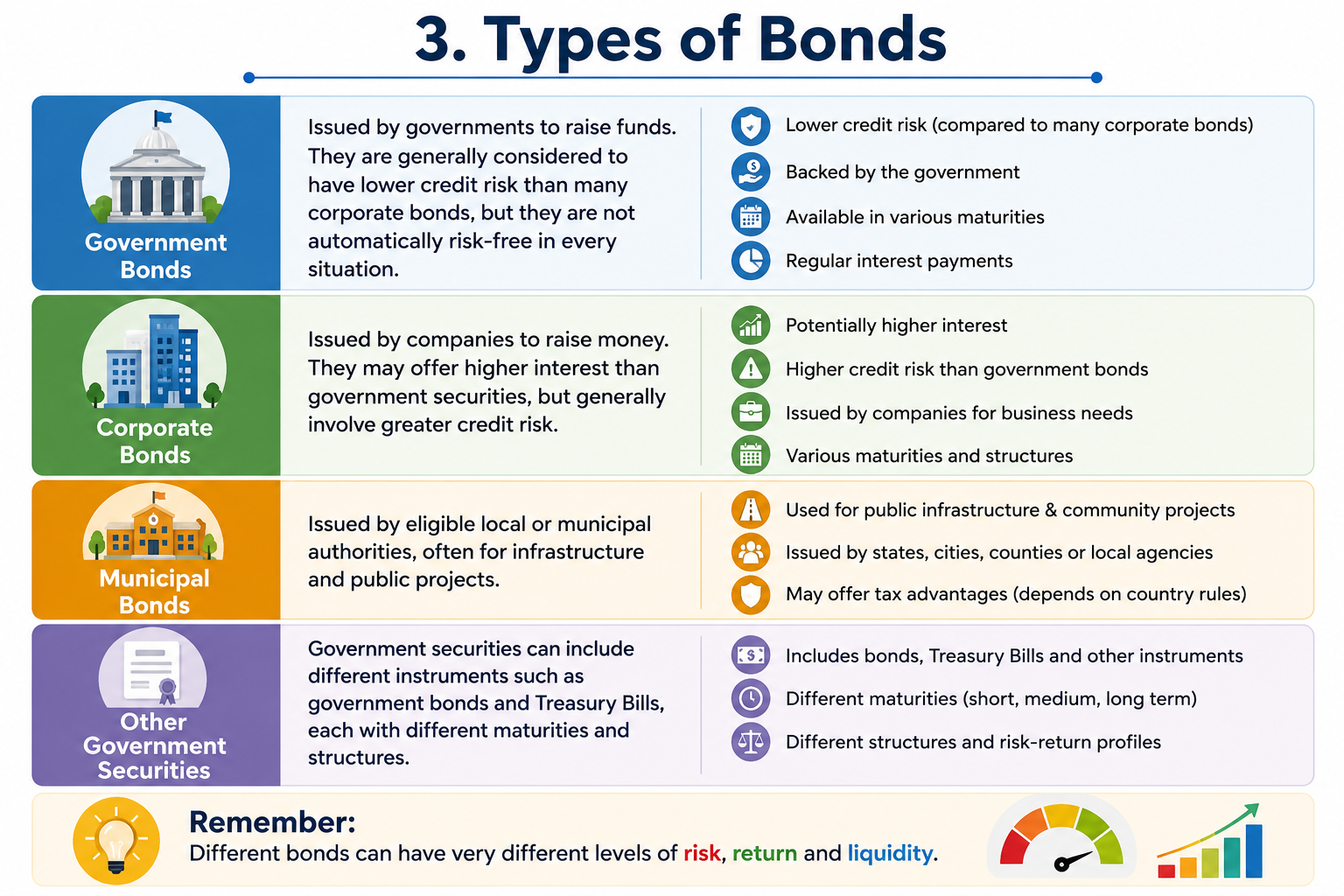
Government Bonds
Issued by governments to raise funds. They are generally considered to have lower credit risk than many corporate bonds, but they are not automatically risk-free in every situation.
Corporate Bonds
Issued by companies to raise money. They may offer higher interest than government securities, but generally involve greater credit risk.
Municipal Bonds
Issued by eligible local or municipal authorities, often for infrastructure and public projects.
Other Government Securities
Government securities can include different instruments such as government bonds and Treasury Bills, each with different maturities and structures.
Remember: Different bonds can have very different levels of risk, return and liquidity.
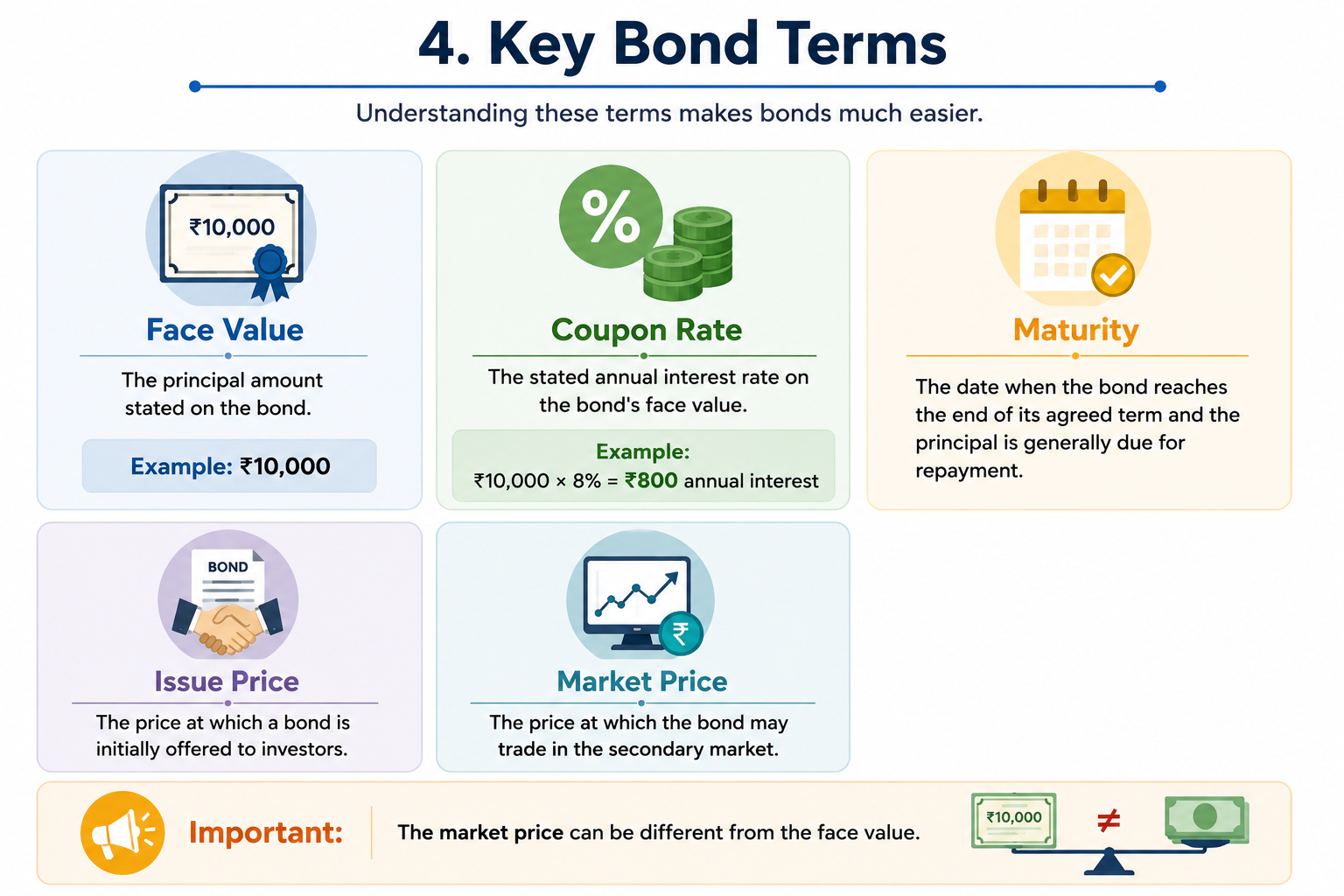
4. Key Bond Terms
Understanding these terms makes bonds much easier.
Face Value
The principal amount stated on the bond.
Example: ₹10,000
Coupon Rate
The stated annual interest rate on the bond’s face value.
Example:
₹10,000 × 8% = ₹800 annual interest
Maturity
The date when the bond reaches the end of its agreed term and the principal is generally due for repayment.
Issue Price
The price at which a bond is initially offered to investors.
Market Price
The price at which the bond may trade in the secondary market.
Important: The market price can be different from the face value.
5. How Bond Returns Work
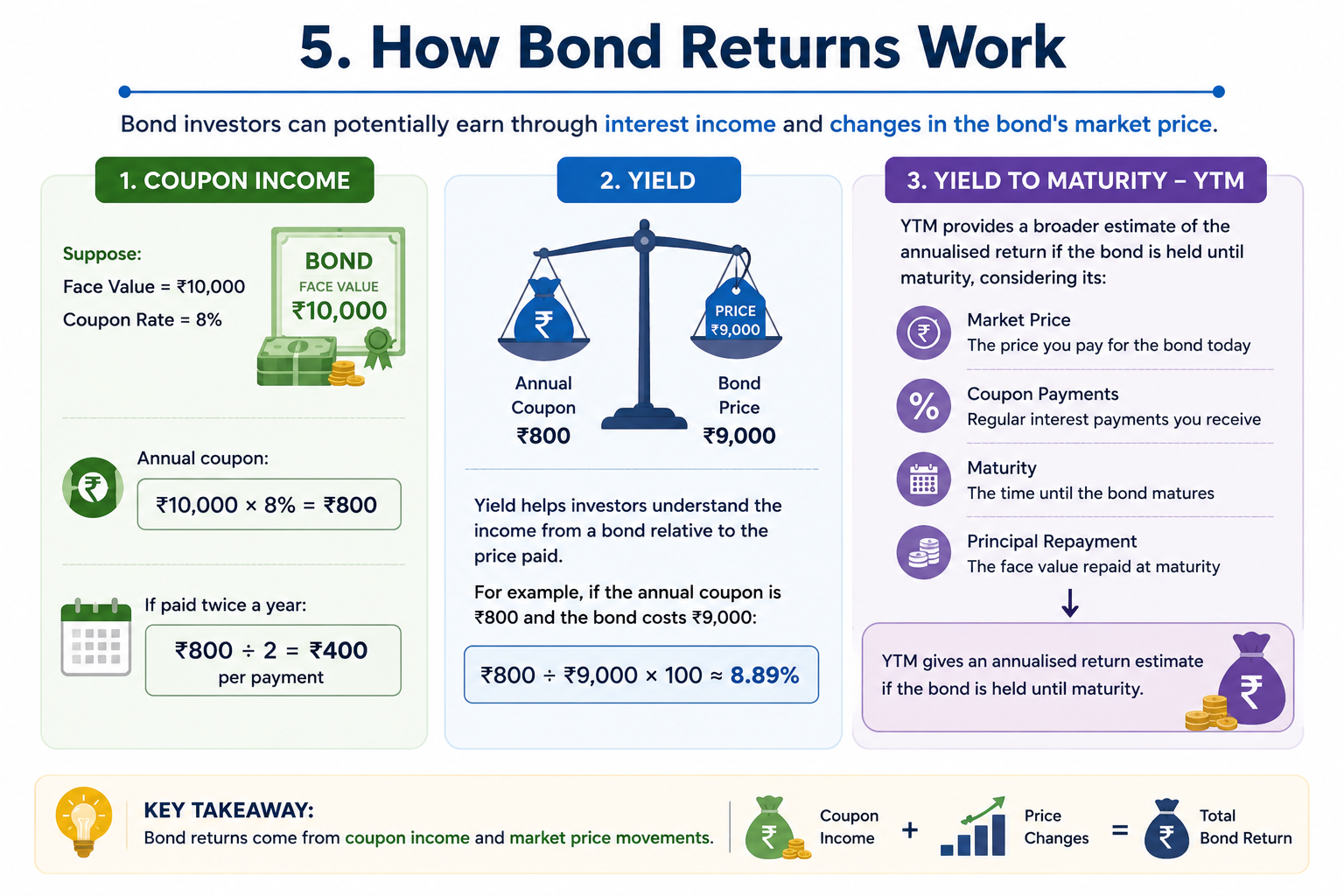
Bond investors can potentially earn through interest income and changes in the bond’s market price.
Coupon Income
Suppose:
Face Value = ₹10,000
Coupon Rate = 8%
Annual coupon:
₹10,000 × 8% = ₹800
If paid twice a year:
₹800 ÷ 2 = ₹400 per payment
Yield
Yield helps investors understand the income from a bond relative to the price paid.
For example, if the annual coupon is ₹800 and the bond costs ₹9,000:
₹800 ÷ ₹9,000 × 100 ≈ 8.89%
Yield to Maturity — YTM
YTM provides a broader estimate of the annualised return if the bond is held until maturity, considering its market price, coupon payments, maturity and principal repayment.
6. Bond Prices & Interest Rates
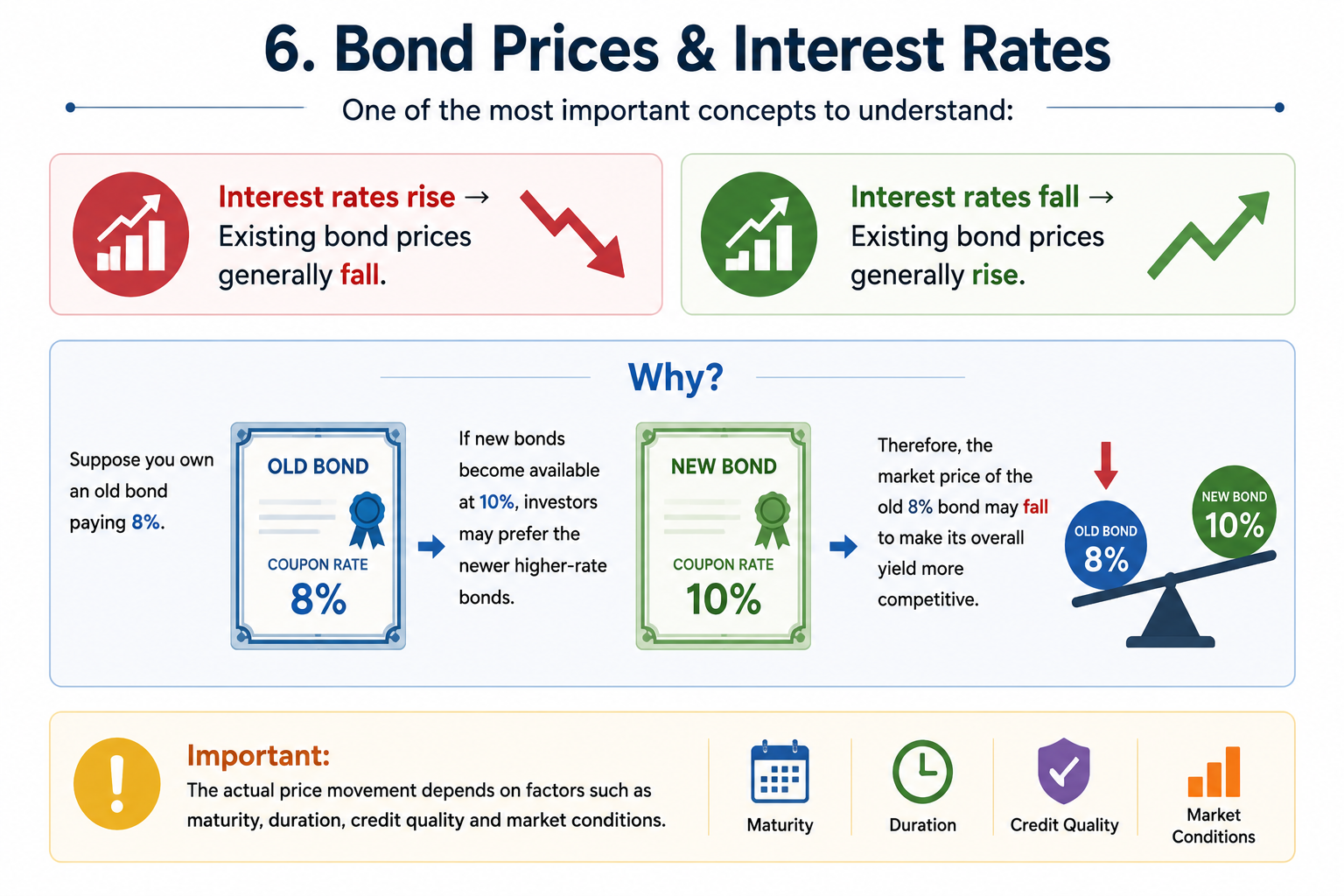
One of the most important concepts to understand:
Interest rates rise → Existing bond prices generally fall.
Interest rates fall → Existing bond prices generally rise.
Why?
Suppose you own an old bond paying 8%.
If new bonds become available at 10%, investors may prefer the newer higher-rate bonds.
Therefore, the market price of the old 8% bond may fall to make its overall yield more competitive.
Important: The actual price movement depends on factors such as maturity, duration, credit quality and market conditions.
7. Bond Ratings & Risks
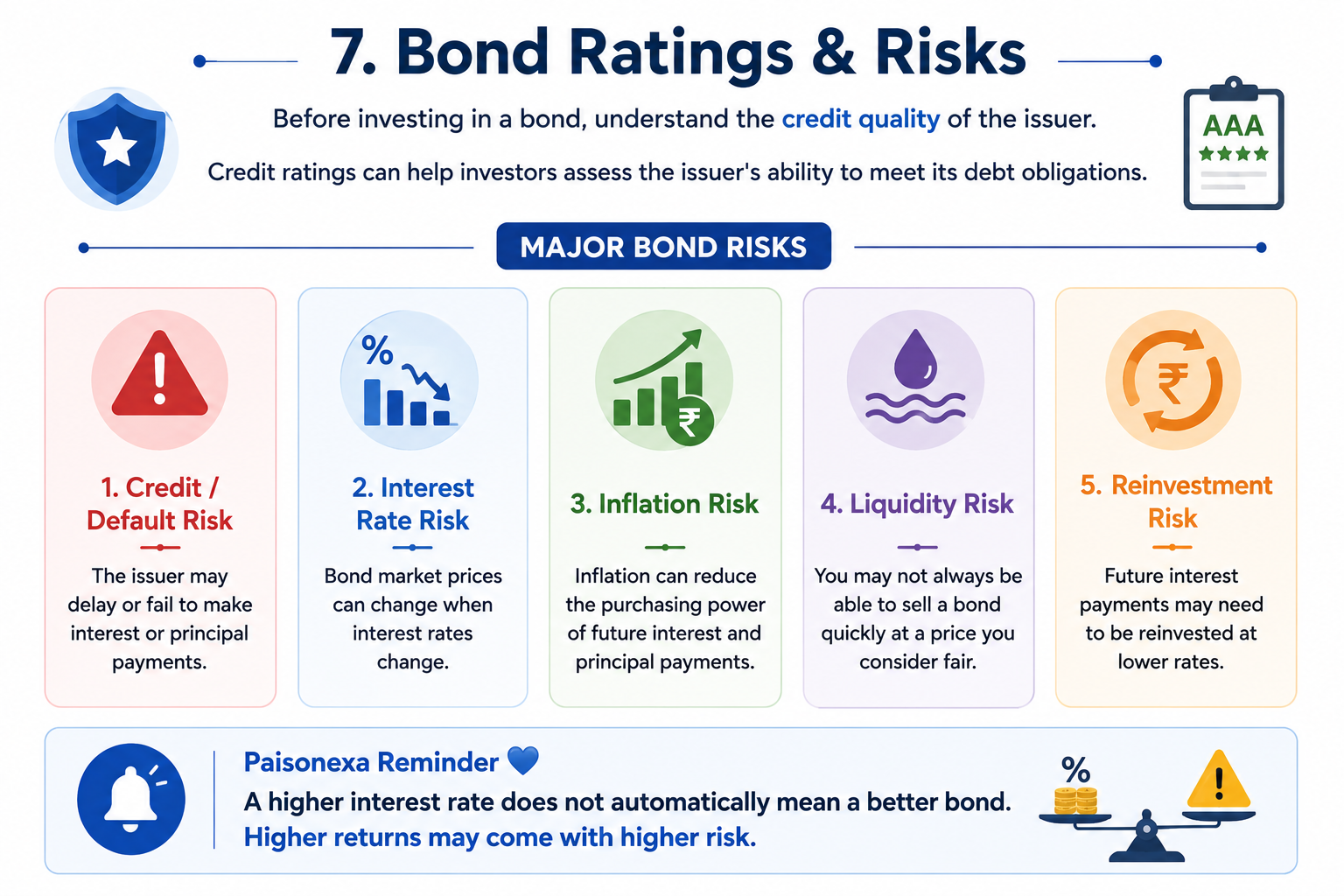
Before investing in a bond, understand the credit quality of the issuer.
Credit ratings can help investors assess the issuer’s ability to meet its debt obligations.
Major Bond Risks
Credit / Default Risk
The issuer may delay or fail to make interest or principal payments.
Interest Rate Risk
Bond market prices can change when interest rates change.
Inflation Risk
Inflation can reduce the purchasing power of future interest and principal payments.
Liquidity Risk
You may not always be able to sell a bond quickly at a price you consider fair.
Reinvestment Risk
Future interest payments may need to be reinvested at lower rates.
Paisonexa Reminder 💙
A higher interest rate does not automatically mean a better bond. Higher returns may come with higher risk.
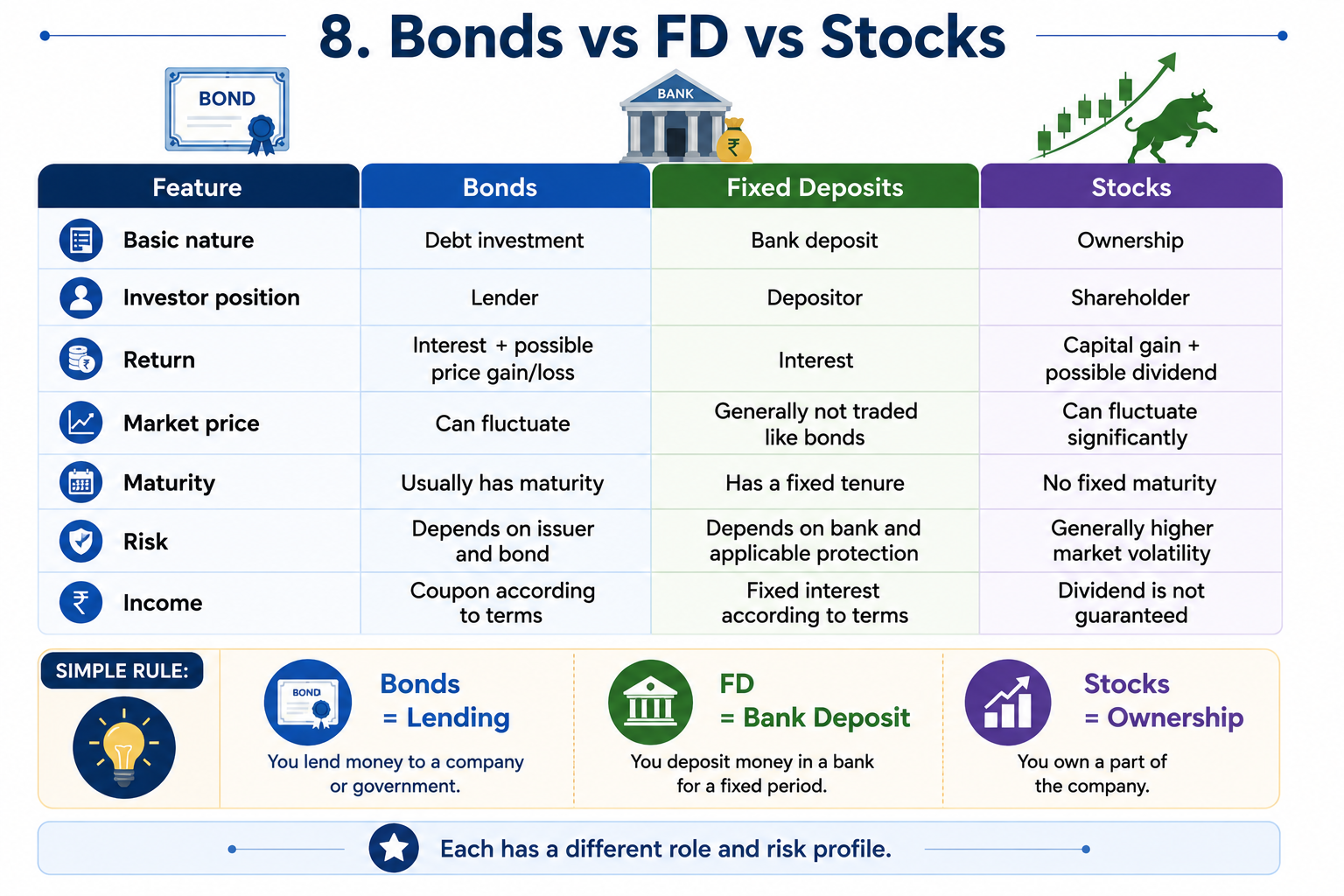
8. Bonds vs FD vs Stocks
| Feature | Bonds | Fixed Deposits | Stocks |
|---|---|---|---|
| Basic nature | Debt investment | Bank deposit | Ownership |
| Investor position | Lender | Depositor | Shareholder |
| Return | Interest + possible price gain/loss | Interest | Capital gain + possible dividend |
| Market price | Can fluctuate | Generally not traded like bonds | Can fluctuate significantly |
| Maturity | Usually has maturity | Has a fixed tenure | No fixed maturity |
| Risk | Depends on issuer and bond | Depends on bank and applicable protection | Generally higher market volatility |
| Income | Coupon according to terms | Fixed interest according to terms | Dividend is not guaranteed |
Simple rule:
Stocks = Ownership
Bonds = Lending
FD = Bank Deposit
Each has a different role and risk profile.
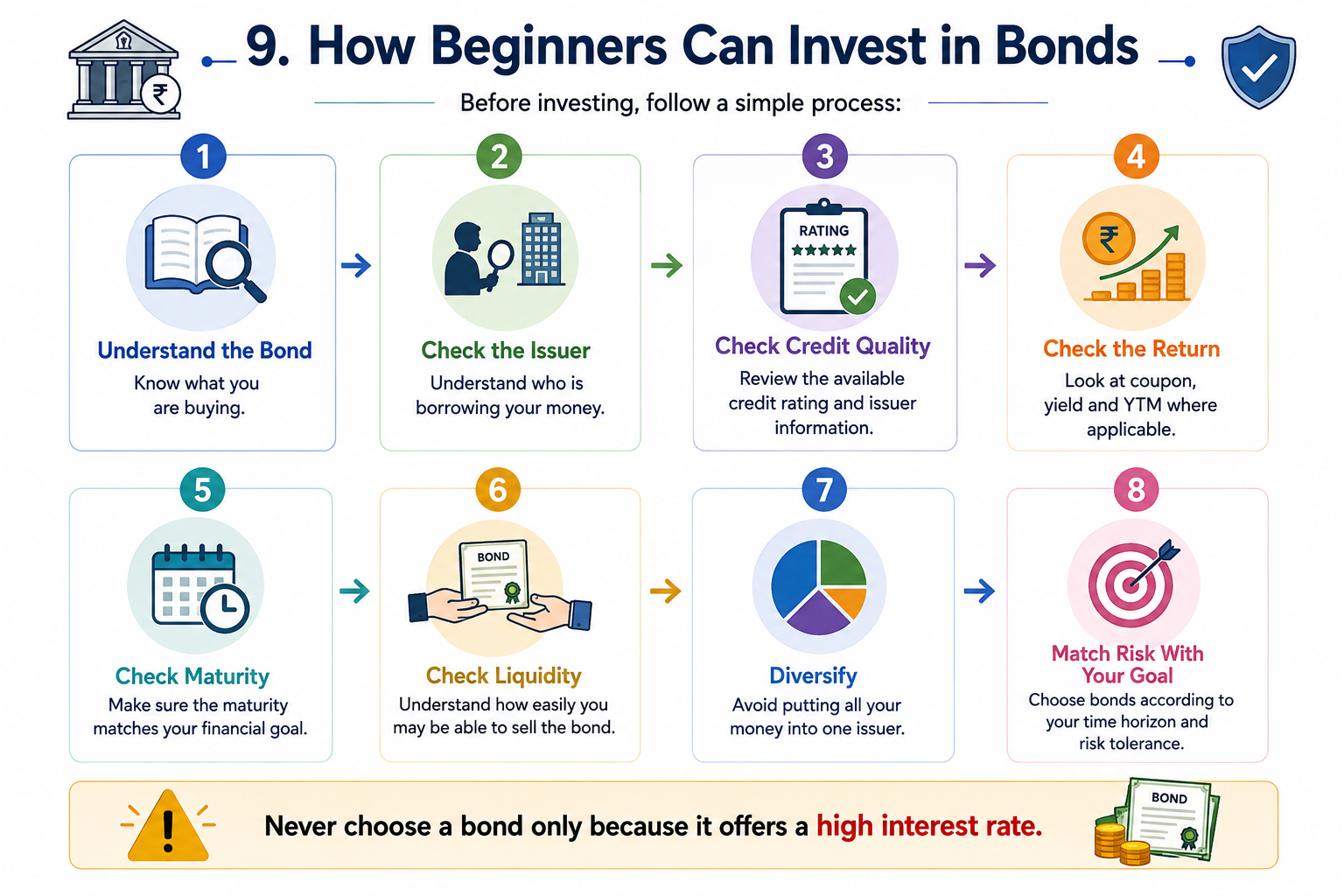
9. How Beginners Can Invest in Bonds
Before investing, follow a simple process:
Step 1 — Understand the Bond
Know what you are buying.
Step 2 — Check the Issuer
Understand who is borrowing your money.
Step 3 — Check Credit Quality
Review the available credit rating and issuer information.
Step 4 — Check the Return
Look at coupon, yield and YTM where applicable.
Step 5 — Check Maturity
Make sure the maturity matches your financial goal.
Step 6 — Check Liquidity
Understand how easily you may be able to sell the bond.
Step 7 — Diversify
Avoid putting all your money into one issuer.
Step 8 — Match Risk With Your Goal
Choose bonds according to your time horizon and risk tolerance.
Never choose a bond only because it offers a high interest rate.
10. Paisonexa Practical Example + Tip 💙
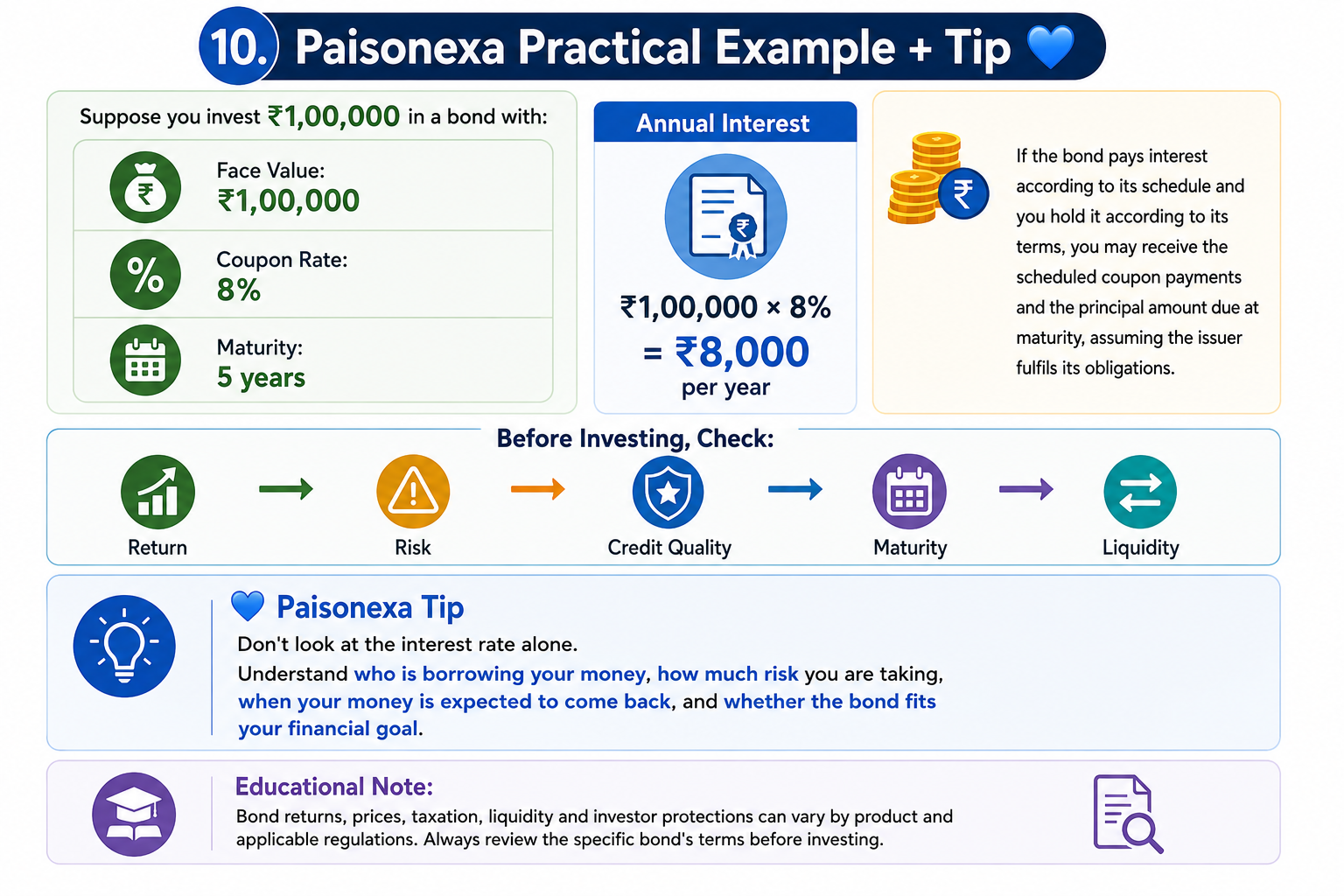
Suppose you invest ₹1,00,000 in a bond with:
- Face Value: ₹1,00,000
- Coupon Rate: 8%
- Maturity: 5 years
Annual Interest
₹1,00,000 × 8% = ₹8,000 per year
If the bond pays interest according to its schedule and you hold it according to its terms, you may receive the scheduled coupon payments and the principal amount due at maturity, assuming the issuer fulfils its obligations.
Before Investing, Check:
Return → Risk → Credit Quality → Maturity → Liquidity
💙 Paisonexa Tip
Don’t look at the interest rate alone. Understand who is borrowing your money, how much risk you are taking, when your money is expected to come back, and whether the bond fits your financial goal.
Educational Note: Bond returns, prices, taxation, liquidity and investor protections can vary by product and applicable regulations. Always review the specific bond’s terms before investing.