1. What Is a Home Loan?
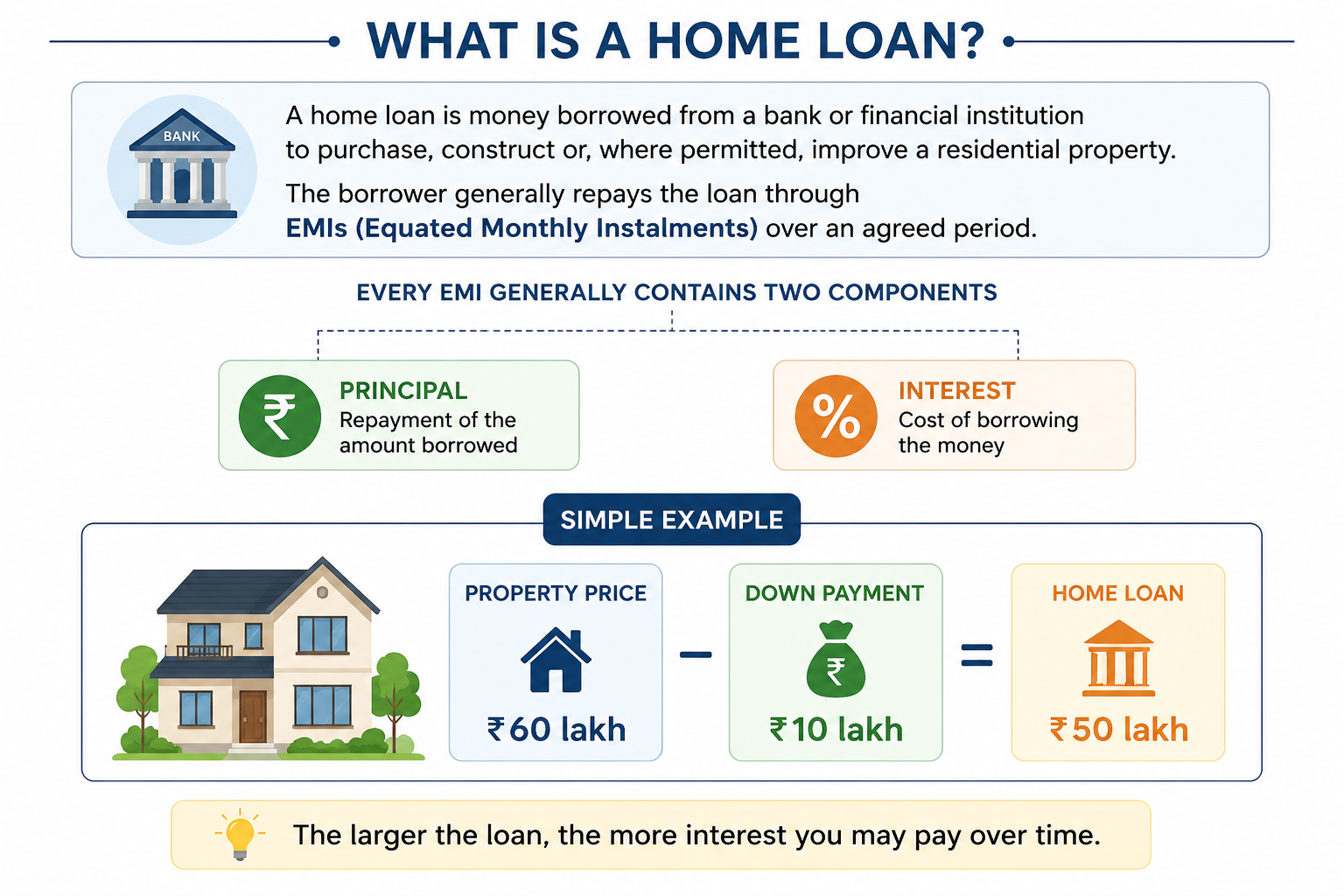
A home loan is money borrowed from a bank or financial institution to purchase, construct or, where permitted, improve a residential property.
The borrower generally repays the loan through EMIs (Equated Monthly Instalments) over an agreed period.
Every EMI generally contains two components:
- Principal — repayment of the amount borrowed
- Interest — cost of borrowing the money
Simple Example
Suppose you buy a house for ₹60 lakh and pay ₹10 lakh as your own contribution.
Your home loan may be:
Property Price → ₹60 lakh
Down Payment → ₹10 lakh
Home Loan → ₹50 lakh
The larger the loan, the more interest you may pay over time.
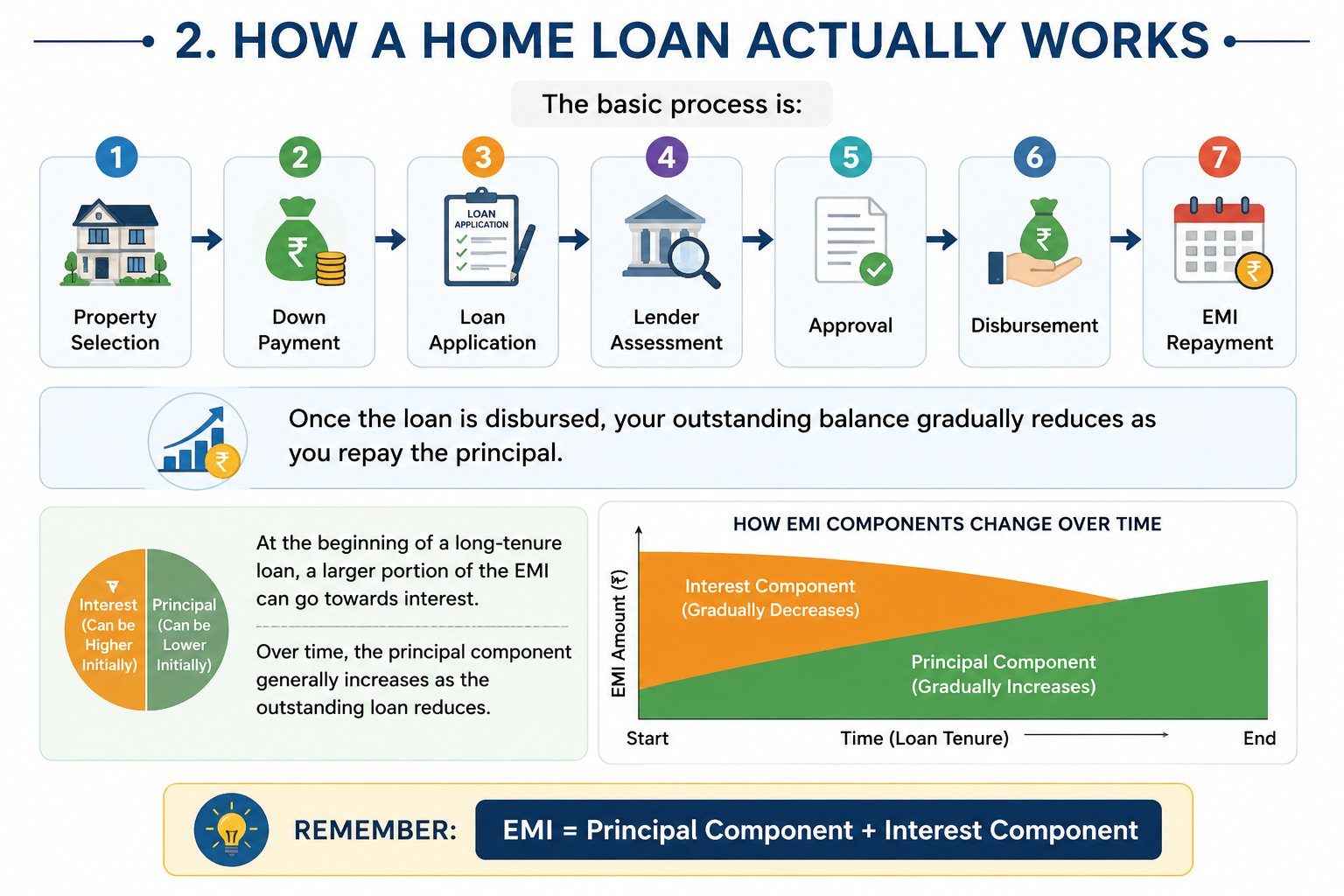
2. How a Home Loan Actually Works
The basic process is:
Property Selection → Down Payment → Loan Application → Lender Assessment → Approval → Disbursement → EMI Repayment
Once the loan is disbursed, your outstanding balance gradually reduces as you repay the principal.
At the beginning of a long-tenure loan, a larger portion of the EMI can go towards interest. Over time, the principal component generally increases as the outstanding loan reduces.
Remember:
EMI = Principal Component + Interest Component
3. How Much Home Loan Can You Afford?
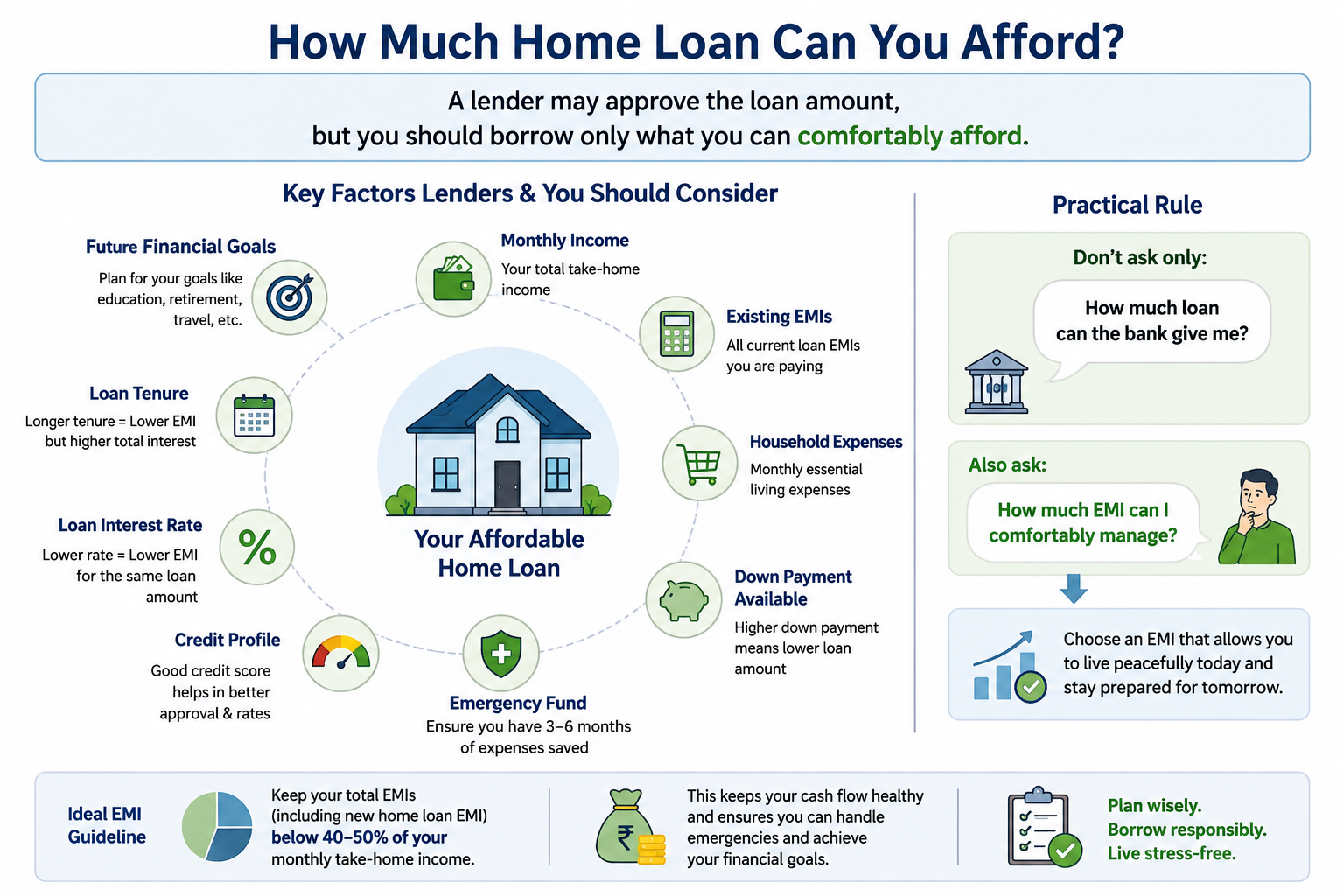
The amount a lender is willing to approve and the amount you can comfortably afford are not necessarily the same.
Consider:
- Monthly income
- Existing EMIs
- Household expenses
- Down payment available
- Emergency fund
- Credit profile
- Loan interest rate
- Loan tenure
- Future financial goals
Practical Rule
Don’t ask only:
“How much loan can the bank give me?”
Also ask:
“How much EMI can I comfortably manage?”
A home loan should not leave your monthly cash flow so tight that you cannot handle emergencies or other financial goals.
4. Down Payment — How Much Should You Pay?
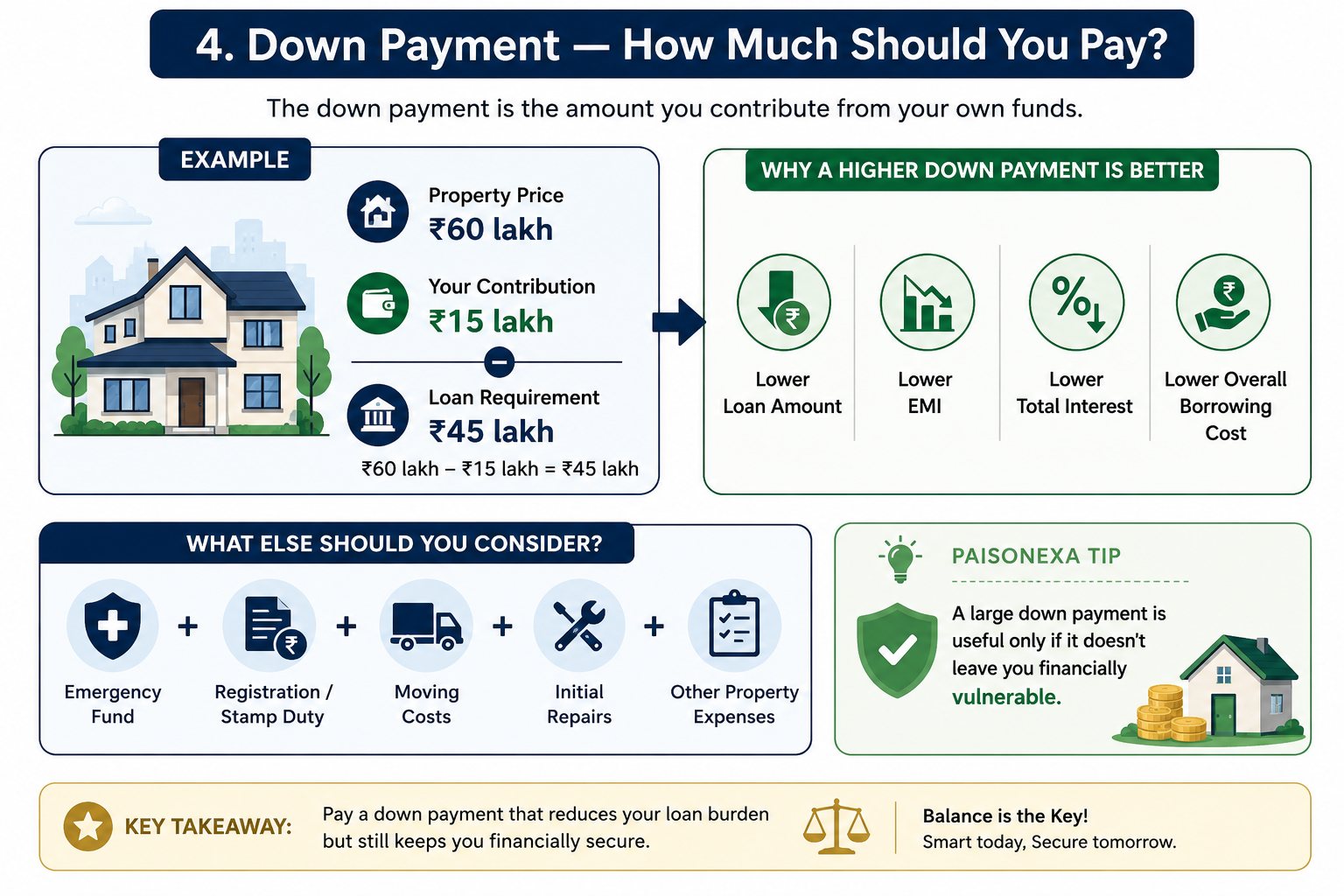
The down payment is the amount you contribute from your own funds.
Example
Property Price = ₹60 lakh
If you contribute:
₹15 lakh
Then the loan requirement becomes:
₹60 lakh − ₹15 lakh = ₹45 lakh
A larger down payment generally means:
- Lower loan amount
- Lower EMI
- Lower total interest
- Lower overall borrowing cost
But don’t use every rupee of your savings for the down payment.
You should also consider:
Emergency Fund + Registration/Stamp Duty + Moving Costs + Initial Repairs + Other Property Expenses
A large down payment is useful only if it doesn’t leave you financially vulnerable.
figure style=”margin:30px auto; width:100%; max-width:1000px; text-align:center;”>
5. EMI Explained With a Real Calculation
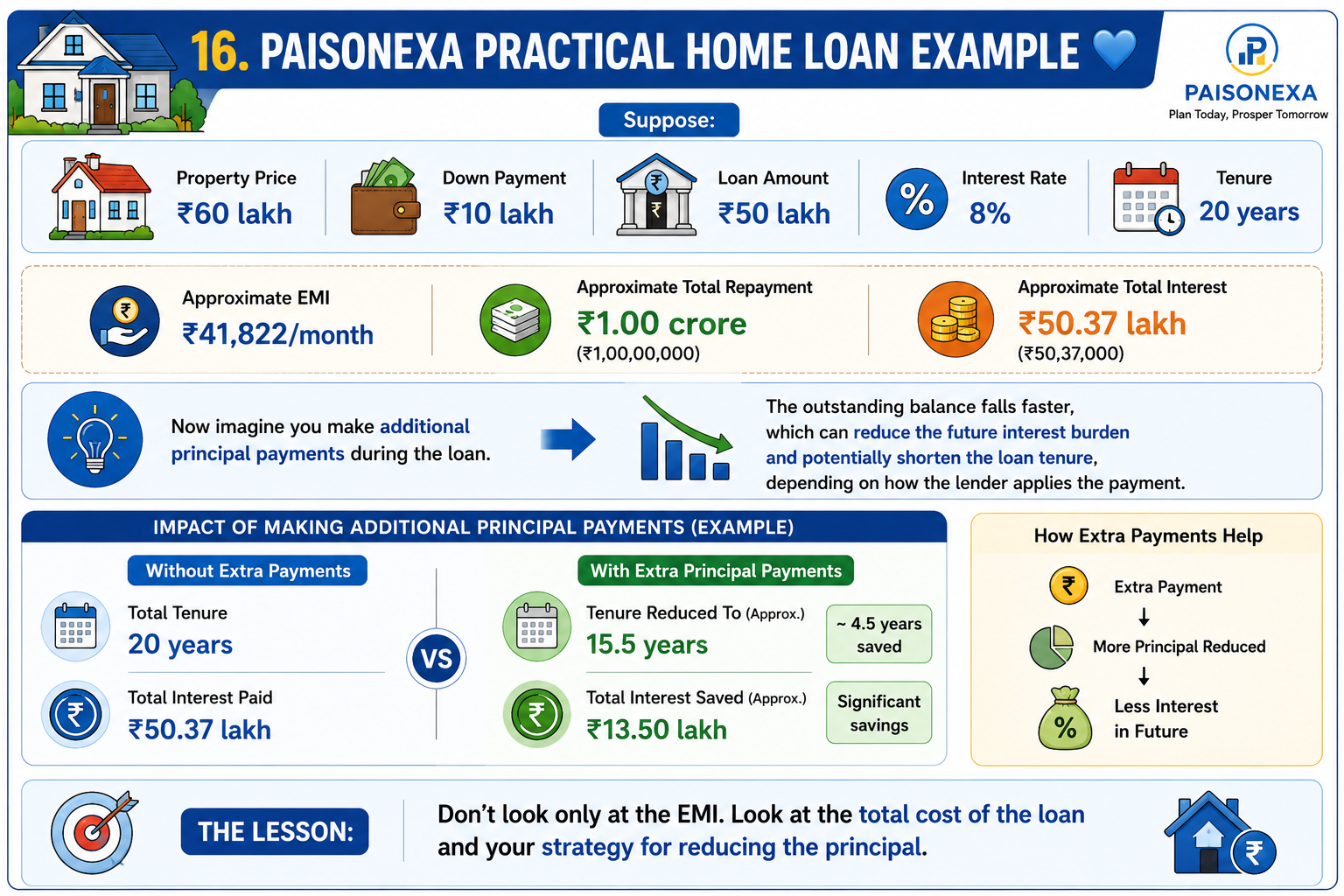
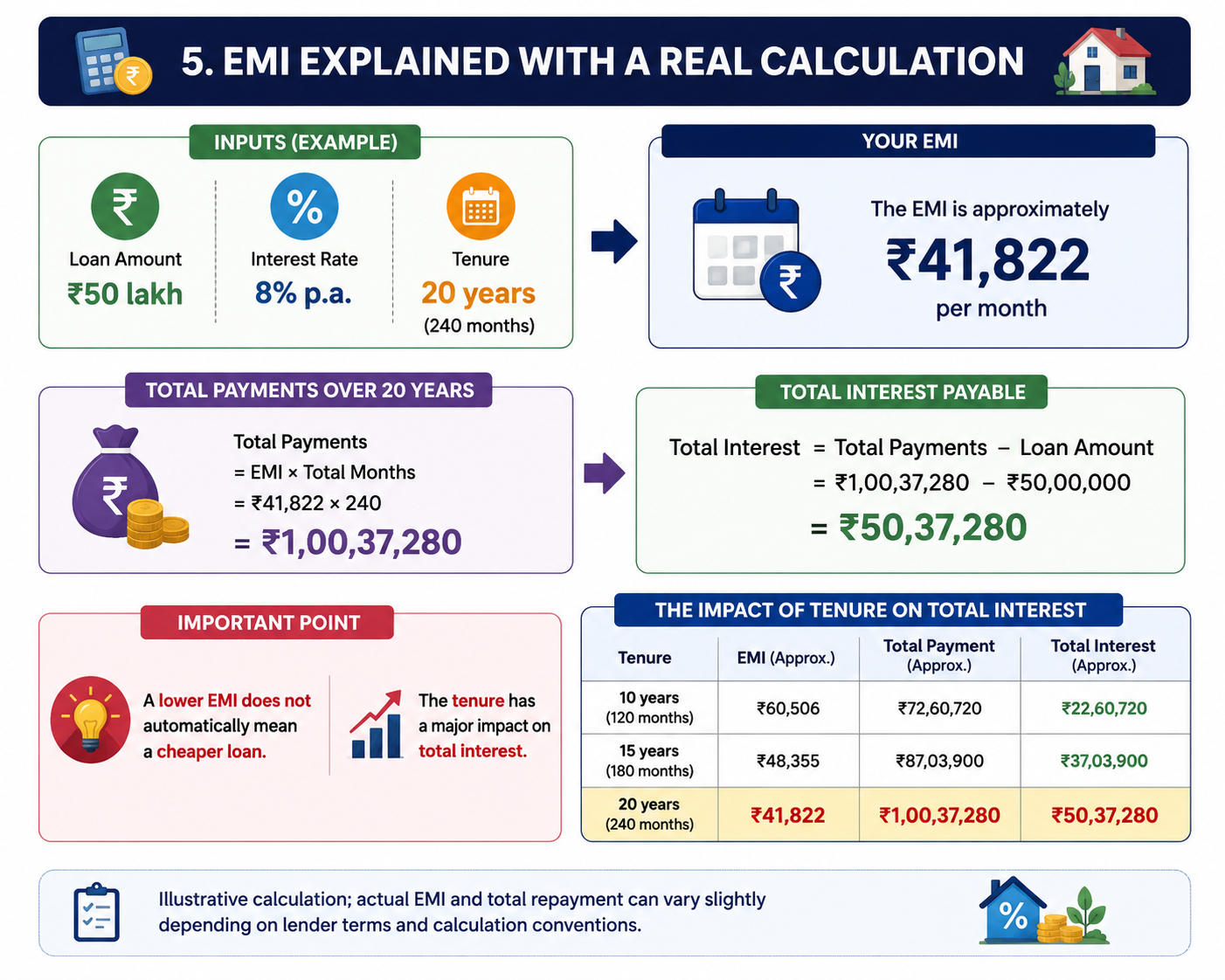
Suppose:
Loan Amount = ₹50 lakh
Interest Rate = 8% p.a.
Tenure = 20 years
The EMI is approximately ₹41,822 per month.
Over 20 years, the total payments would be approximately:
₹41,822 × 240 = ₹1,00,37,280
So the approximate total interest would be:
₹1,00,37,280 − ₹50,00,000 = ₹50,37,280
This shows an important point:
A lower EMI does not automatically mean a cheaper loan.
The tenure has a major impact on total interest.
Illustrative calculation; actual EMI and total repayment can vary slightly depending on lender terms and calculation conventions.
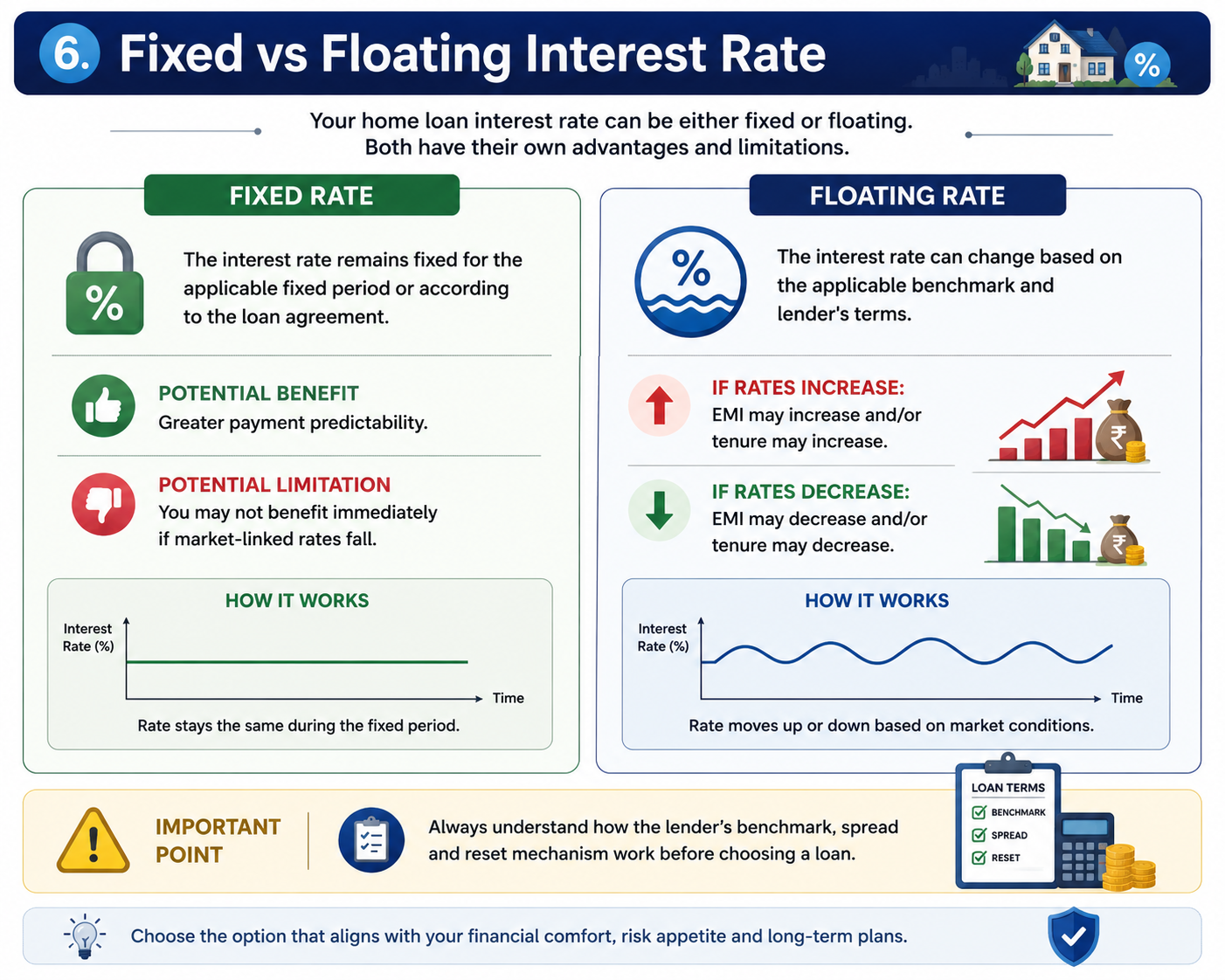
6. Fixed vs Floating Interest Rate
Fixed Rate
The interest rate remains fixed for the applicable fixed period or according to the loan agreement.
Potential benefit:
Greater payment predictability.
Potential limitation:
You may not benefit immediately if market-linked rates fall.
Floating Rate
The interest rate can change based on the applicable benchmark and lender’s terms.
If rates increase:
EMI may increase and/or tenure may increase.
If rates decrease:
EMI may decrease and/or tenure may decrease.
Always understand how the lender’s benchmark, spread and reset mechanism work before choosing a loan.
7. Home Loan Tenure — 10, 20 or 30 Years?
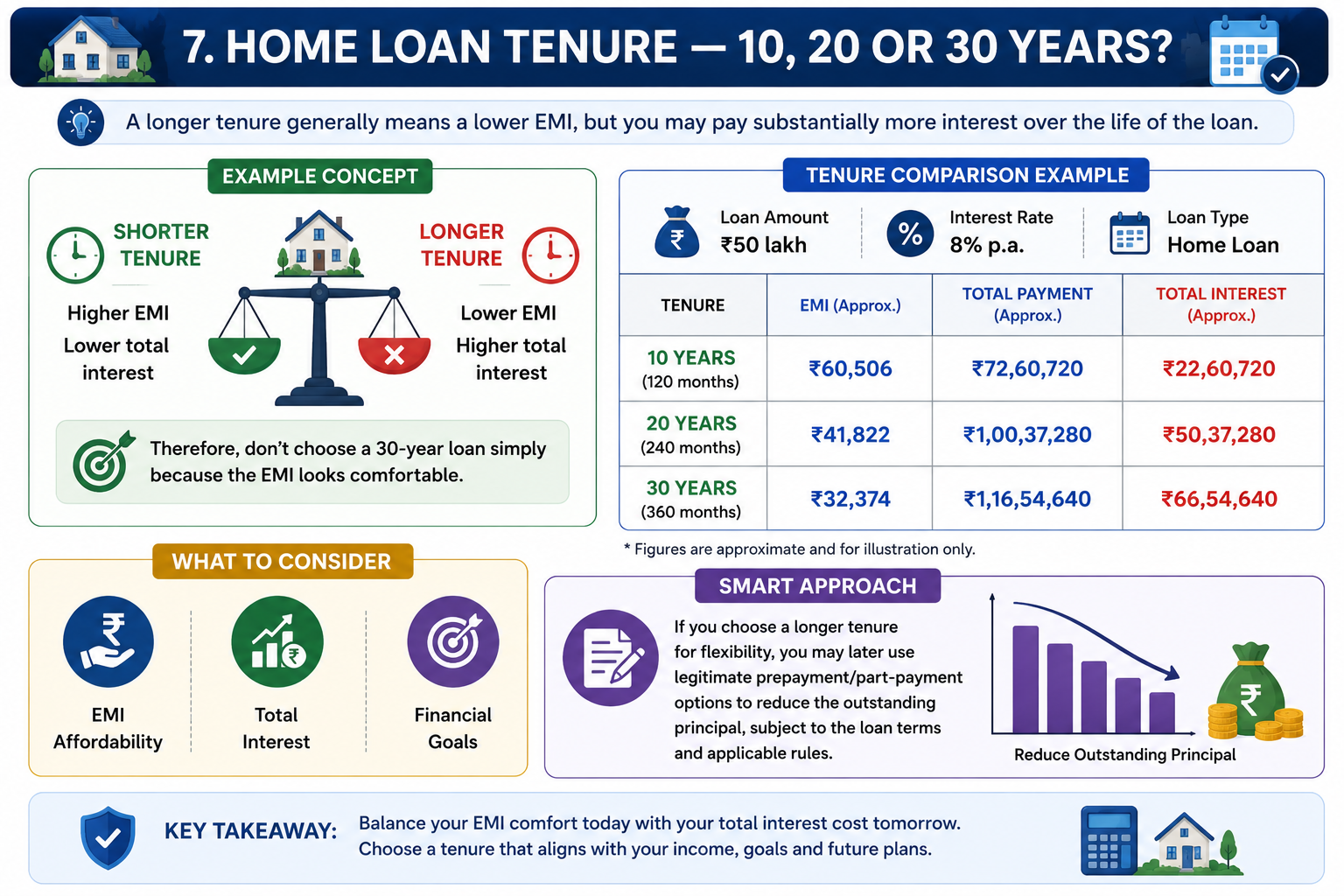
A longer tenure generally means a lower EMI, but you may pay substantially more interest over the life of the loan.
Example Concept
Shorter Tenure
Higher EMI → Lower total interest
Longer Tenure
Lower EMI → Higher total interest
Therefore, don’t choose a 30-year loan simply because the EMI looks comfortable.
Consider:
EMI affordability + Total Interest + Financial Goals
Smart Approach
If you choose a longer tenure for flexibility, you may later use legitimate prepayment/part-payment options to reduce the outstanding principal, subject to the loan terms and applicable rules.
8. Prepayment & Part-Payment — How to Reduce Interest
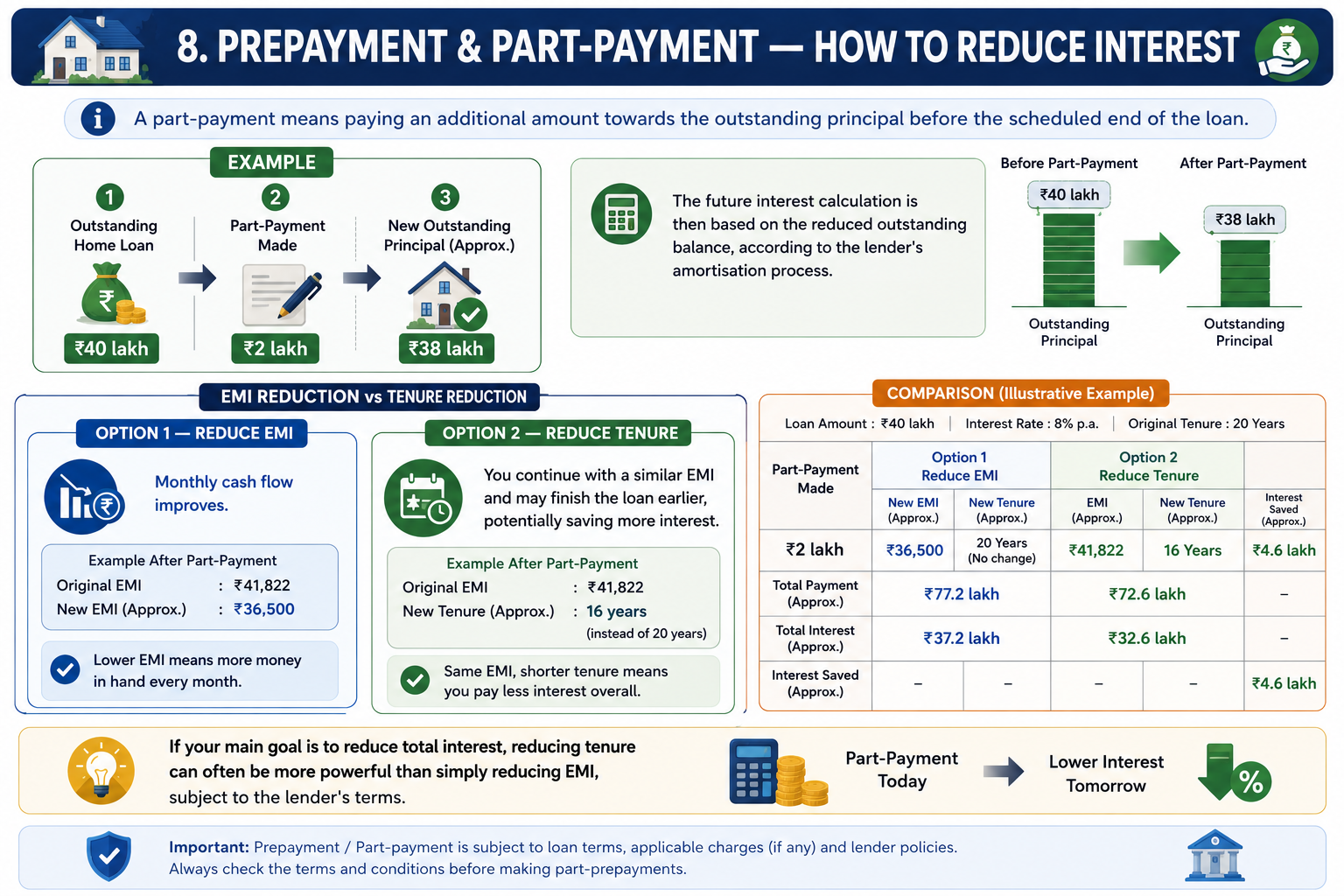
A part-payment means paying an additional amount towards the outstanding principal before the scheduled end of the loan.
Example
Suppose your outstanding home loan is:
₹40 lakh
You make a part-payment of:
₹2 lakh
Your outstanding principal may reduce to approximately:
₹38 lakh
The future interest calculation is then based on the reduced outstanding balance, according to the lender’s amortisation process.
EMI Reduction vs Tenure Reduction
After a part-payment, lenders may provide options depending on the loan terms.
Option 1 — Reduce EMI
Monthly cash flow improves.
Option 2 — Reduce Tenure
You continue with a similar EMI and may finish the loan earlier, potentially saving more interest.
If your main goal is to reduce total interest, reducing tenure can often be more powerful than simply reducing EMI, subject to the lender’s terms.
9. Home Loan Charges You Should Know
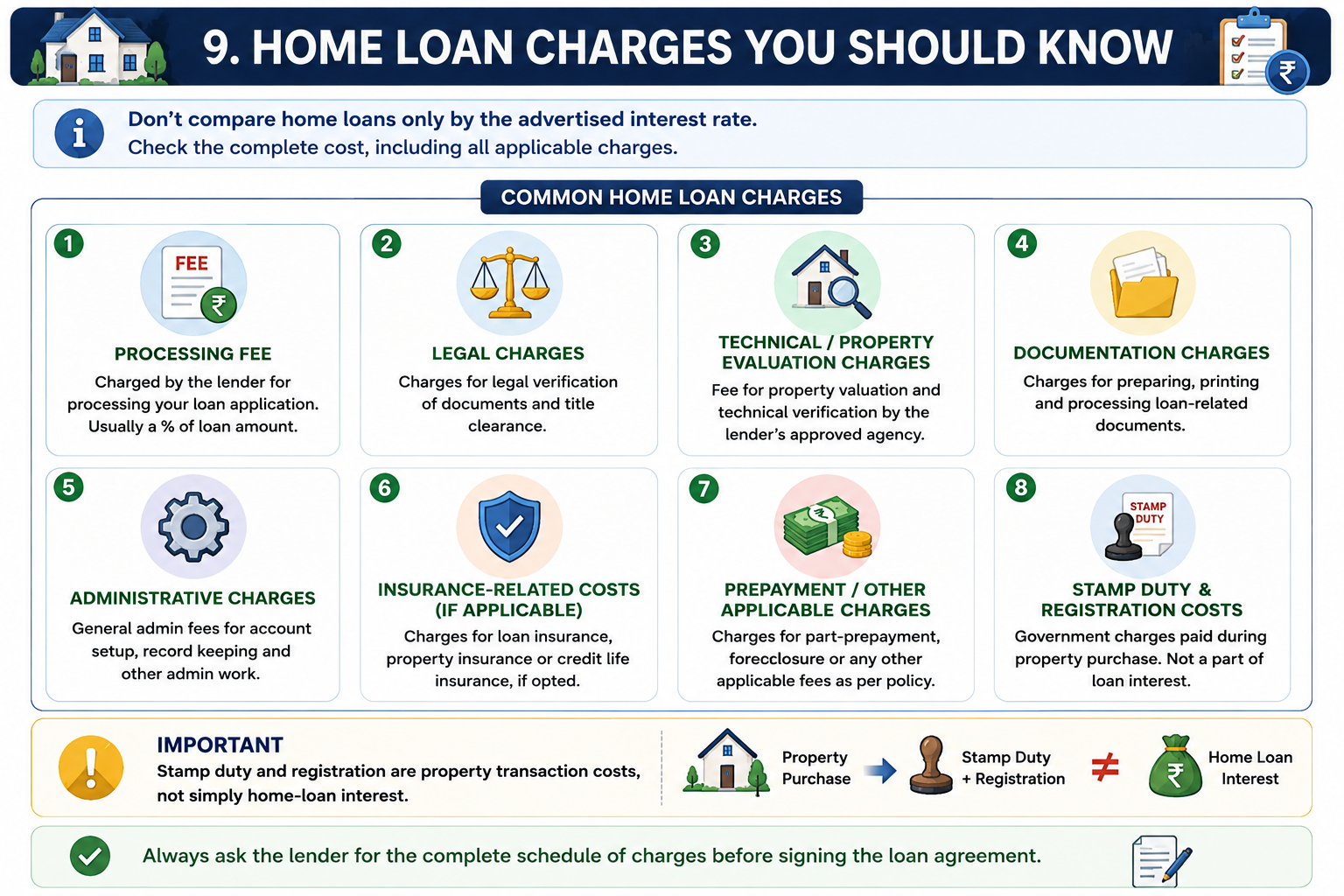
Don’t compare home loans only by the advertised interest rate.
Check the complete cost, including applicable:
- Processing fee
- Legal charges
- Technical/property evaluation charges
- Documentation charges
- Administrative charges
- Insurance-related costs, if applicable
- Prepayment/other applicable charges
- Stamp duty and registration costs related to the property
Important
Stamp duty and registration are property transaction costs, not simply home-loan interest.
Always ask the lender for the complete schedule of charges before signing.
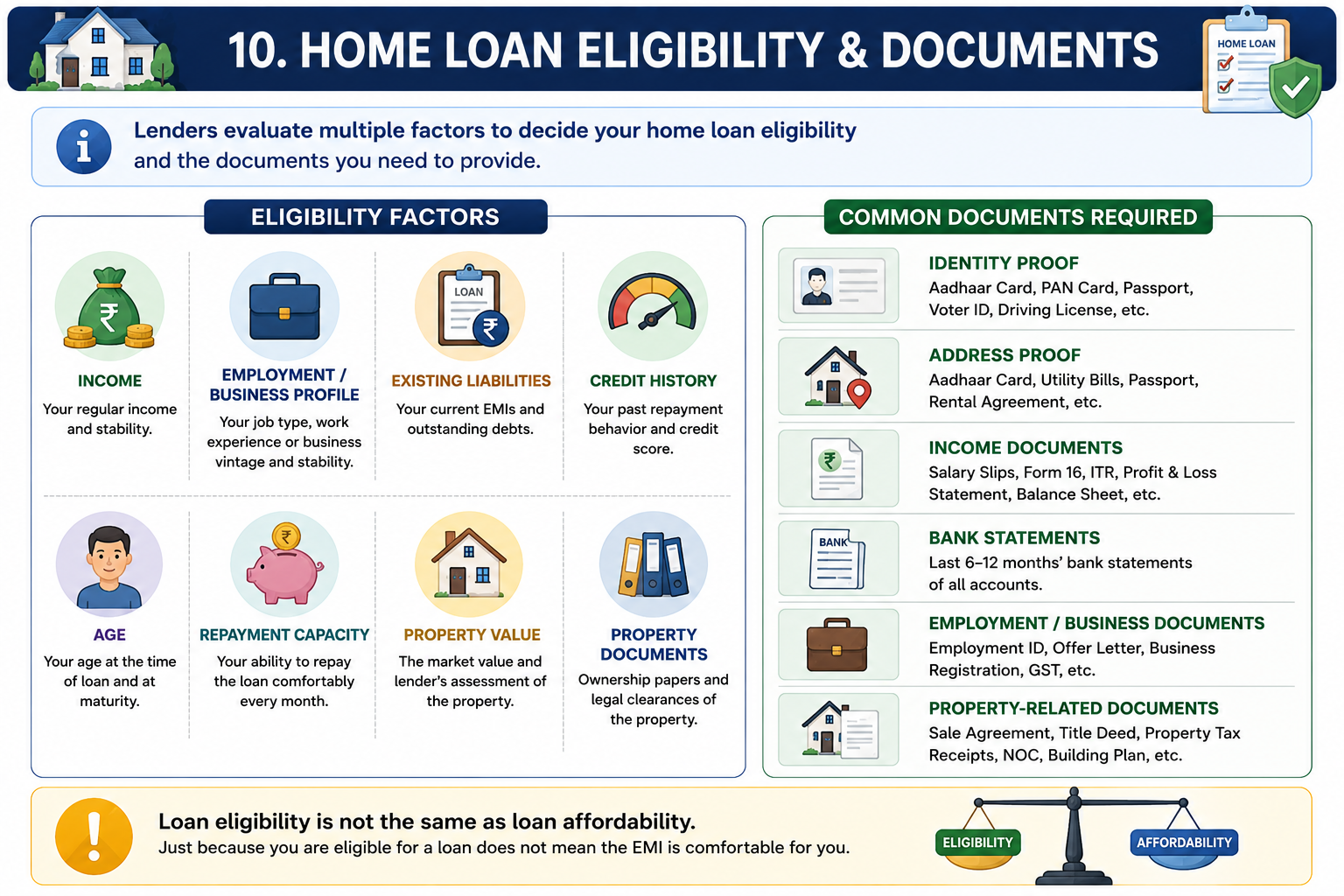
10. Home Loan Eligibility & Documents
Lenders generally assess factors such as:
- Income
- Employment/business profile
- Existing liabilities
- Credit history
- Age
- Repayment capacity
- Property value
- Property documents
Common documents may include:
- Identity proof
- Address proof
- Income documents
- Bank statements
- Employment/business documents
- Property-related documents
The exact requirements vary by lender and borrower profile.
Loan eligibility is not the same as loan affordability.
11. Credit Score & Home Loan
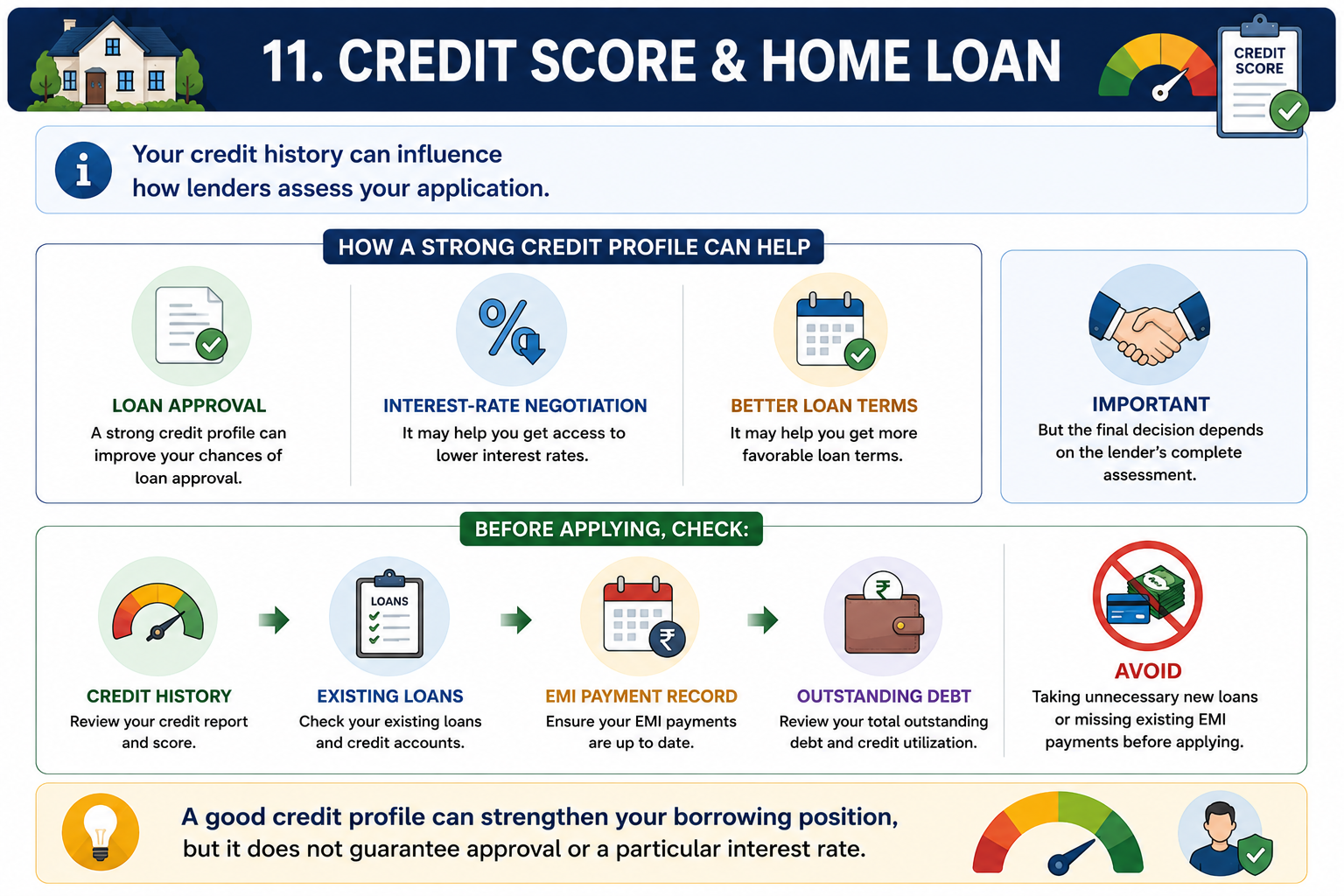
Your credit history can influence how lenders assess your application.
A strong credit profile can potentially help with:
- Loan approval
- Interest-rate negotiation
- Loan terms
But the final decision depends on the lender’s complete assessment.
Before Applying
Check:
Credit history → Existing loans → EMI payment record → Outstanding debt
Avoid taking unnecessary new loans or missing existing EMI payments before applying.
A good credit profile can strengthen your borrowing position, but it does not guarantee approval or a particular interest rate.
12. Home Loan Tax Benefits
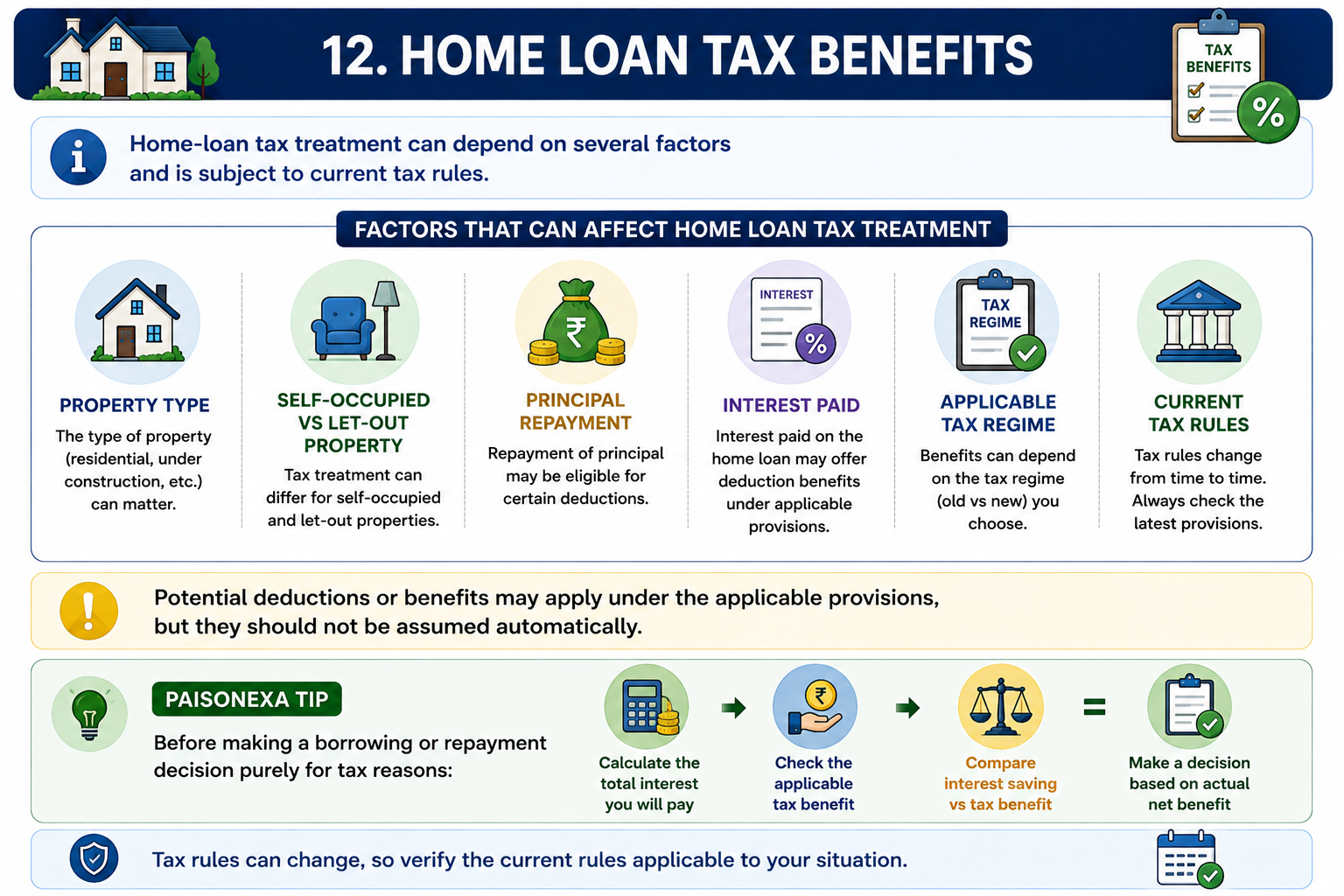
Home-loan tax treatment can depend on factors such as:
- Property type
- Self-occupied vs let-out property
- Principal repayment
- Interest paid
- Applicable tax regime
- Current tax rules
Potential deductions or benefits may apply under the applicable provisions, but they should not be assumed automatically.
Paisonexa Tip
Before making a borrowing or repayment decision purely for tax reasons:
Compare the actual interest saving with the applicable tax benefit.
Tax rules can change, so verify the current rules applicable to your situation.
13. What Happens If Interest Rates Change?
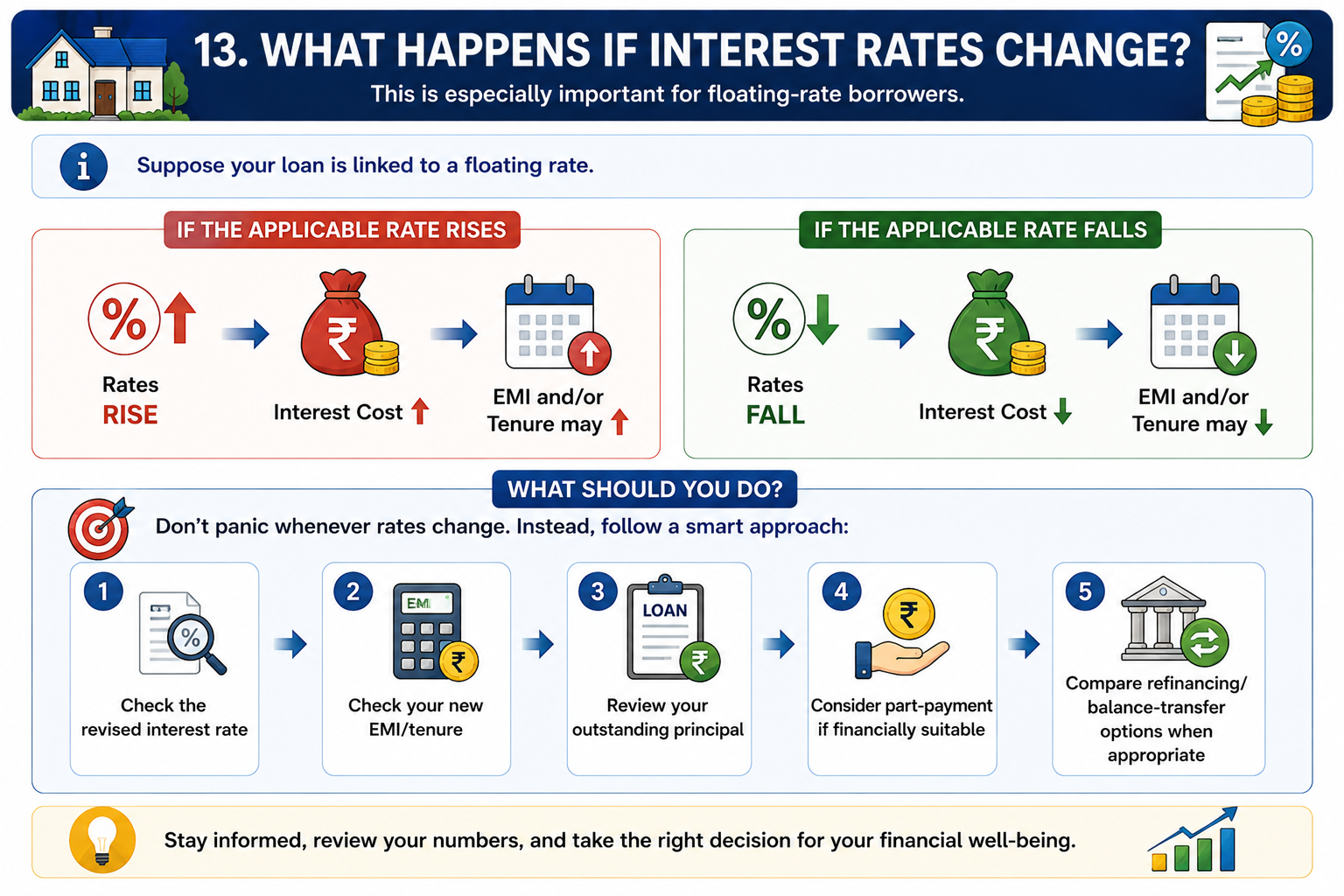
This is especially important for floating-rate borrowers.
Suppose your loan is linked to a floating rate.
If the applicable rate rises:
Interest Cost ↑ → EMI and/or Tenure may ↑
If the applicable rate falls:
Interest Cost ↓ → EMI and/or Tenure may ↓
What Should You Do?
Don’t panic whenever rates change.
Instead:
- Check the revised interest rate
- Check your new EMI/tenure
- Review your outstanding principal
- Consider part-payment if financially suitable
- Compare refinancing/balance-transfer options when appropriate
14. Balance Transfer — When Does It Make Sense?
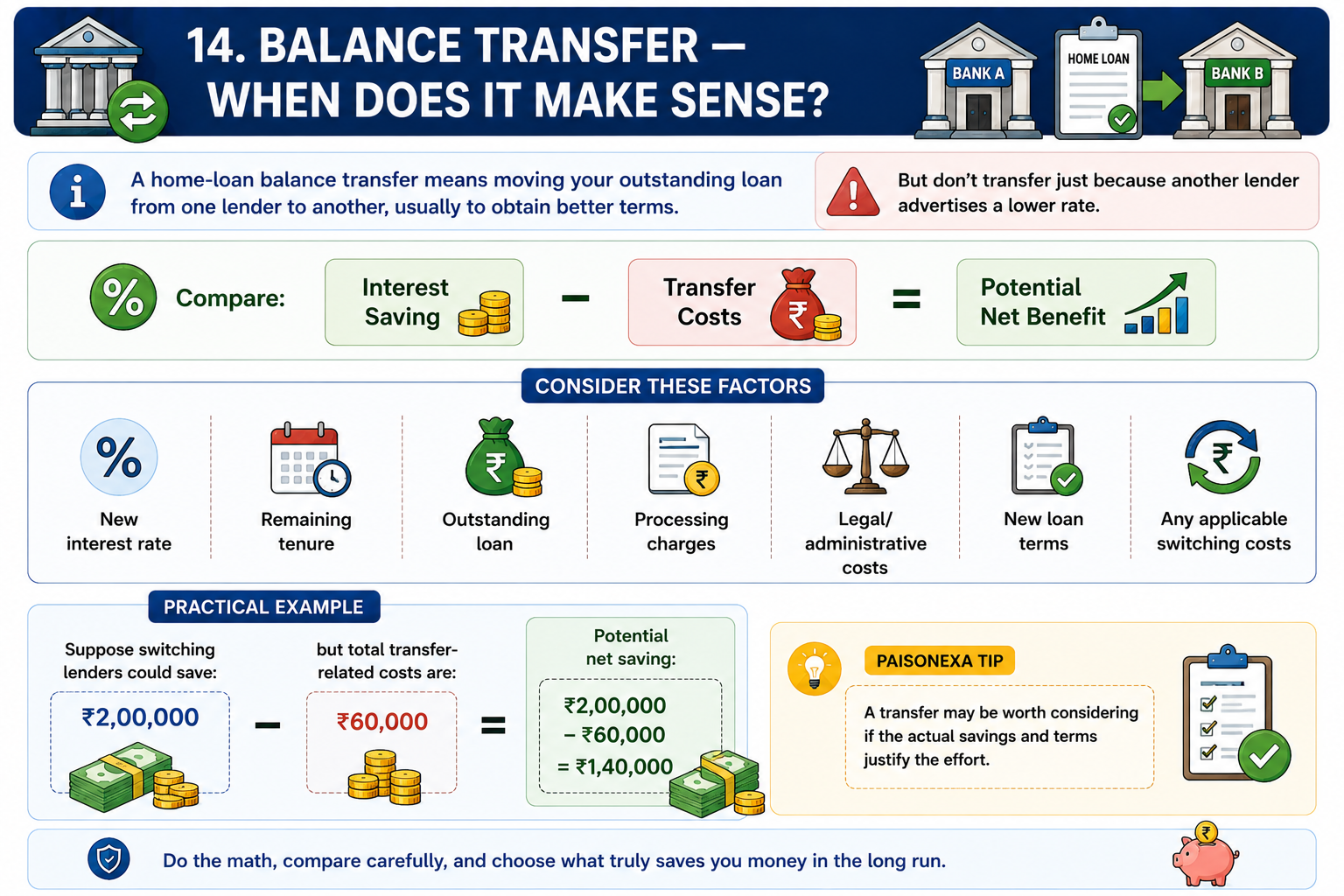
A home-loan balance transfer means moving your outstanding loan from one lender to another, usually to obtain better terms.
But don’t transfer just because another lender advertises a lower rate.
Compare:
Interest Saving − Transfer Costs = Potential Net Benefit
Consider:
- New interest rate
- Remaining tenure
- Outstanding loan
- Processing charges
- Legal/administrative costs
- New loan terms
- Any applicable switching costs
Practical Example
Suppose switching lenders could save:
₹2,00,000
but total transfer-related costs are:
₹60,000
Potential net saving:
₹2,00,000 − ₹60,000 = ₹1,40,000
A transfer may be worth considering if the actual savings and terms justify the effort
div style=”width:100%; max-width:1000px; margin:30px auto; text-align:center;”>