1. What Is Asset Allocation?
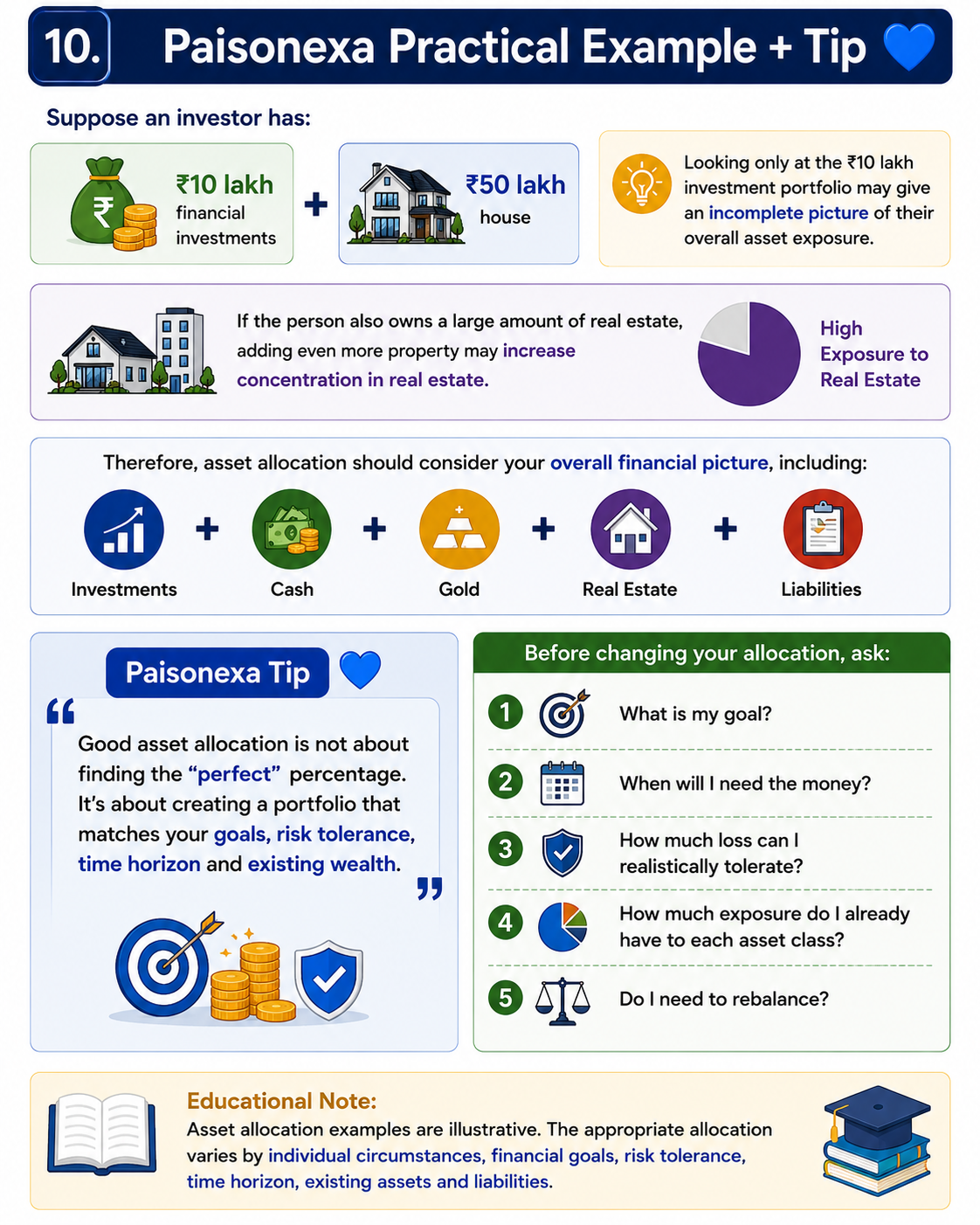
Asset allocation means deciding how your money will be distributed across different types of assets based on your financial goals, risk tolerance and investment time horizon.
The main asset classes include:
- Equity — Stocks and Equity Mutual Funds
- Debt / Fixed Income — Bonds, Fixed Deposits and other debt instruments
- Gold — Physical Gold, Gold ETFs and other gold investments
- Cash / Cash Equivalents — Savings and highly liquid investments
- Real Estate — House, land and investment property
Simple Example
Suppose you have ₹10 lakh available for long-term financial planning.
Instead of putting the entire ₹10 lakh into stocks, you may divide it across different asset classes.
For example:
Equity → ₹5 lakh
Debt → ₹2 lakh
Gold → ₹1 lakh
Cash → ₹1 lakh
Real Estate → ₹1 lakh
This is an example only. The right allocation depends on the individual investor.
Asset allocation is about deciding where your money should work — not simply choosing individual investments.
2. Why Is Asset Allocation Important?
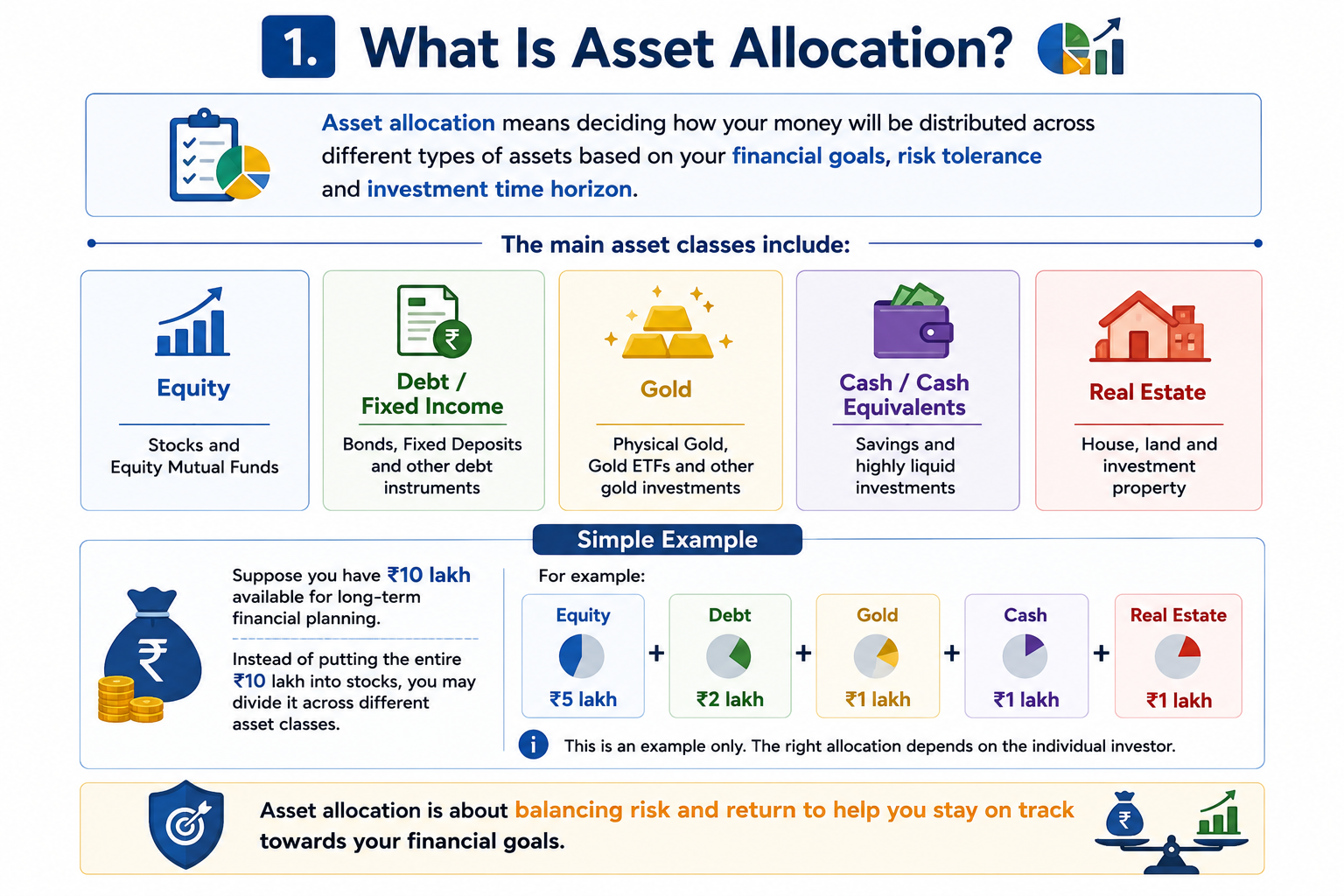
Different assets behave differently.
Stocks may provide higher long-term growth potential but can experience significant short-term volatility.
Debt investments may provide more predictable income and generally lower volatility than equities, depending on the product and issuer.
Gold can provide diversification and may behave differently from stocks during some market conditions.
Cash provides liquidity for short-term needs.
Real estate can provide potential rental income and long-term appreciation, but it can also require significant capital and may be difficult to sell quickly.
Because different assets have different characteristics, spreading investments can help manage overall portfolio risk.
Key Idea
Don’t put all your financial eggs in one basket.
3. The Five Major Asset Classes
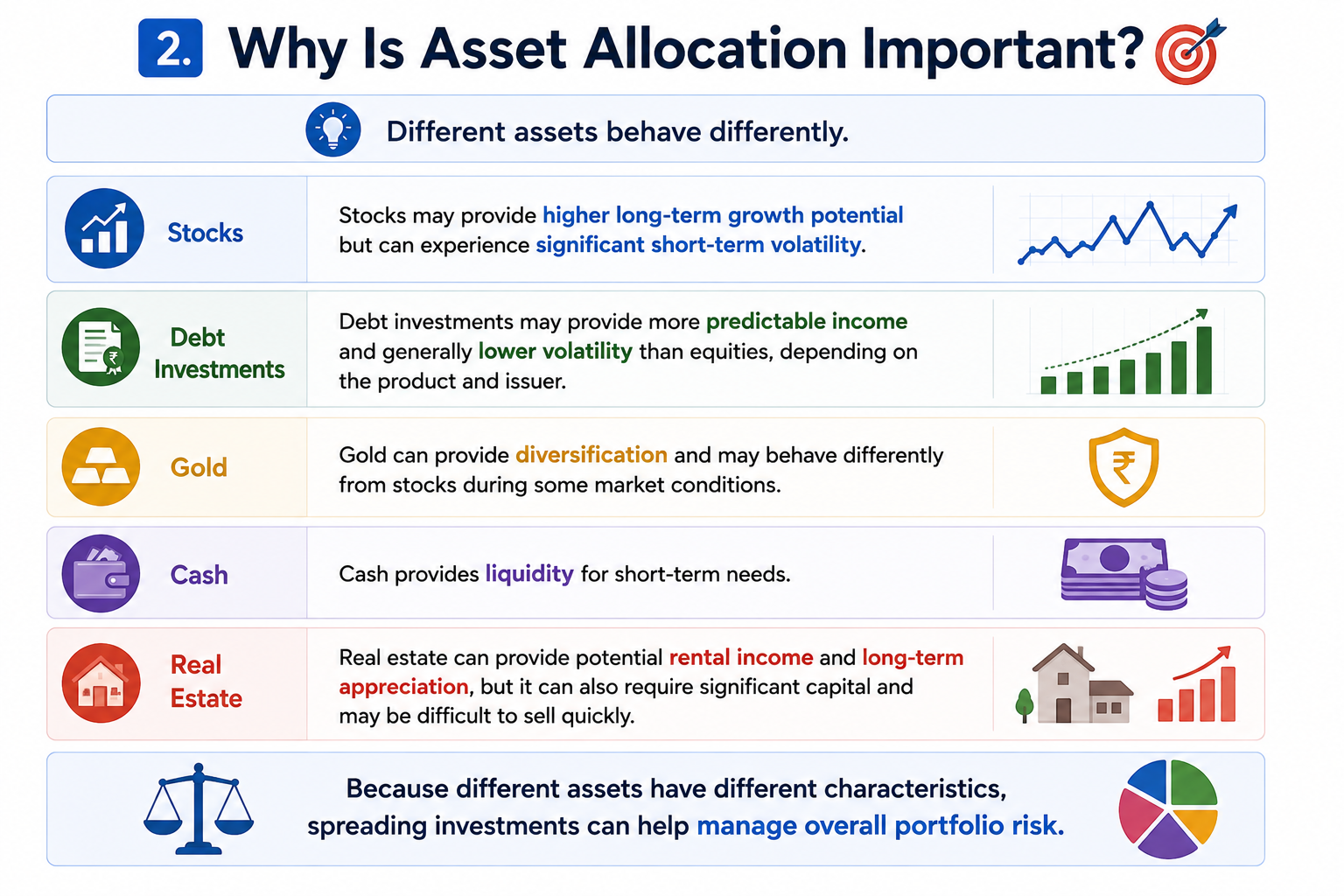
1. Equity
Includes:
- Stocks
- Equity Mutual Funds
- Equity ETFs
Main purpose: Long-term growth
Risk: Generally higher
Suitable for: Investors who can tolerate market fluctuations and have a longer investment horizon.
2. Debt / Fixed Income
Includes:
- Bonds
- Fixed Deposits
- Government securities
- Other fixed-income instruments
Main purpose: Income and relative stability
Risk: Varies by issuer, product and maturity
Suitable for: Investors seeking more predictable cash flows or lower portfolio volatility.
3. Gold
Includes:
- Physical Gold
- Gold ETFs
- Other regulated gold investment products
Main purpose: Diversification and potential hedge against certain economic risks
Risk: Gold prices can fluctuate.
Suitable for: Investors looking to diversify beyond traditional financial assets.
4. Cash / Cash Equivalents
Includes:
- Savings account balances
- Highly liquid short-term investments
Main purpose: Liquidity and emergency needs
Risk: Low market volatility, but inflation can reduce purchasing power over time.
Suitable for: Short-term needs and emergency reserves.
5. Real Estate
Includes:
- Residential property
- Commercial property
- Land
- Investment property
Main purpose: Potential long-term appreciation and rental income
Risk: Property prices can fall, and real estate can be difficult to sell quickly.
Important distinction:
A self-occupied house is primarily a personal-use asset.
An investment property is purchased mainly to generate rental income, appreciation or both.
Real estate can be part of your overall wealth allocation, but it should not automatically be treated the same way as a liquid investment portfolio.
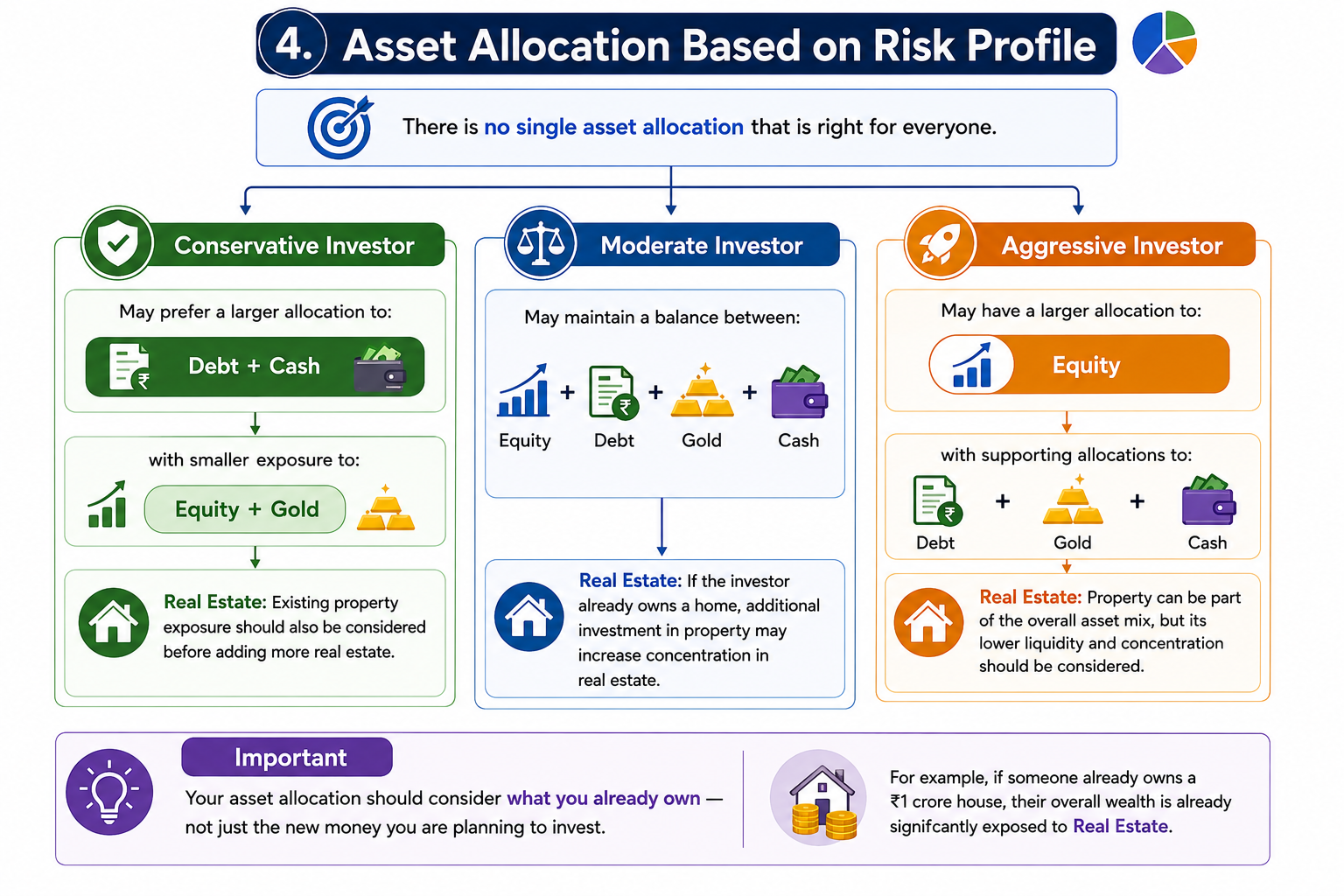
4. Asset Allocation Based on Risk Profile
There is no single asset allocation that is right for everyone.
Conservative Investor
May prefer a larger allocation to:
Debt + Cash
with smaller exposure to:
Equity + Gold
Real Estate: Existing property exposure should also be considered before adding more real estate.
Moderate Investor
May maintain a balance between:
Equity + Debt + Gold + Cash
Real Estate: If the investor already owns a home, additional investment in property may increase concentration in real estate.
Aggressive Investor
May have a larger allocation to:
Equity
with supporting allocations to:
Debt + Gold + Cash
Real Estate: Property can be part of the overall asset mix, but its lower liquidity and concentration should be considered.
💡 Important
Your asset allocation should consider what you already own — not just the new money you are planning to invest.
For example, if someone already owns a ₹1 crore house, their overall wealth is already significantly exposed to Real Estate.
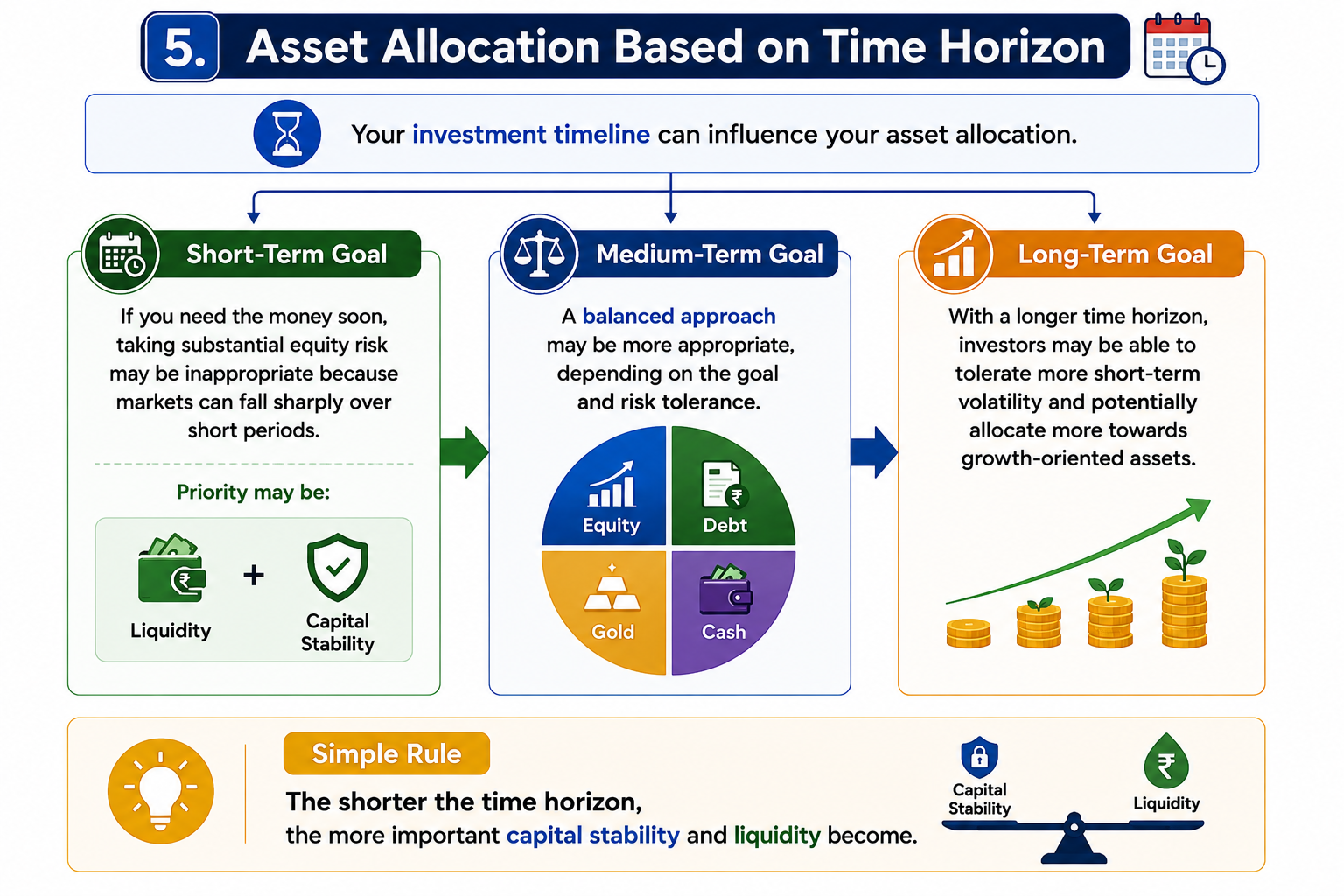
5. Asset Allocation Based on Time Horizon
Your investment timeline can influence your asset allocation.
Short-Term Goal
If you need the money soon, taking substantial equity risk may be inappropriate because markets can fall sharply over short periods.
Priority may be:
Liquidity + Capital Stability
Medium-Term Goal
A balanced approach may be more appropriate, depending on the goal and risk tolerance.
Long-Term Goal
With a longer time horizon, investors may be able to tolerate more short-term volatility and potentially allocate more towards growth-oriented assets.
Simple Rule
The shorter the time horizon, the more important capital stability and liquidity become.
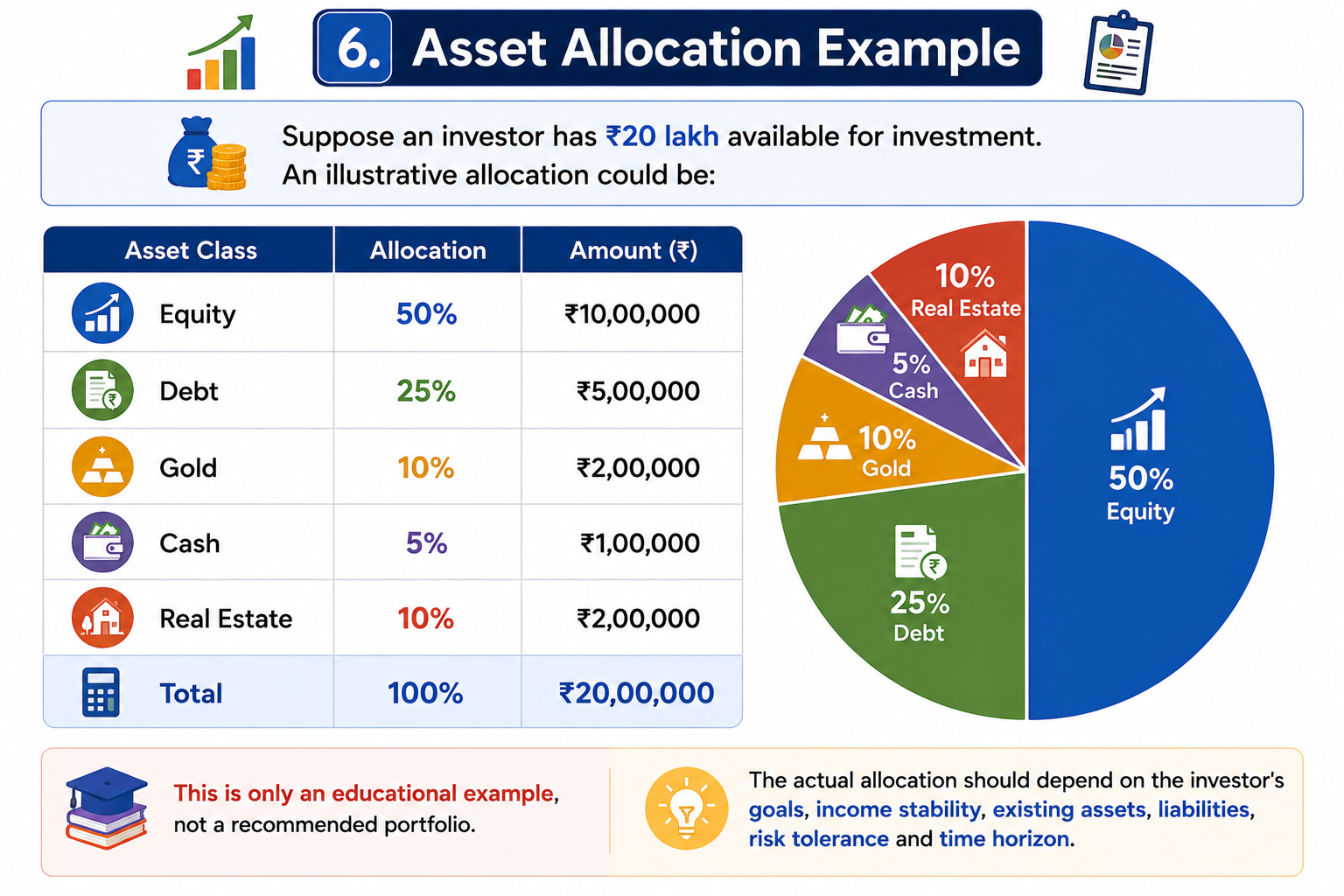
6. Asset Allocation Example
Suppose an investor has ₹20 lakh available for investment.
An illustrative allocation could be:
| Asset Class | Allocation | Amount |
|---|---|---|
| Equity | 50% | ₹10,00,000 |
| Debt | 25% | ₹5,00,000 |
| Gold | 10% | ₹2,00,000 |
| Cash | 5% | ₹1,00,000 |
| Real Estate | 10% | ₹2,00,000 |
| Total | 100% | ₹20,00,000 |
This is only an educational example, not a recommended portfolio.
The actual allocation should depend on the investor’s goals, income stability, existing assets, liabilities, risk tolerance and time horizon.
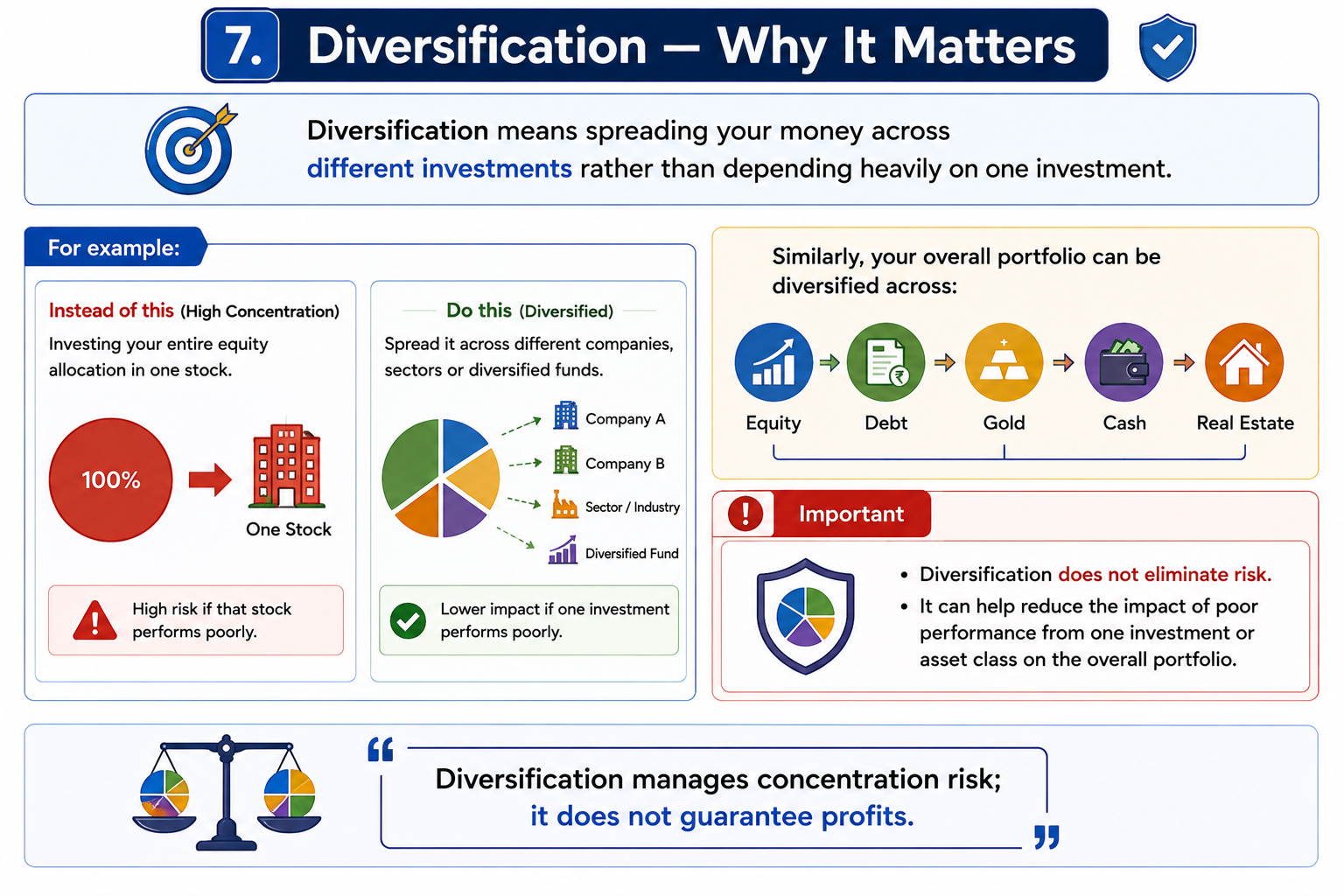
7. Diversification — Why It Matters
Diversification means spreading your money across different investments rather than depending heavily on one investment.
For example:
Instead of investing your entire equity allocation in one stock, you may spread it across different companies, sectors or diversified funds.
Similarly, your overall portfolio can be diversified across:
Equity → Debt → Gold → Cash → Real Estate
Important
Diversification does not eliminate risk.
It can help reduce the impact of poor performance from one investment or asset class on the overall portfolio.
Diversification manages concentration risk; it does not guarantee profits.
8. Rebalancing Your Portfolio
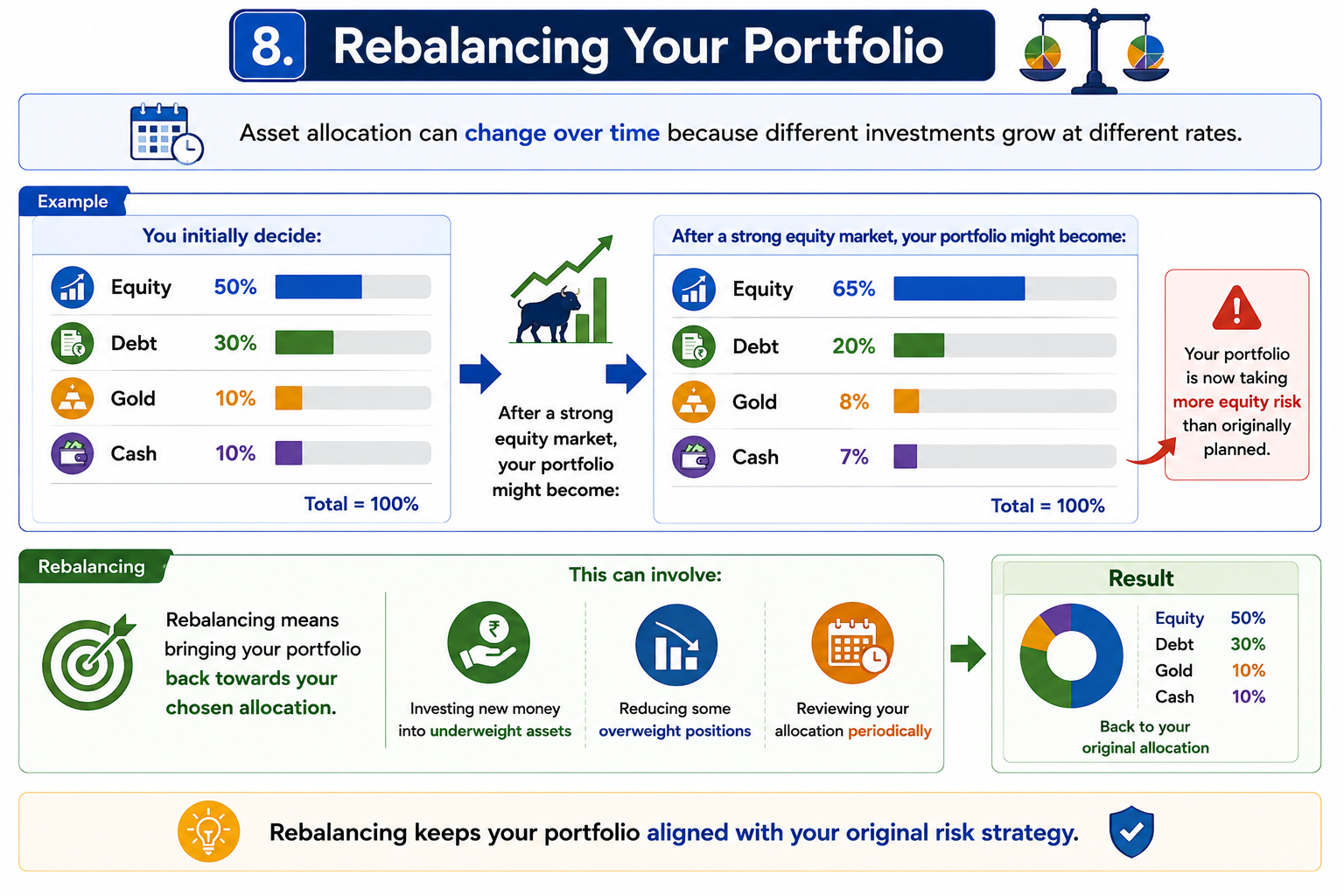
Asset allocation can change over time because different investments grow at different rates.
Example
You initially decide:
Equity = 50%
Debt = 30%
Gold = 10%
Cash = 10%
After a strong equity market, your portfolio might become:
Equity = 65%
Debt = 20%
Gold = 8%
Cash = 7%
Your portfolio is now taking more equity risk than originally planned.
Rebalancing
Rebalancing means bringing your portfolio back towards your chosen allocation.
This can involve:
- Investing new money into underweight assets
- Reducing some overweight positions
- Reviewing your allocation periodically
Rebalancing keeps your portfolio aligned with your original risk strategy.
9. Common Asset Allocation Mistakes
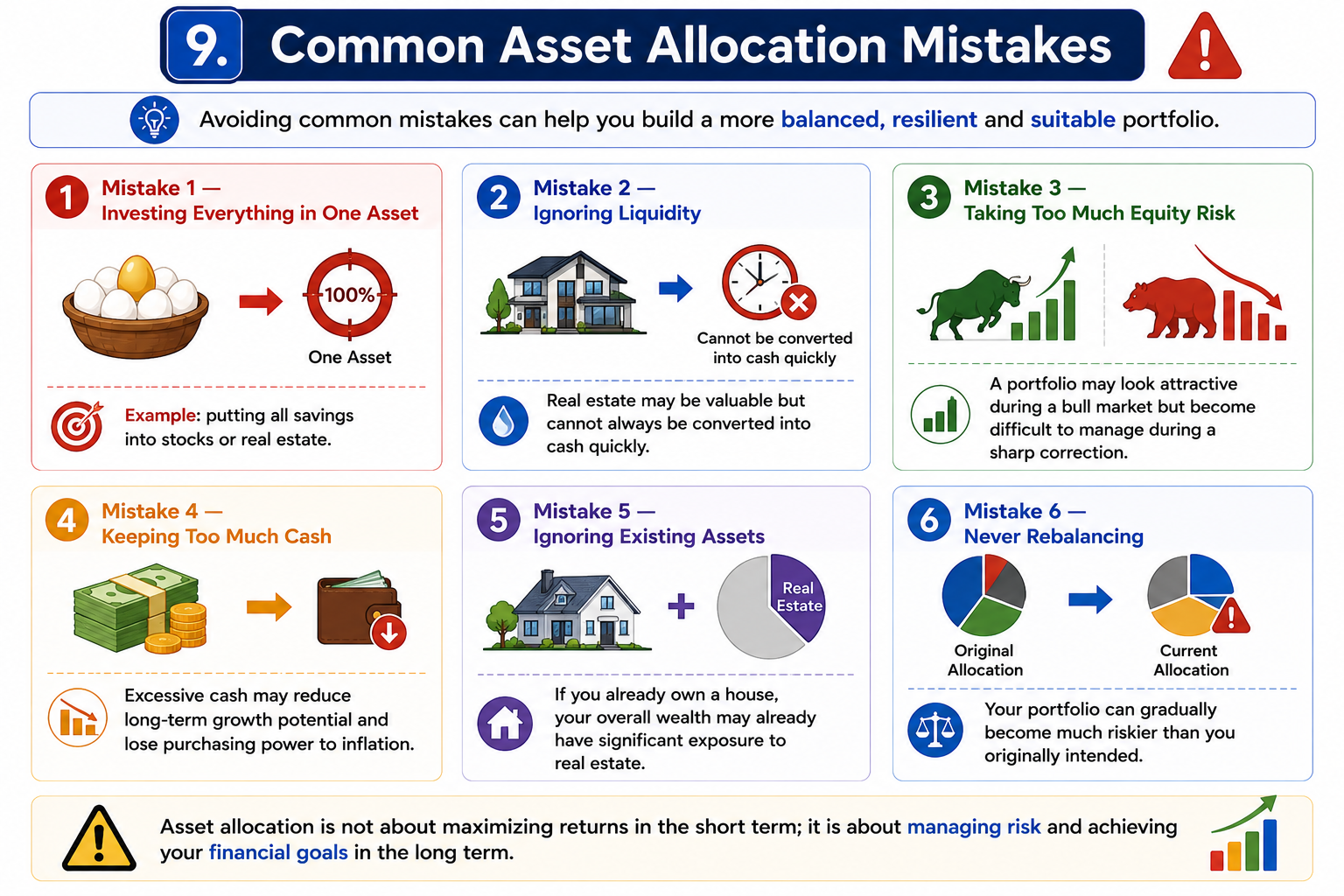
Mistake 1 — Investing Everything in One Asset
Example: putting all savings into stocks or real estate.
Mistake 2 — Ignoring Liquidity
Real estate may be valuable but cannot always be converted into cash quickly.
Mistake 3 — Taking Too Much Equity Risk
A portfolio may look attractive during a bull market but become difficult to manage during a sharp correction.
Mistake 4 — Keeping Too Much Cash
Excessive cash may reduce long-term growth potential and lose purchasing power to inflation.
Mistake 5 — Ignoring Existing Assets
If you already own a house, your overall wealth may already have significant exposure to real estate.
Mistake 6 — Never Rebalancing
Your portfolio can gradually become much riskier than you originally intended.
10. Paisonexa Practical Example + Tip 💙
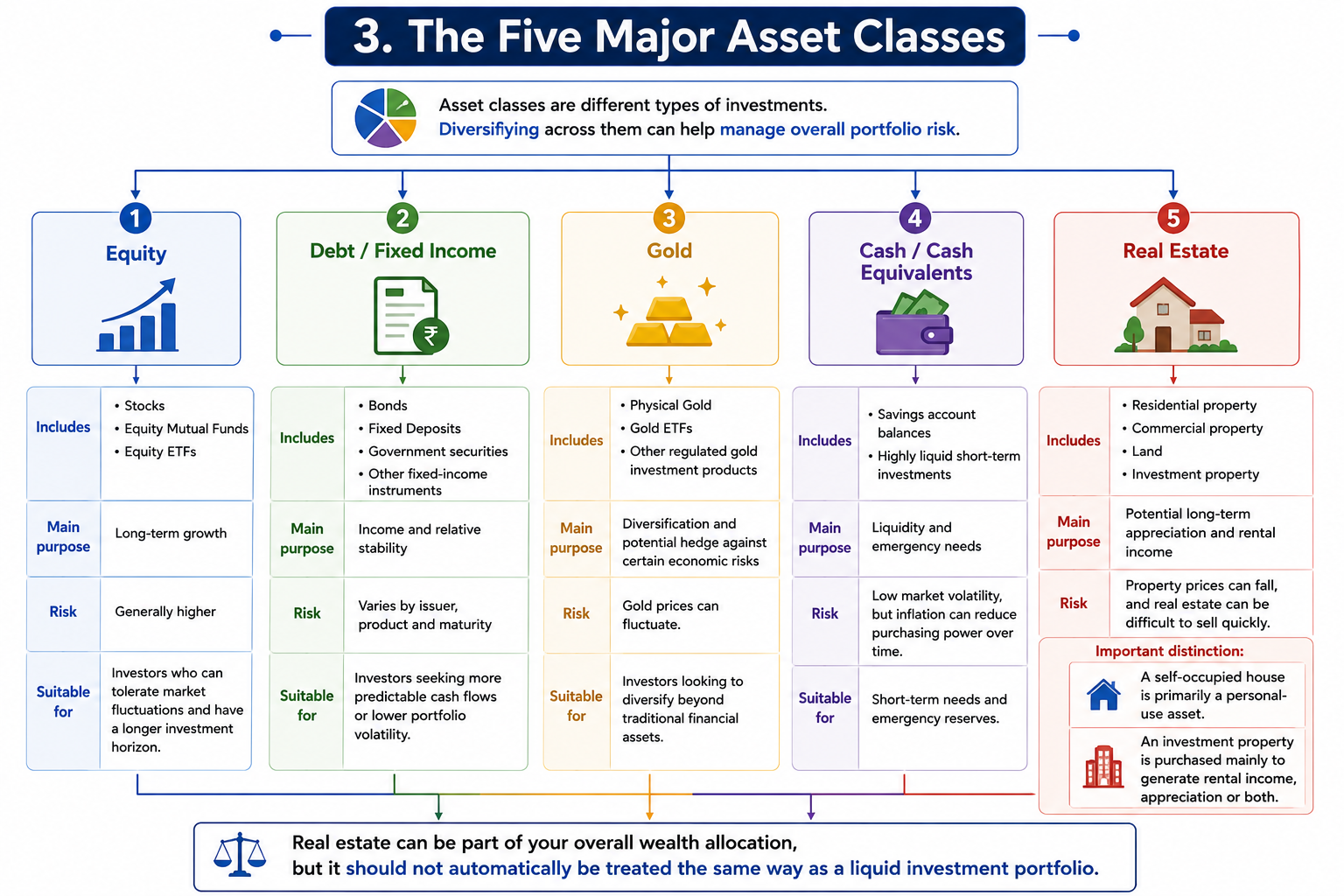
Suppose an investor has:
₹10 lakh financial investments + a ₹50 lakh house.
Looking only at the ₹10 lakh investment portfolio may give an incomplete picture of their overall asset exposure.
If the person also owns a large amount of real estate, adding even more property may increase concentration in real estate.
Therefore, asset allocation should consider your overall financial picture, including:
Investments + Cash + Gold + Real Estate + Liabilities
Paisonexa Tip 💙
Good asset allocation is not about finding the “perfect” percentage. It’s about creating a portfolio that matches your goals, risk tolerance, time horizon and existing wealth.
Before changing your allocation, ask:
1. What is my goal?
2. When will I need the money?
3. How much loss can I realistically tolerate?
4. How much exposure do I already have to each asset class?
5. Do I need to rebalance?
Educational Note: Asset allocation examples are illustrative. The appropriate allocation varies by individual circumstances, financial goals, risk tolerance, time horizon, existing assets and liabilities.