1. What Are Stocks?
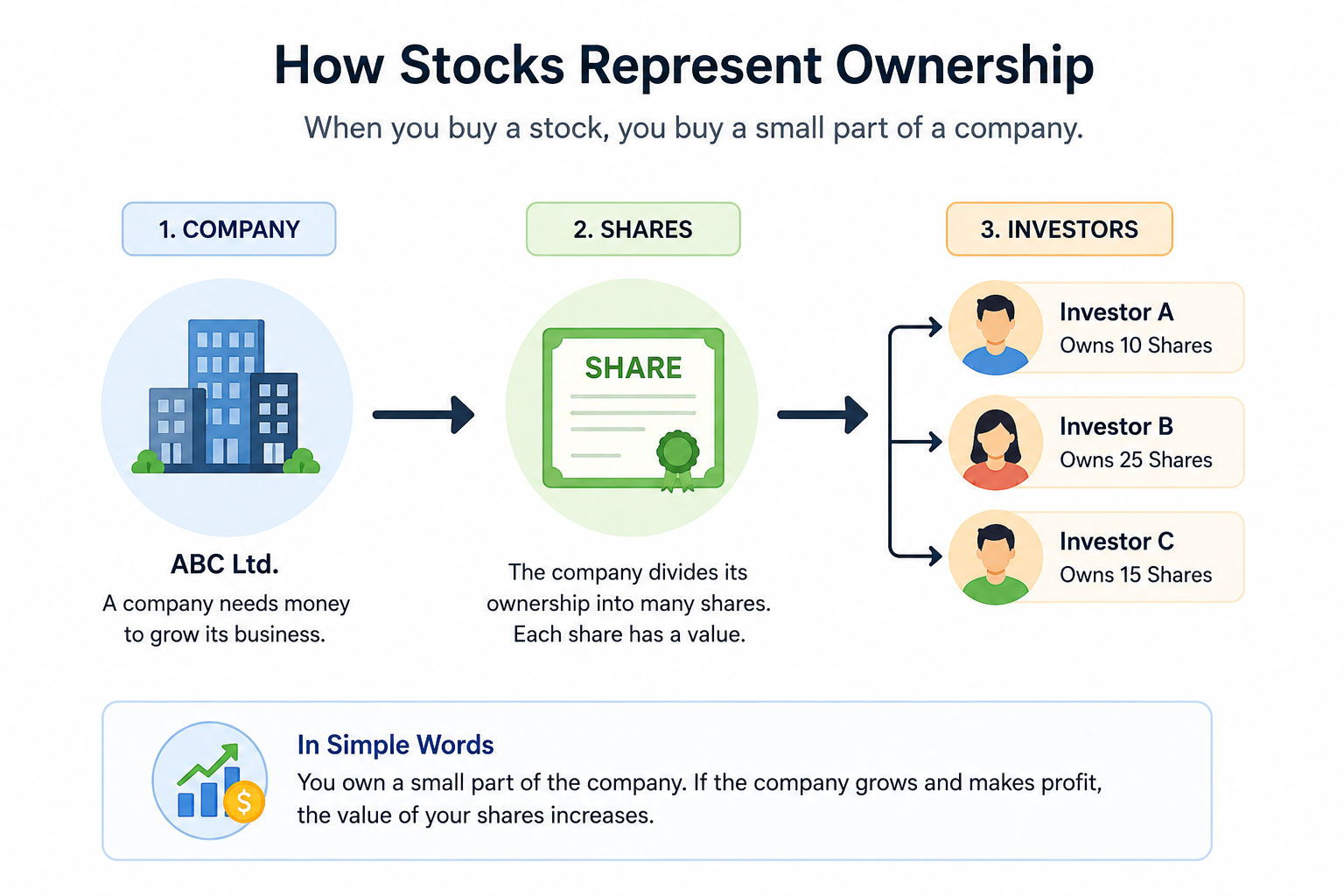
- What is a stock?
- What is a share?
- How owning a share means owning a small part of a company
- Simple example: Company worth ₹10 crore divided into 10 lakh shares
Small Diagram:Company → Divides Ownership → Shares → Investors
2. How Does the Stock Market Work?
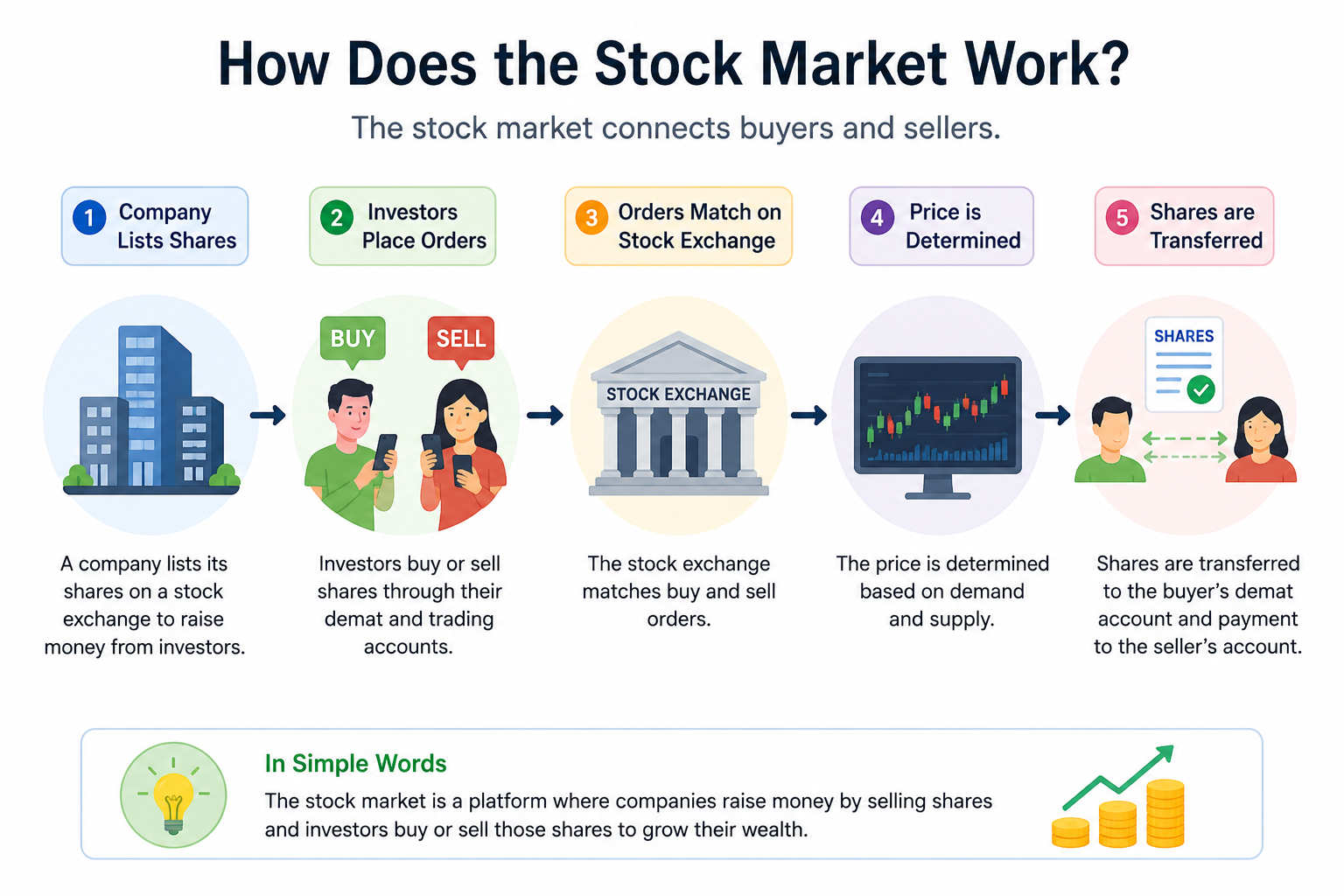
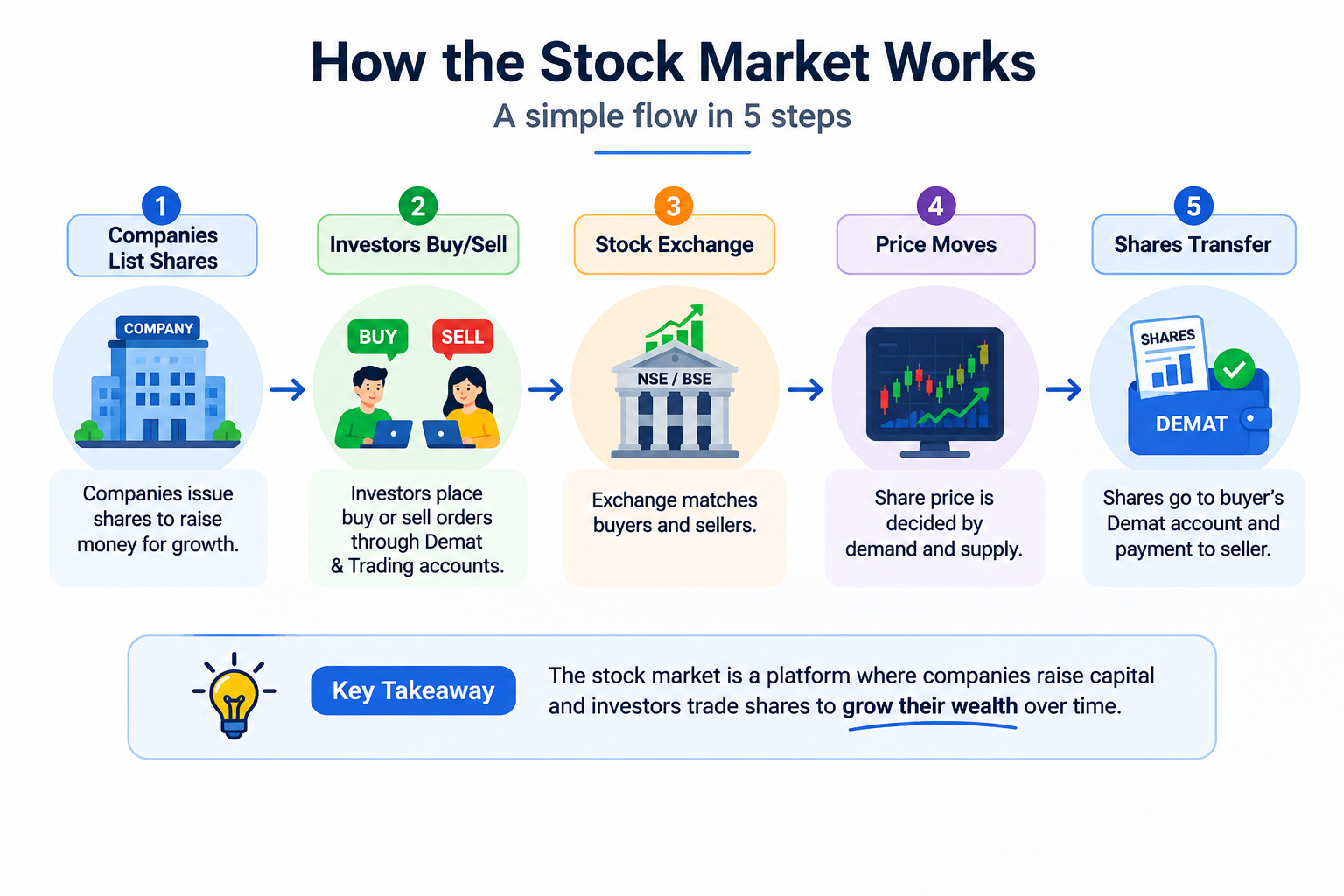
Explain the complete journey:
Company → Stock Exchange → Buyer & Seller → Trade → Investor
Cover:
- Buying shares
- Selling shares
- Stock exchanges
- Market price
- Demand and supply
3. Primary Market vs Secondary Market
Primary Market
- Company issues shares to investors
- IPO is the major example
Secondary Market
- Investors buy and sell existing shares among themselves
- NSE/BSE trading
Simple comparison diagram will make this very easy to understand.
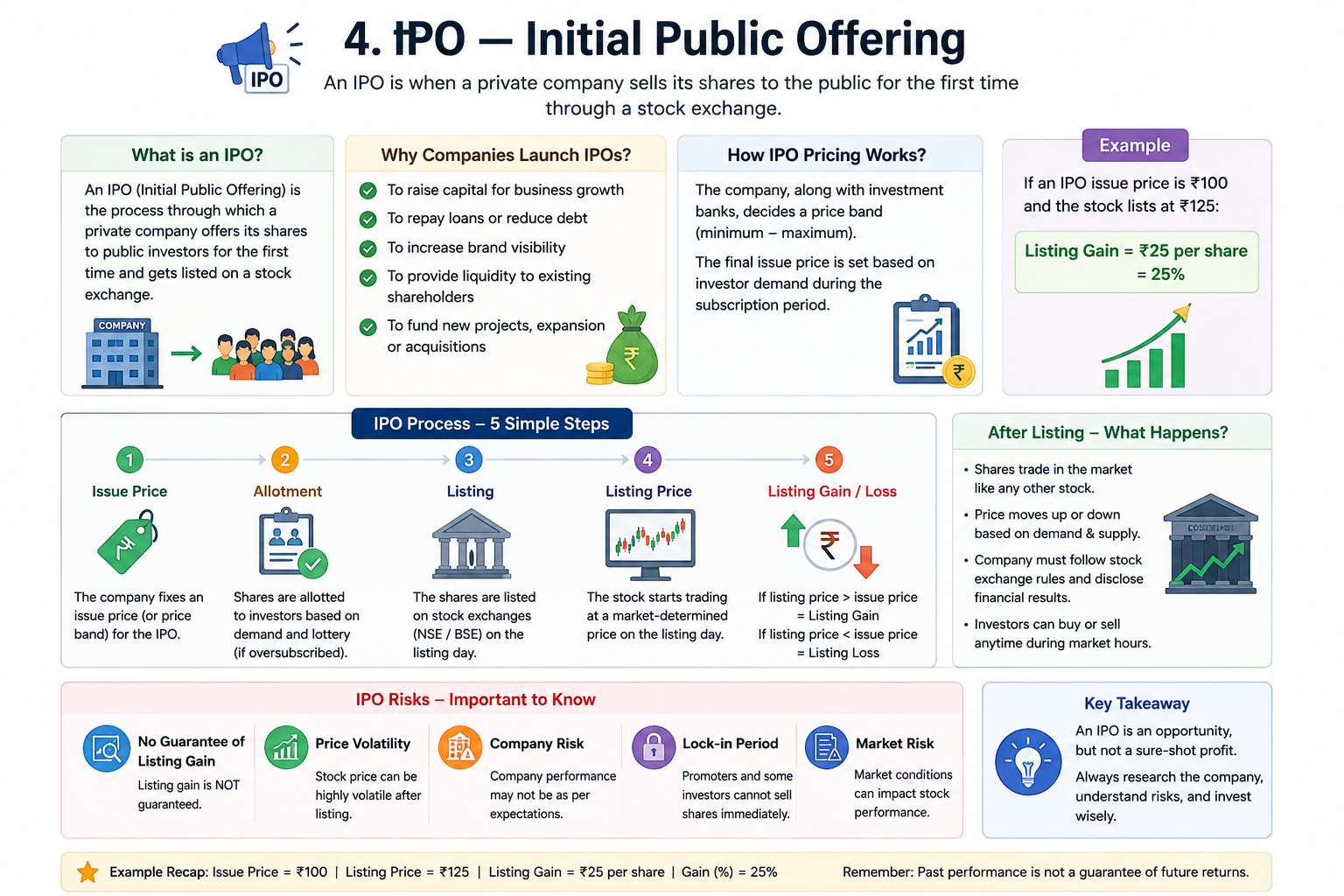
4. IPO — Initial Public Offering
Explain:
- What is an IPO?
- Why companies launch IPOs
- How IPO pricing works
- Issue Price
- Allotment
- Listing
- Listing Price
- Listing Gain/Loss
- What happens after listing?
- IPO risks
Example:
If an IPO issue price is ₹100 and the stock lists at ₹125:
Listing Gain = ₹25 per share = 25%
Also explain that a listing gain is not guaranteed.
5. Types of Stocks
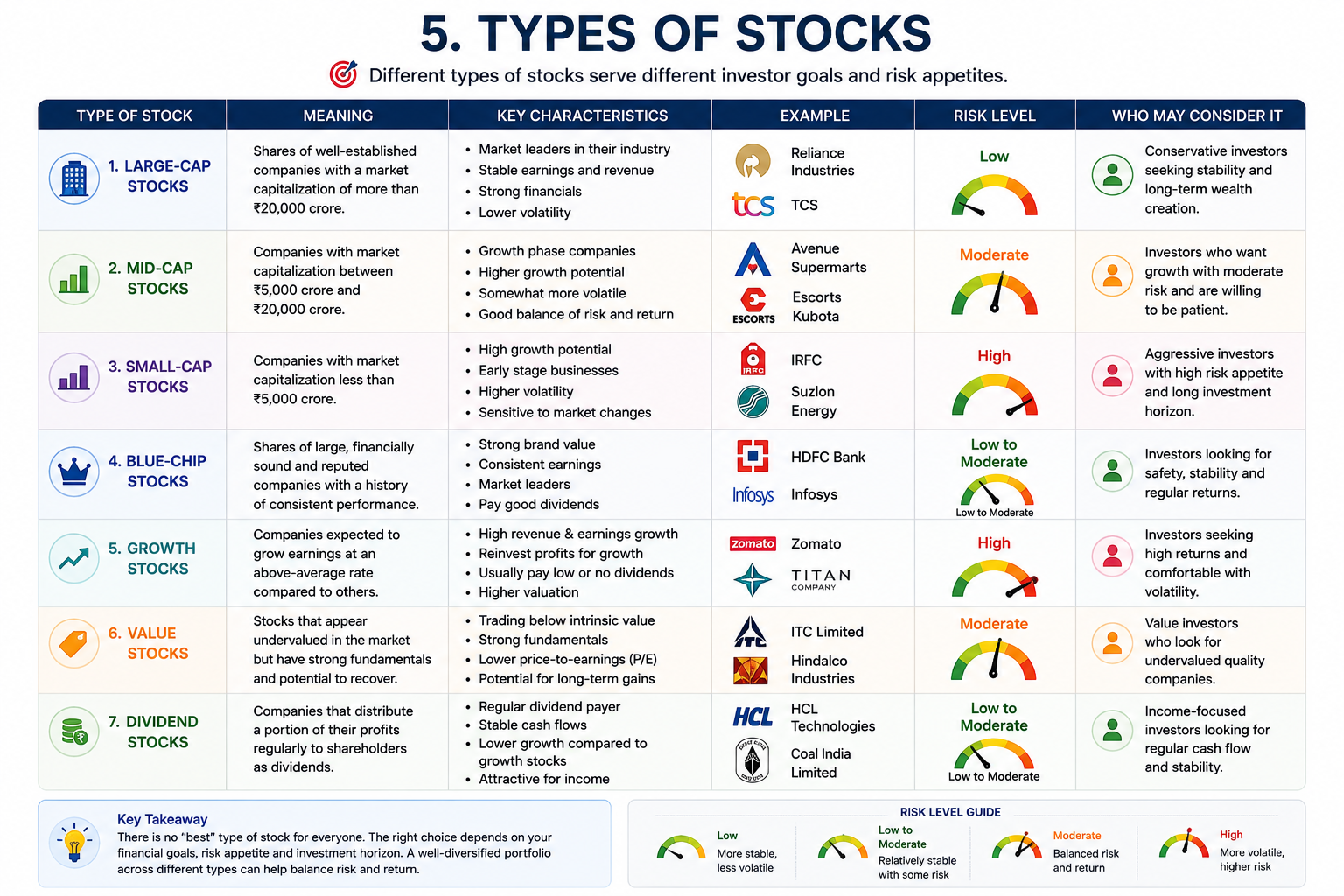
Explain the major classifications:
- Large-Cap Stocks
- Mid-Cap Stocks
- Small-Cap Stocks
- Blue-Chip Stocks
- Growth Stocks
- Value Stocks
- Dividend Stocks
For every type:
Meaning → Characteristics → Example → Risk level → Who may consider it
6. NSE and BSE — India’s Major Stock Exchanges
Explain:
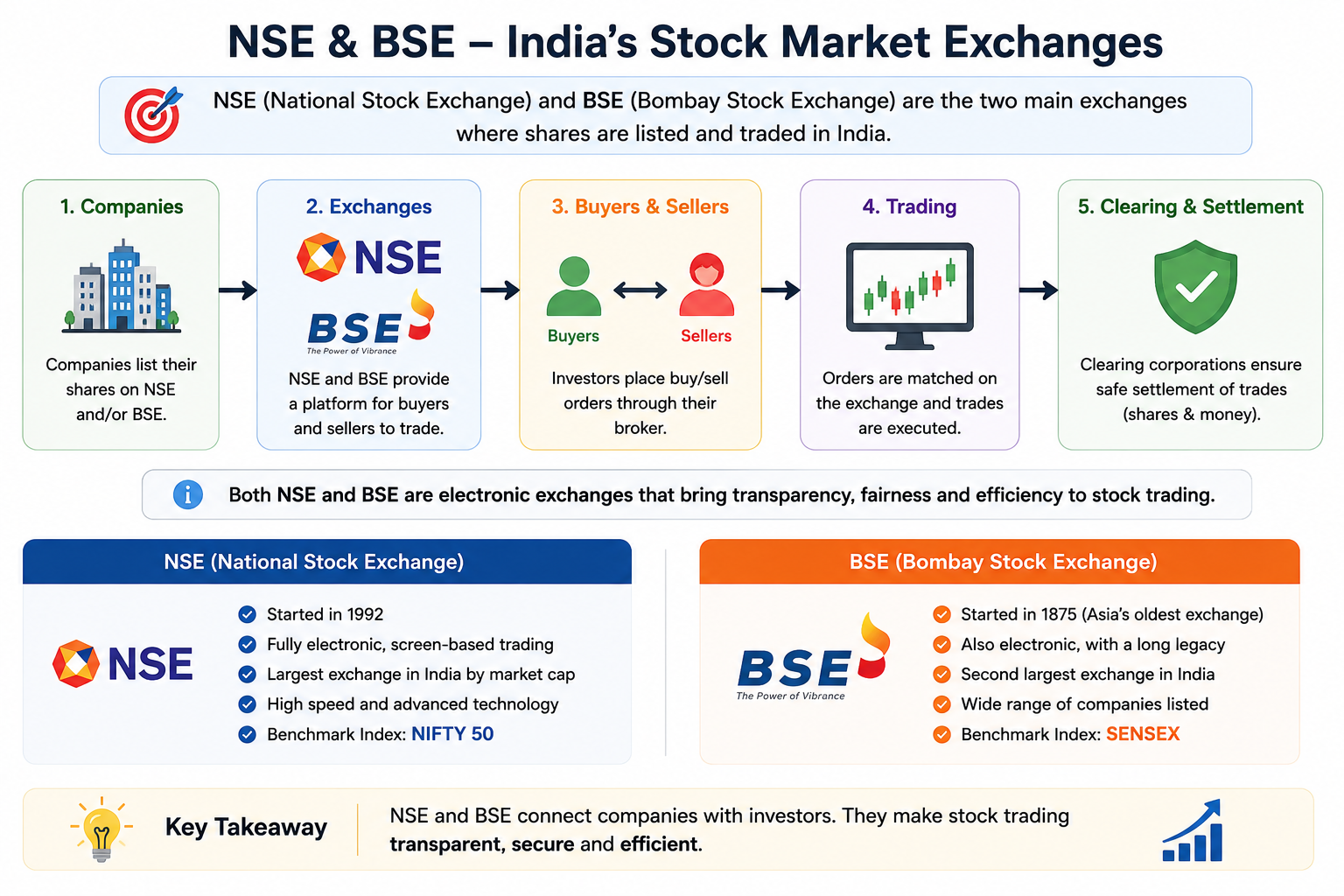
NSE — National Stock Exchange
BSE — Bombay Stock Exchange
Include:
- What a stock exchange does
- Why exchanges are important
- NSE vs BSE in simple language
7. What Are Stock Market Indices?
Very important distinction:
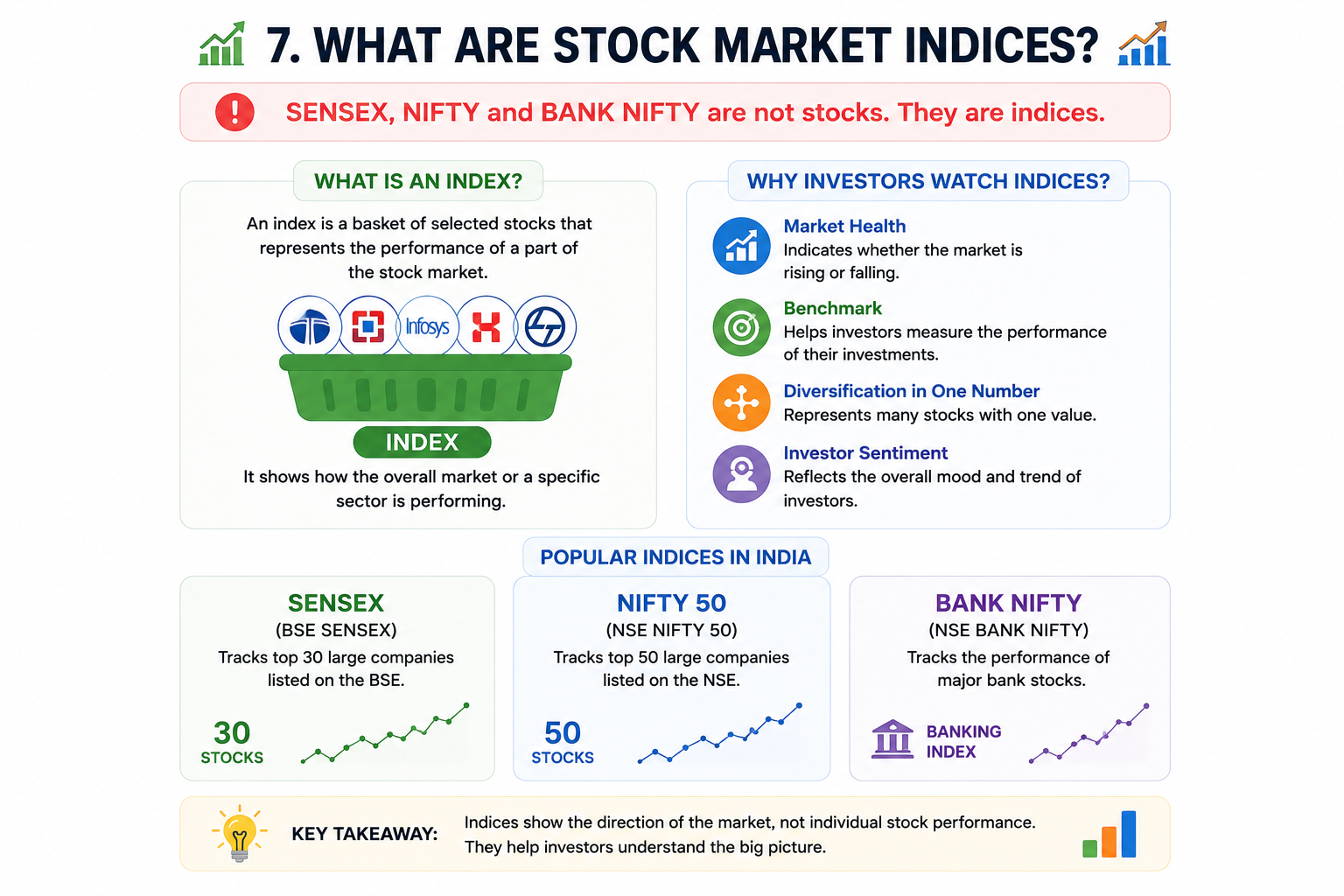
SENSEX, NIFTY and BANK NIFTY are not stocks. They are indices.
Explain what an index means and why investors watch indices.
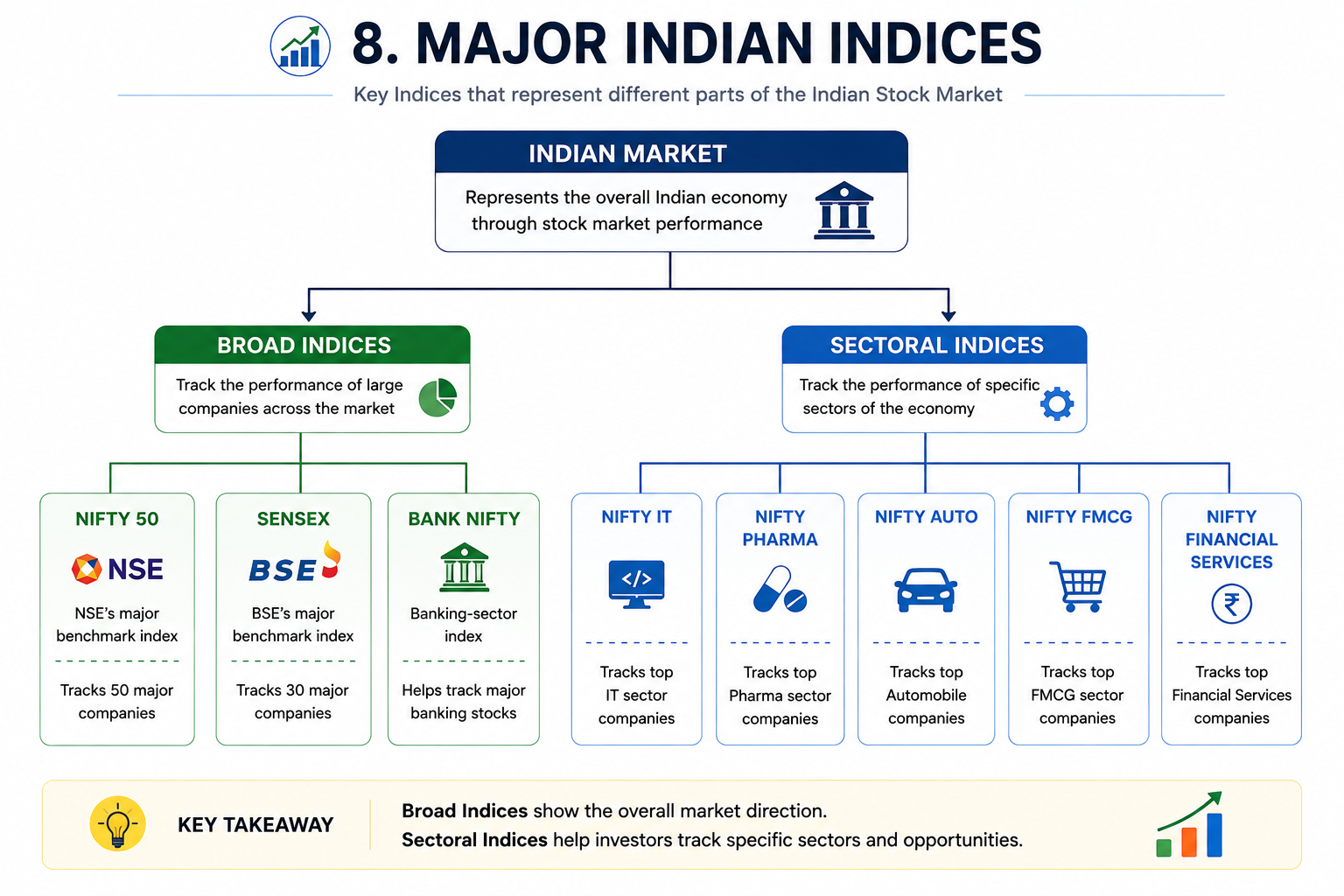
8. Major Indian Indices
NIFTY 50
- NSE’s major benchmark index
- Tracks 50 major companies
SENSEX
- BSE’s major benchmark index
- Tracks 30 major companies
BANK NIFTY
- Banking-sector index
- Helps track major banking stocks
Then introduce important sectoral indices such as:
- NIFTY IT
- NIFTY Pharma
- NIFTY Auto
- NIFTY FMCG
- NIFTY Financial Services
Diagram:Indian Market → Broad Indices → Sectoral Indices
9. How Do Investors Make Money From Stocks?
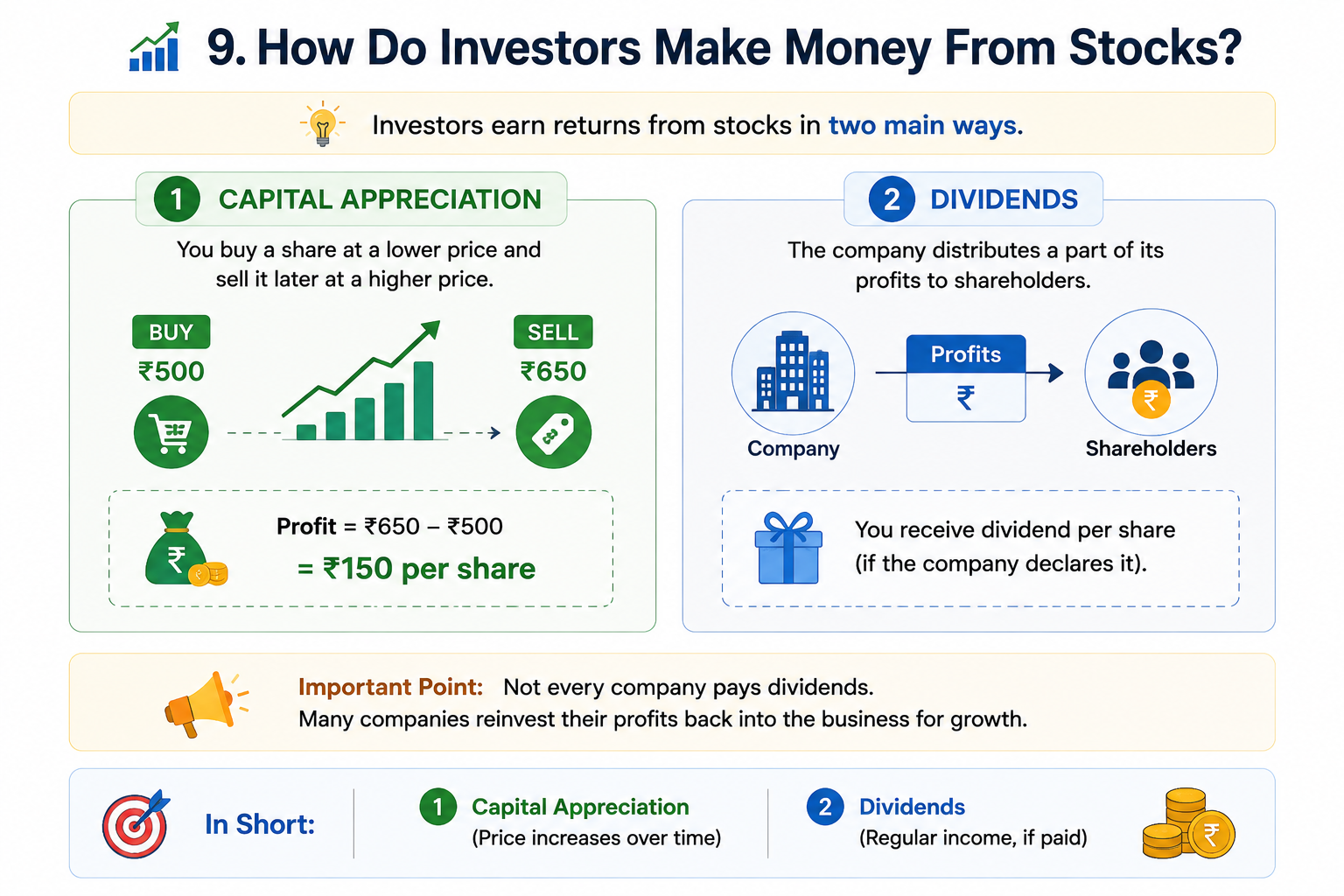
Two primary ways:
1. Capital Appreciation
Buy at ₹500 → Sell at ₹650
Profit = ₹150 per share
2. Dividends
Company distributes part of its profits to shareholders.
Explain that not every company pays dividends.
10. Why Do Stock Prices Go Up and Down?
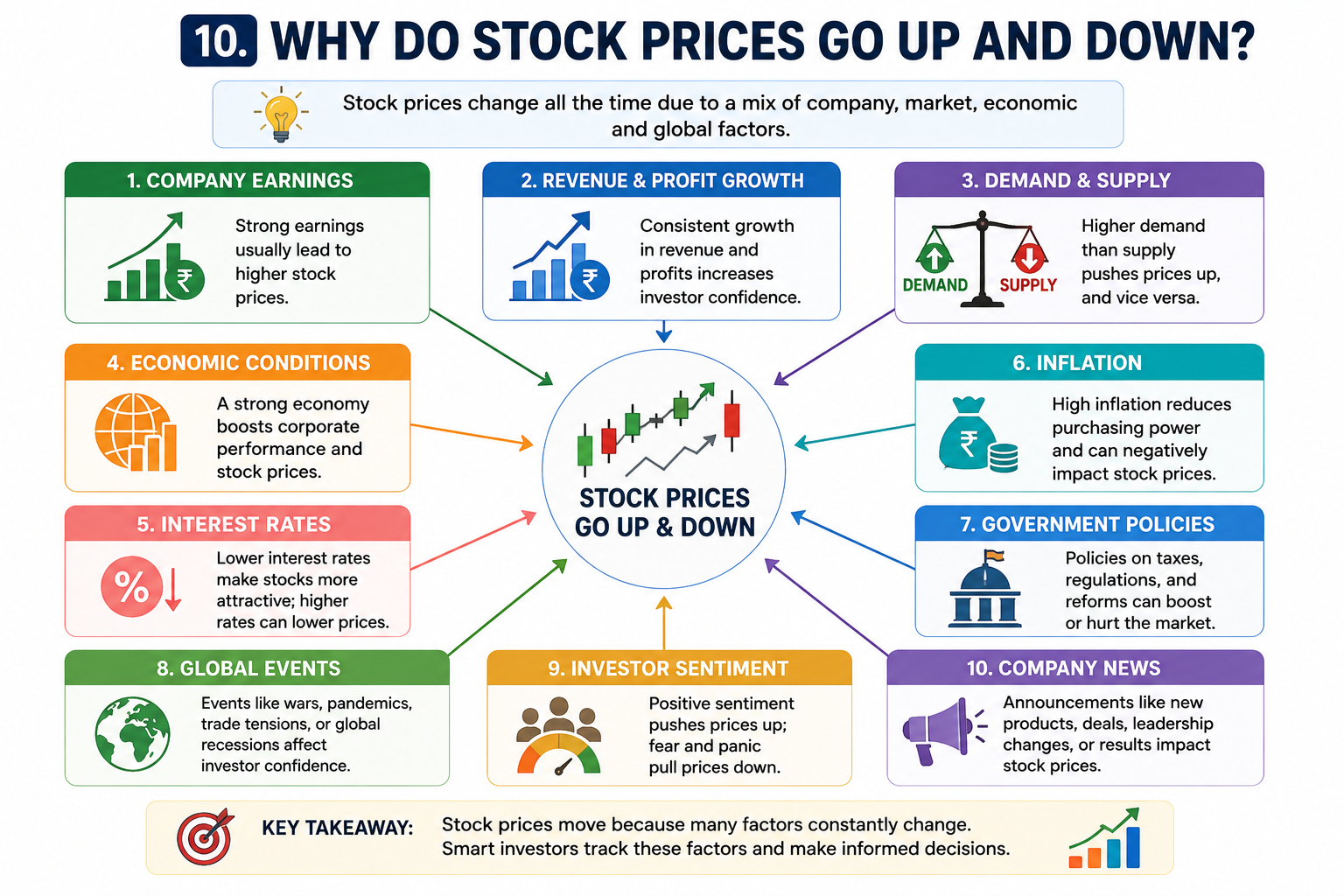
Explain the major factors:
- Company earnings
- Revenue and profit growth
- Demand & supply
- Economic conditions
- Interest rates
- Inflation
- Government policies
- Global events
- Investor sentiment
- Company news
11. Investing vs Trading
A very useful beginner section.
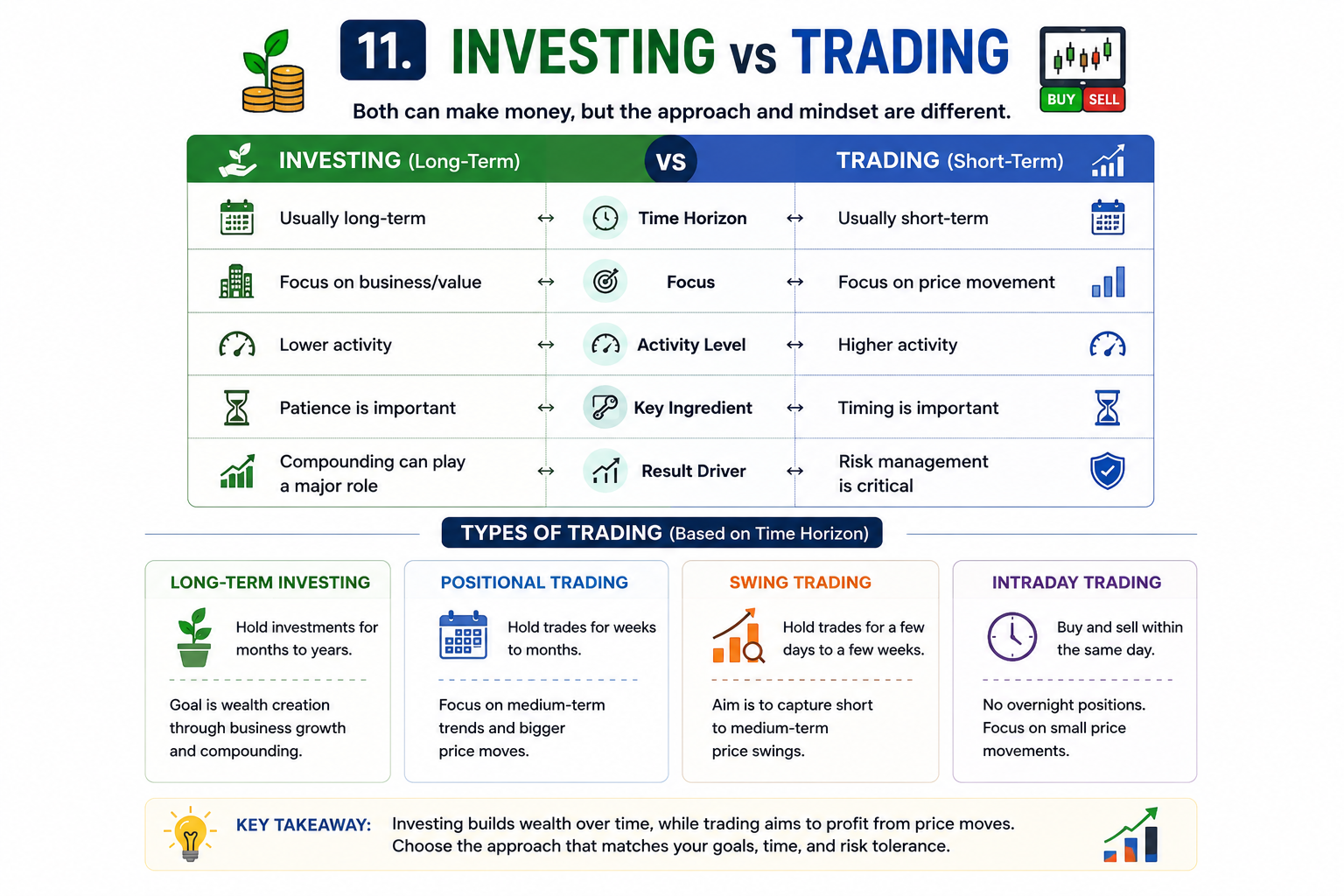
| Investing | Trading |
|---|---|
| Usually long-term | Usually short-term |
| Focus on business/value | Focus on price movement |
| Lower activity | Higher activity |
| Patience is important | Timing is important |
| Compounding can play a major role | Risk management is critical |
Then explain:
- Long-term investing
- Positional trading
- Swing trading
- Intraday trading
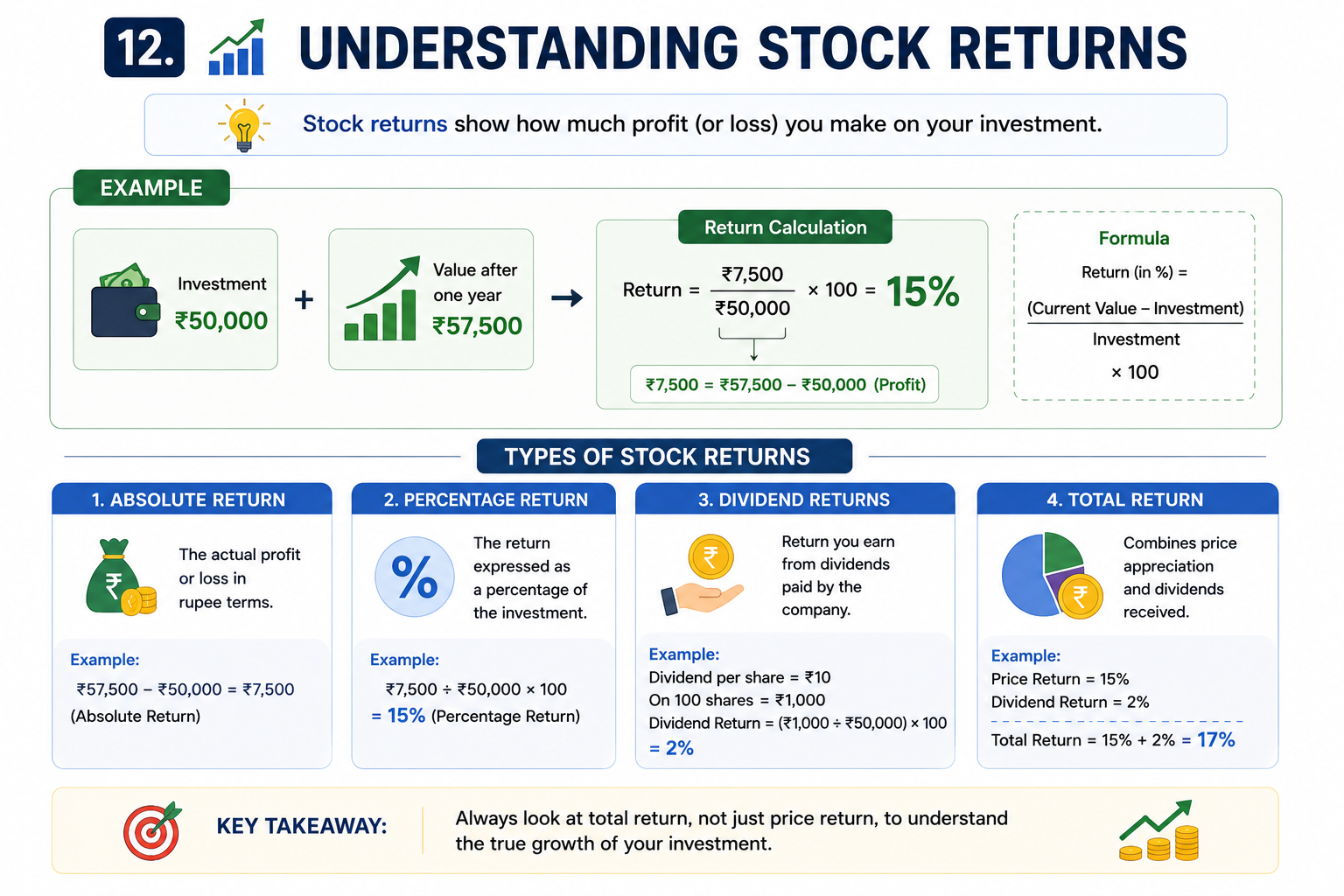
12. Understanding Stock Returns
Practical calculation:
Example
Investment = ₹50,000
Value after one year = ₹57,500
Return:
₹7,500 ÷ ₹50,000 × 100 = 15%
Also explain:
- Absolute return
- Percentage return
- Dividend return
- Total return
13. Risks of Investing in Stocks
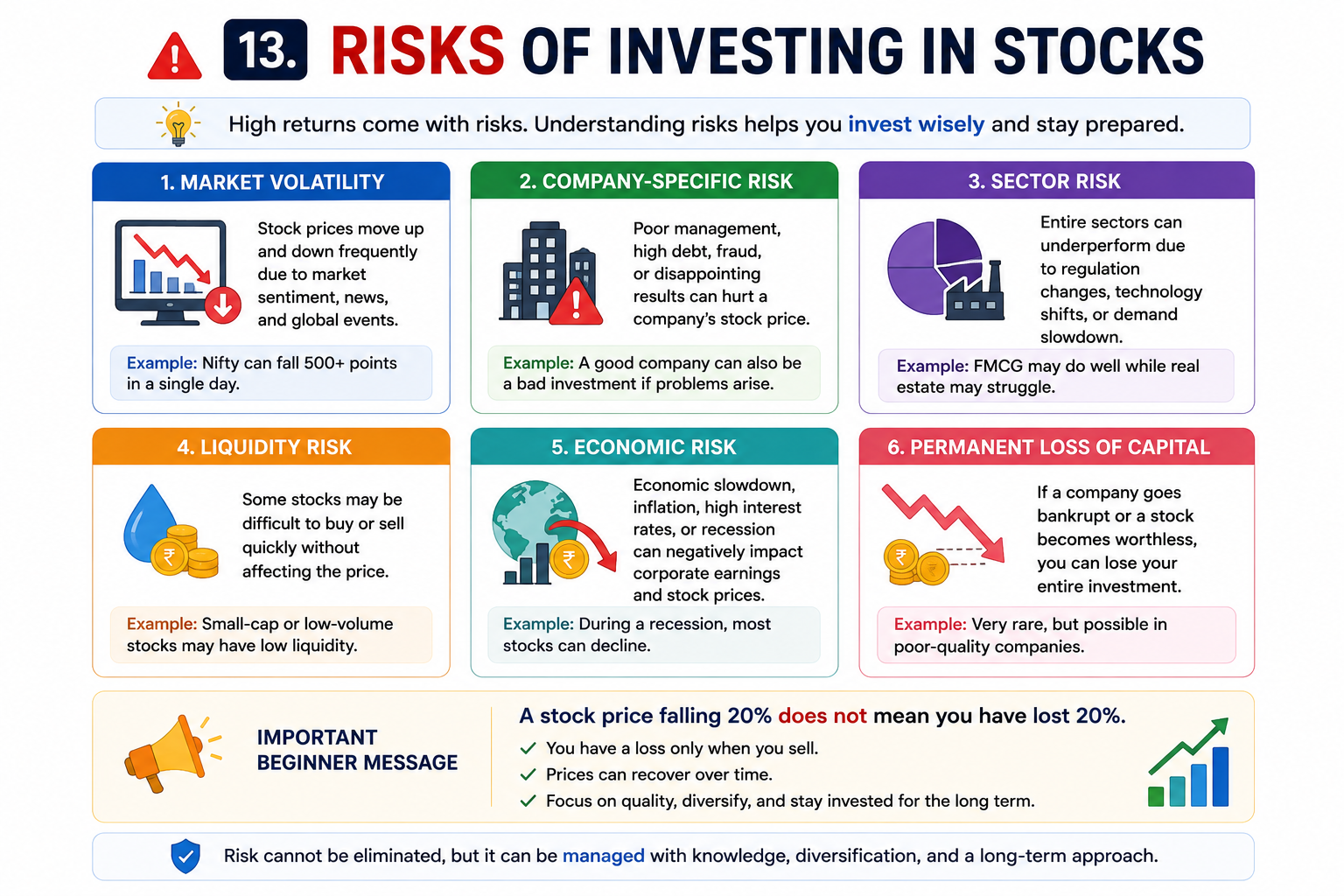
Explain honestly:
- Market volatility
- Company-specific risk
- Sector risk
- Liquidity risk
- Economic risk
- Permanent loss of capital
Important beginner message:
A stock price falling 20% does not automatically mean the company is bad—but investors must understand why it fell.
14. How Beginners Can Start Investing in Stocks
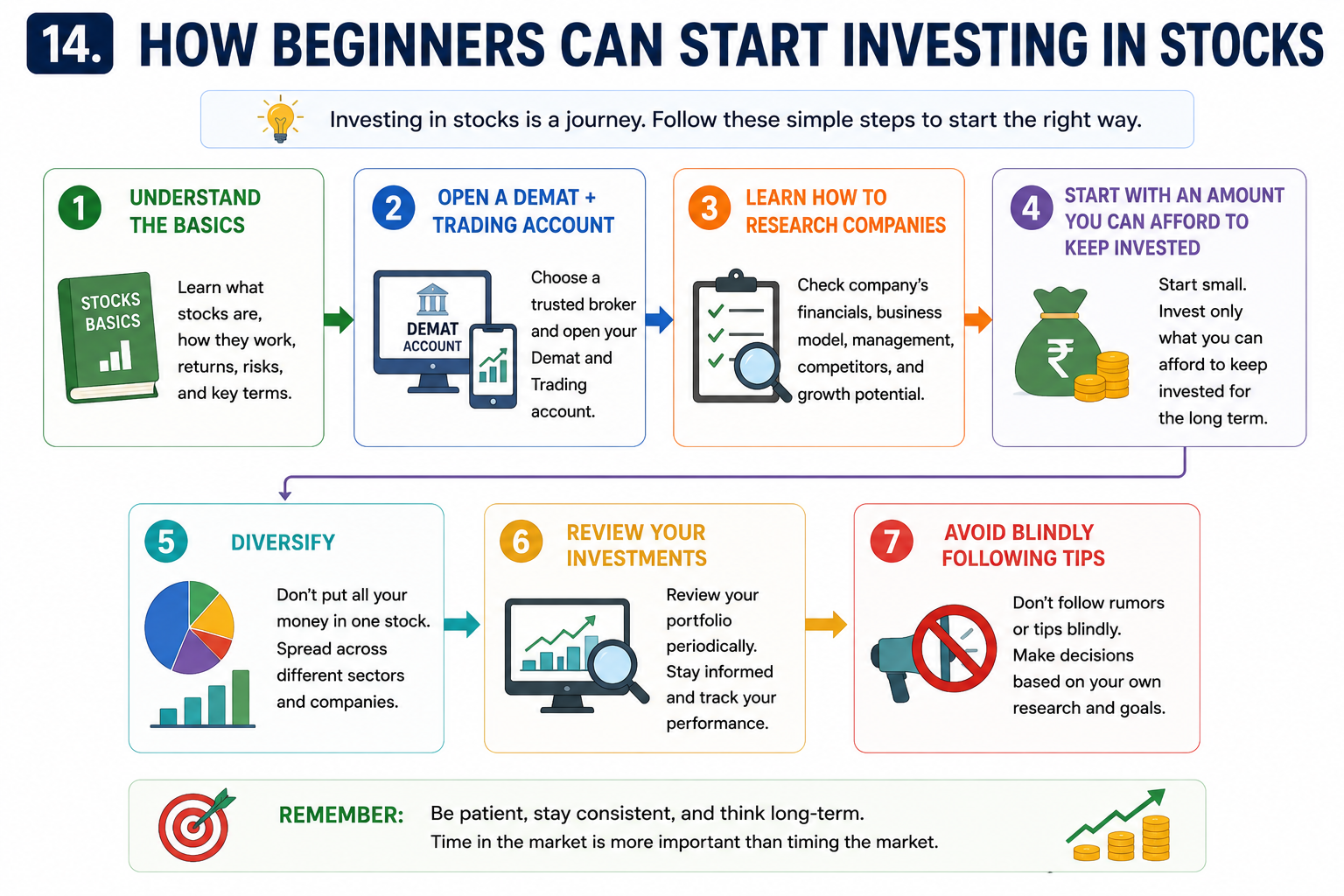
Step-by-step:
Step 1: Understand the basics
Step 2: Open a Demat + Trading account
Step 3: Learn how to research companies
Step 4: Start with an amount you can afford to keep invested
Step 5: Diversify
Step 6: Review your investments
Step 7: Avoid blindly following tips
15. Common Beginner Mistakes
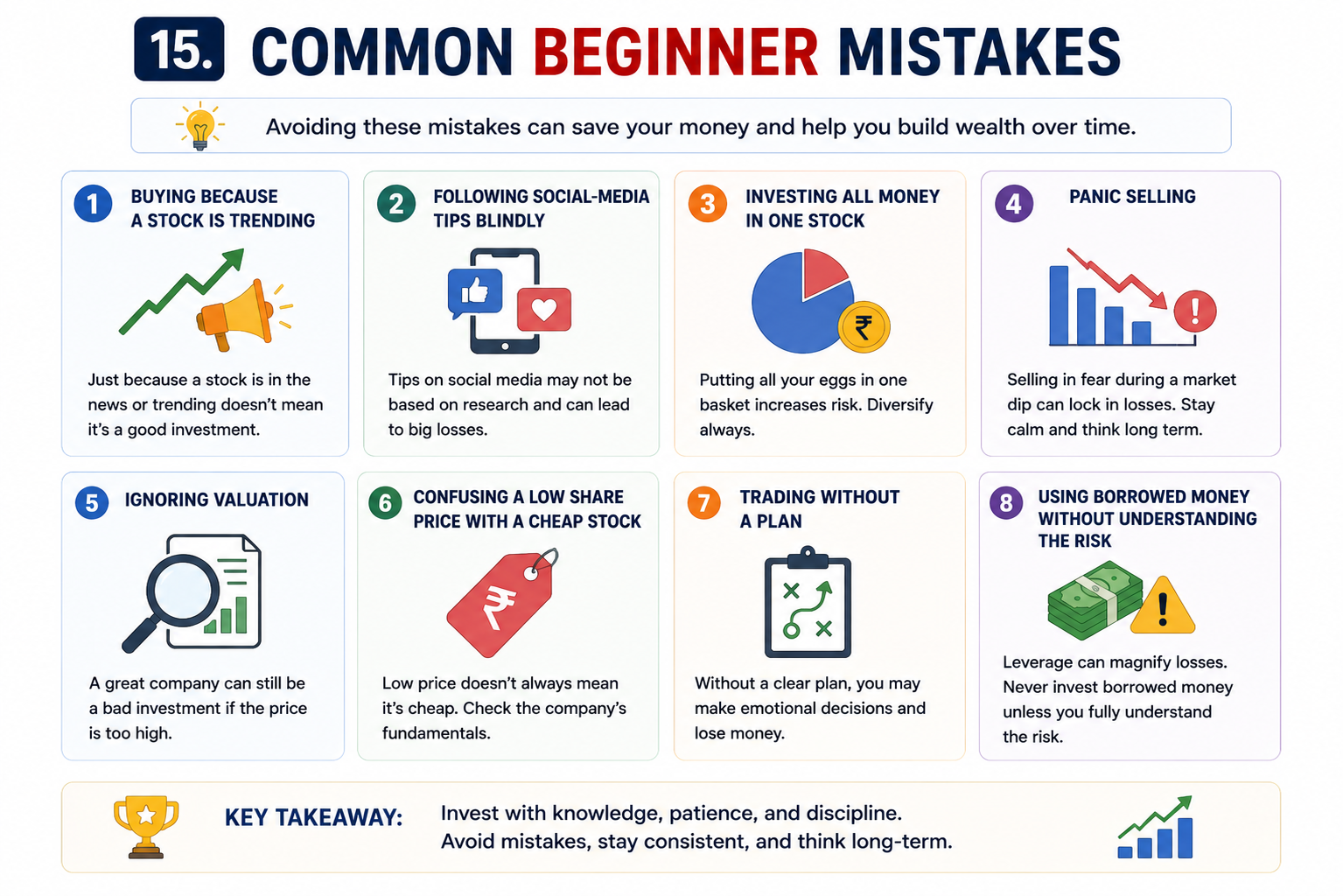
- Buying because a stock is trending
- Following social-media tips blindly
- Investing all money in one stock
- Panic selling
- Ignoring valuation
- Confusing a low share price with a cheap stock
- Trading without a plan
- Using borrowed money without understanding the risk
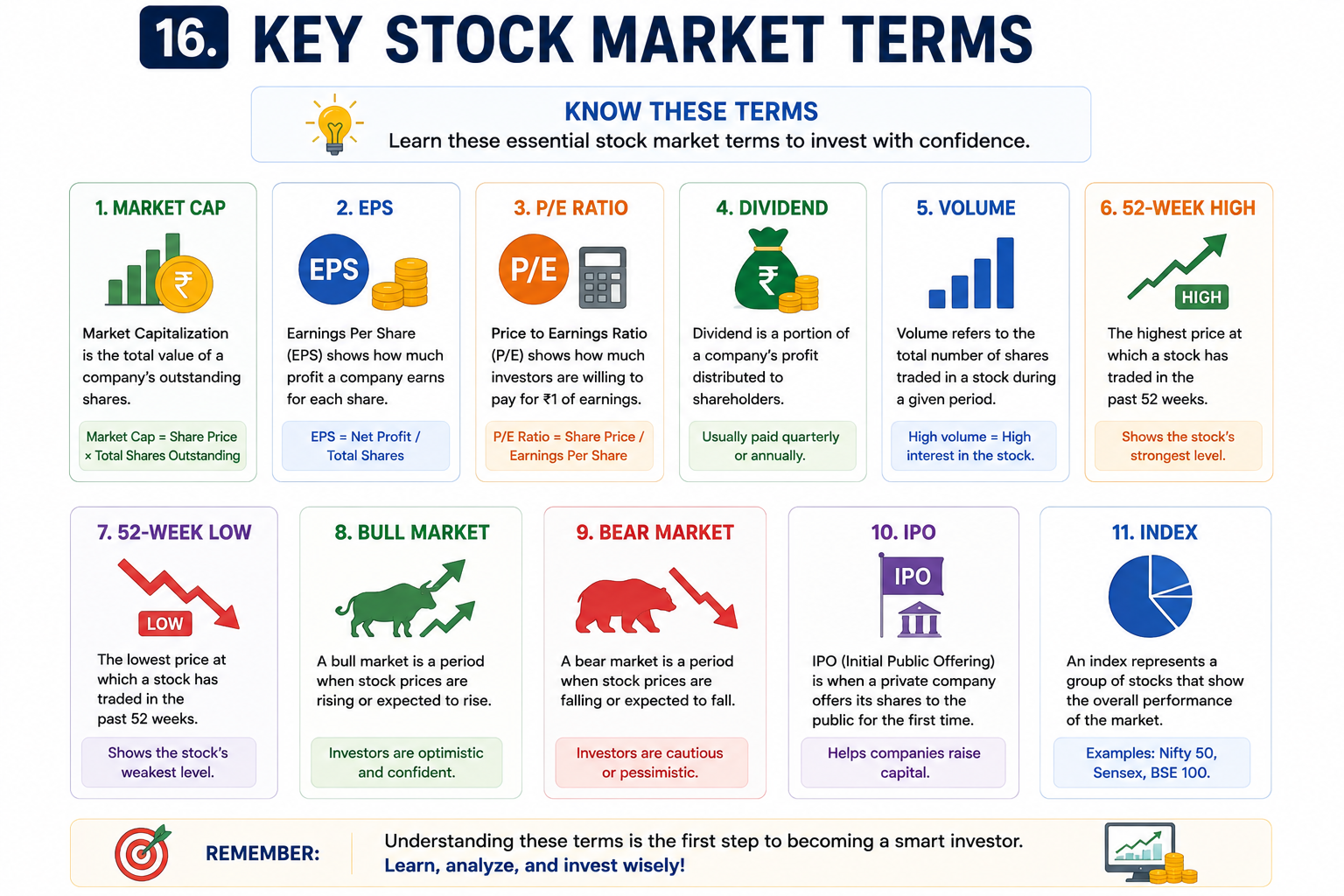
16. Key Stock Market Terms
A small “Know These Terms” box:
Market Cap | EPS | P/E Ratio | Dividend | Volume | 52-Week High | 52-Week Low | Bull Market | Bear Market | IPO | Index
17. Paisonexa Practical Example 💙
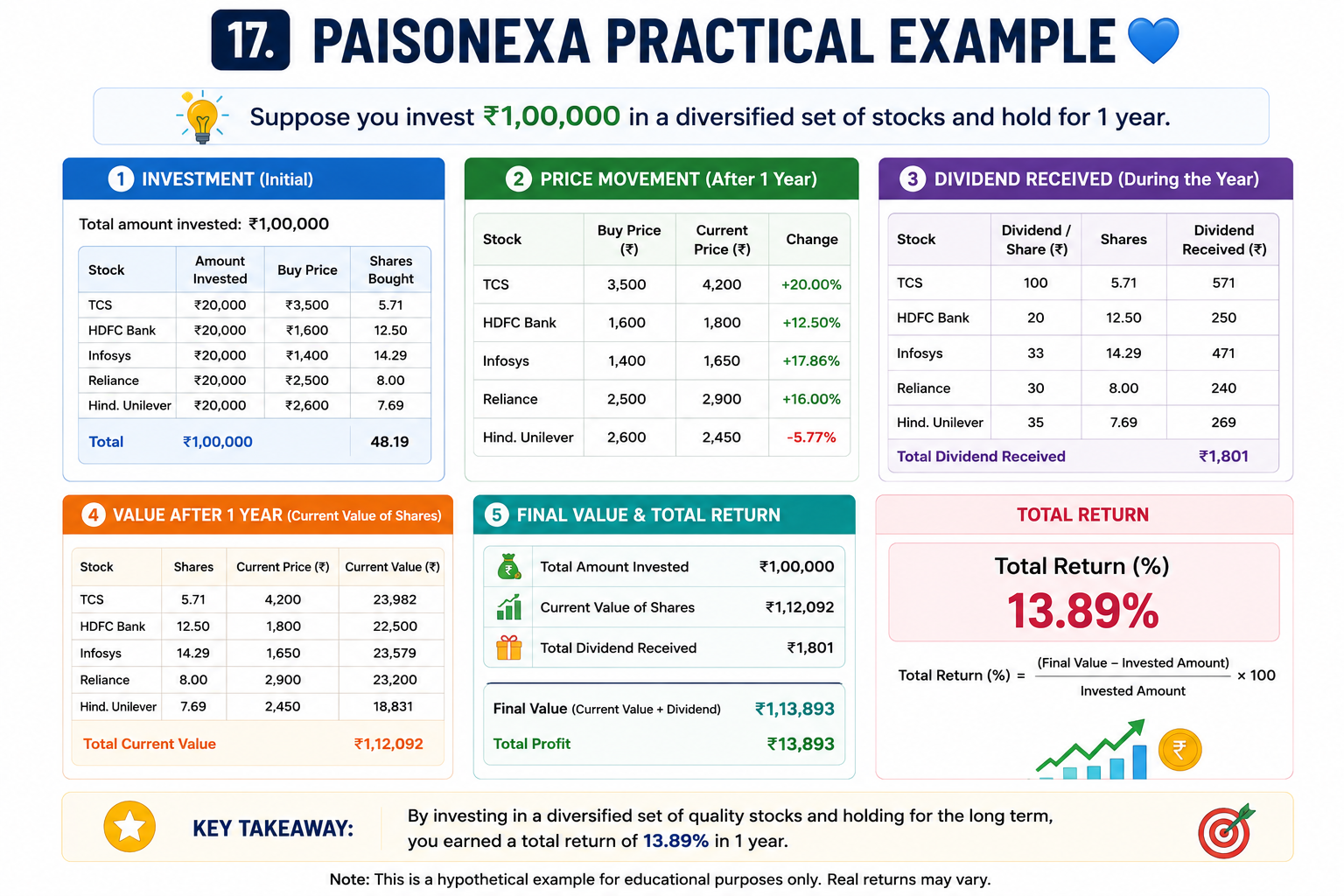
Ek complete example:
Suppose you invest ₹1,00,000 in a diversified set of stocks.
Show:
- Investment
- Number/value of shares
- Price movement
- Dividend
- Final value
- Total return
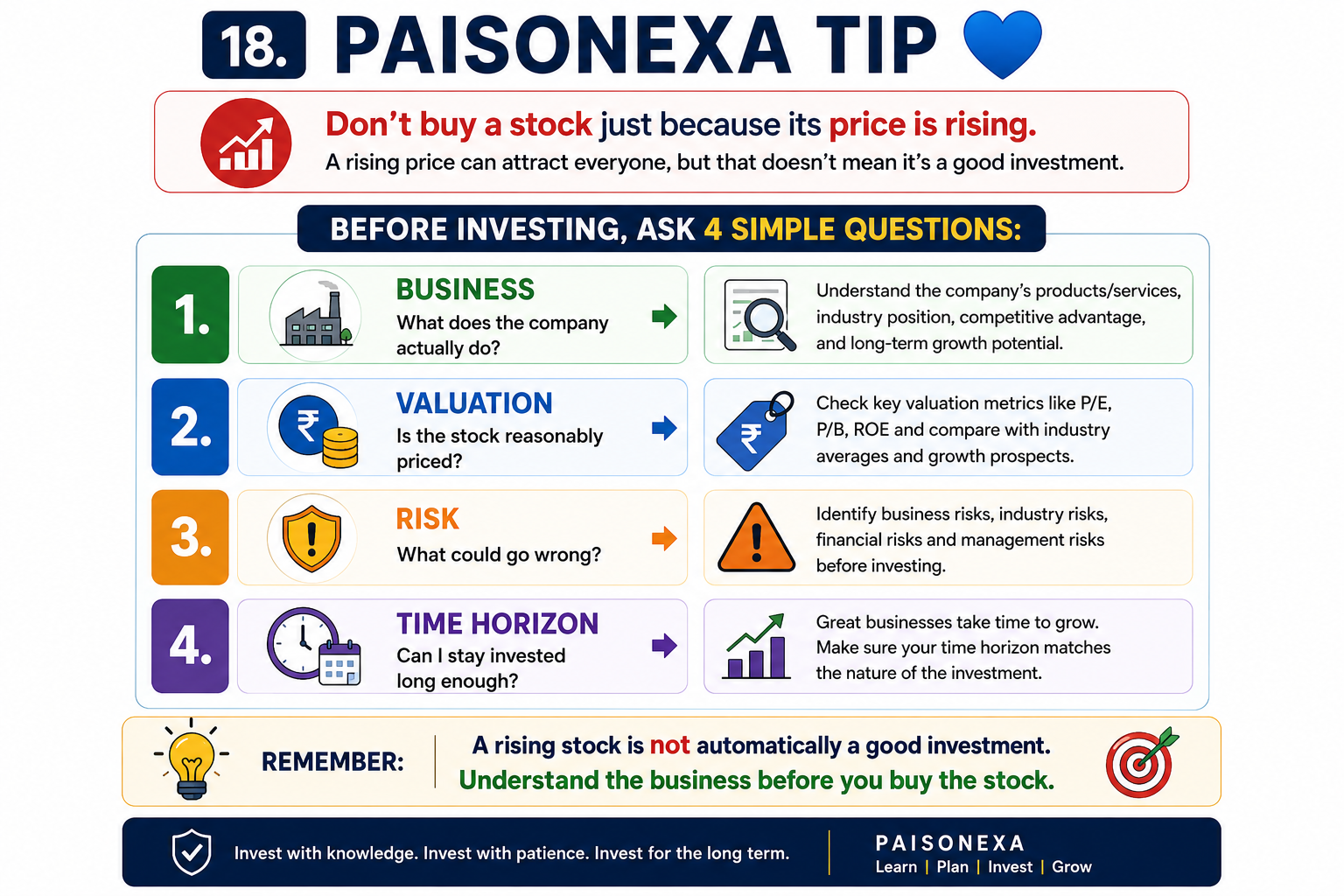
18. Paisonexa Tip 💙
Don’t buy a stock simply because its price is rising. Understand the business, valuation, risk and your investment time horizon before investing.